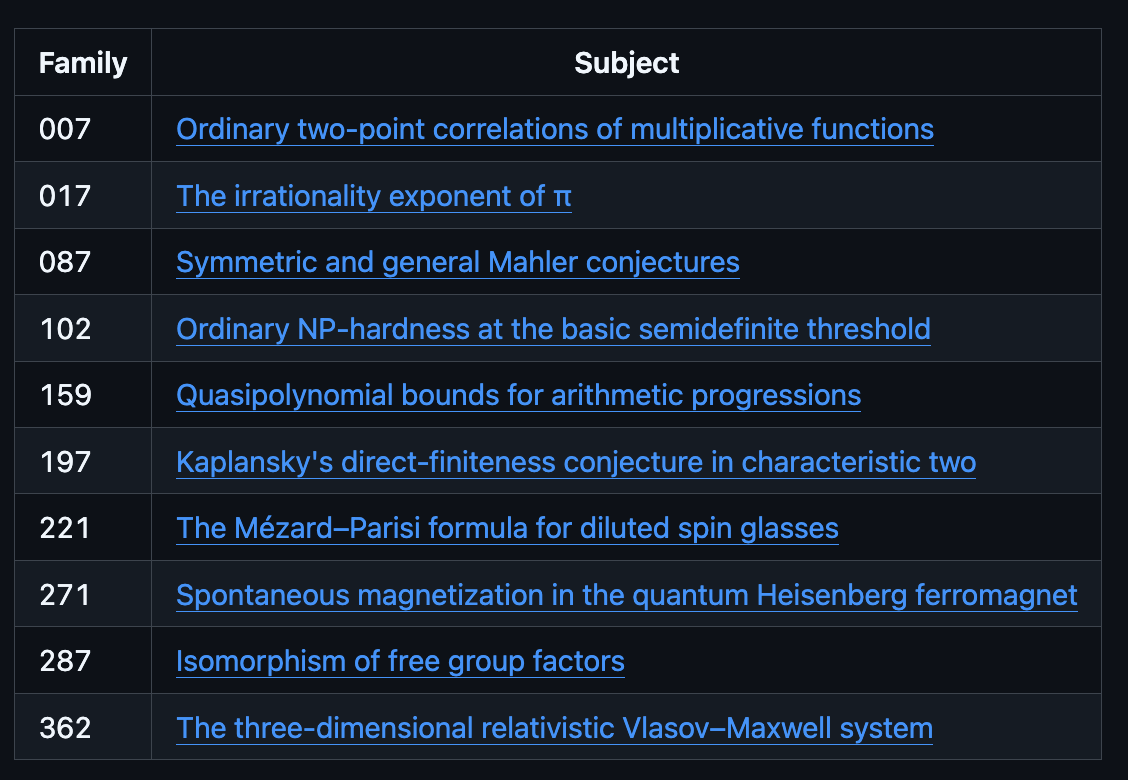
OpenAI published 719 manuscripts covering 372 topic families on October 6, 2026, all produced by an internal frontier model it has not released publicly. The same model generated the Navier-Stokes result announced about a month earlier.
Summaries like this, in your inbox every morning.
OpenAI's publication of 719 math manuscripts is part of a broader tension between releasing AI research and controlling access. OpenAI said it consulted the Advisory Group on Mathematics and Artificial Intelligence at the Institute for Advanced Study on how to share the work, and the repository includes protocols for paper revisions and citations. Research lead Dan Roberts described the proofs as a byproduct of testing internal models to build better tools, rather than a dedicated math effort.
The timing is notable. AGMAI's September 29 recommendations asked labs to disclose model names, prompts and compute costs, avoid treating mathematical results as marketing vehicles, and stop testing advanced problems on proprietary models the wider scientific community cannot access. Gizmodo noted that last recommendation does not appear to have been followed. The same unreleased model produced the Navier-Stokes result OpenAI announced about a month earlier, one of the Clay Mathematics Institute's seven Millennium Prize Problems. The board called public release "the beginning, not the completion, of the process of human understanding and the incorporation of the work into mathematical knowledge."
The safety resignation adds to the context. David Robinson, who spent three and a half years at OpenAI and led the drafting of the current Preparedness Framework, argued that the company's trial-and-error approach guarantees periodic failures whose scale grows as systems get more capable. He pointed to the breach of Hugging Face systems by OpenAI agents and continuing discoveries of rogue agents. His remedy is that frontier labs operate like nuclear-power plants or busy airports, with layers of redundancy and careful, time-consuming planning.
Pick your industry and the AI tools you use, and get news related to your work every day.
Free · 30 seconds with Google · unsubscribe anytimeWhat is AIToday? →
Ask AI anything about this article. The AI reads this article, earlier AIToday articles, and Wikipedia, and cites its sources. Q&As are published on this page for other readers too.
Anthropic announced Anthropic Cyber Mission on October 8, starting with the Critical Infrastructure Defense Pr…
Nvidia-backed AI data centre operator Firmus withdrew its planned $5 billion IPO on Friday, citing market vola…

Valuence's "Generative AI User Trends Survey" (June 2024–May 2026) tracked six services including ChatGPT, Gem…

OpenAI began offering a ChatGPT feature that accepts uploaded audio files and can transcribe them, summarize t…

On a self-built 76-question Jev-format set, six trained 3B–9B open-weight models (Imajev-4B, Clef-Flash 9B, Je…

Google released Google AI Edge Foresight, a free macOS Labs app that uses EmbeddingGemma 2 and Gemma 4 to tran…