What happened
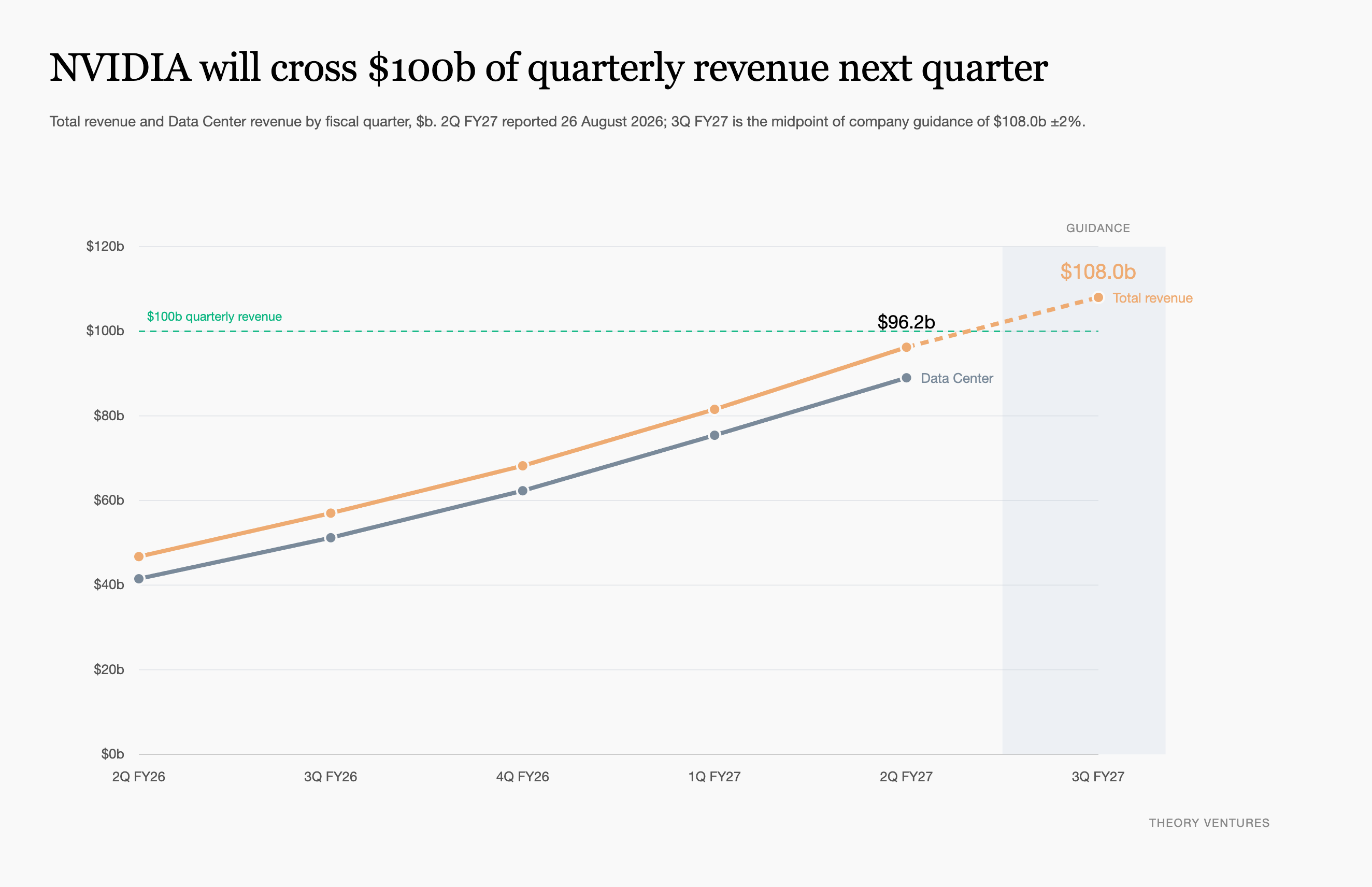
NVIDIA reported $96b in Q2 FY27 revenue, up 106% year-over-year, and guided Q3 to $108b ±2%. This is the first time any semiconductor company has crossed $100b in quarterly revenue, and no company has done so while growing at triple digits.
Why it matters
Neoclouds (AI startups and cloud providers) contributed the majority of net-new Data Center revenue for the first time. This shift diversifies NVIDIA's customer base but raises credit risk, as these buyers have weaker balance sheets than Big Tech. Days sales outstanding jumped from 45 to 60 days, and receivables hit $63b, with NVIDIA extending payment terms on large multi-quarter agreements with investment-grade customers.
What to watch
Watch DSO next quarter. If 60 days holds or falls, it was a one-time reset. If it climbs, it signals NVIDIA is extending more credit to sustain demand from buyers who cannot self-fund their growth.
Summaries like this, in your inbox every morning.
NVIDIA's latest earnings show a company scaling to unprecedented levels, with Q2 revenue of $96b and a Q3 guide of $108b. This places it on track to annualize $432b, making it the sixth largest company by revenue globally, ahead of Apple, McKesson, and Alphabet. The shift toward neoclouds for net-new data center revenue is a double-edged sword: it diversifies NVIDIA's customer base, reducing reliance on hyperscalers, but it also introduces credit risk, as these smaller buyers may need more supplier financing to sustain their growth.
Jensen Huang frames this as a 'golden age of new AI labs and startups,' with multiple frontier labs scaling in parallel. However, the financial mechanics reveal the strain: receivable growth outpaced revenue growth significantly, and DSO jumped from a stable 45-day band to 60 days in a single quarter. This suggests NVIDIA is using its balance sheet to fund its customers' expansion, a strategy that could boost demand short-term but may raise questions about sustainability if credit needs keep growing.
The key metric to watch is DSO. If it stabilizes or falls, the payment-term extension was a one-time adjustment. If it rises further, it signals NVIDIA is increasingly acting as a financier for the AI buildout, which could have implications for cash flow and risk exposure.
Pick your industry and the AI tools you use, and get news related to your work every day.
Free · 30 seconds with Google · unsubscribe anytimeWhat is AIToday? →
Ask AI anything about this article. The AI reads this article, earlier AIToday articles, and Wikipedia, and cites its sources. Q&As are published on this page for other readers too.
Chunghwa Telecom president Rong-shy Lin said the shift from conversational AI to autonomous AI agents is resha…

CoreWeave fell 5% in premarket trading Friday and was on track to finish the week down 15%, after rebounding f…
Apple and Meta said they would jointly release a new open-weight AI model designed to run on high-end Macs, ai…

Investors put $38.5 billion into Asian startups in Q3, per Crunchbase data

A longtime Anthropic investor told Fortune he expects shares priced around $1.8 trillion, below the company's…

In Q2, billionaires or their funds sold six 'Magnificent Seven' AI stocks