What happened
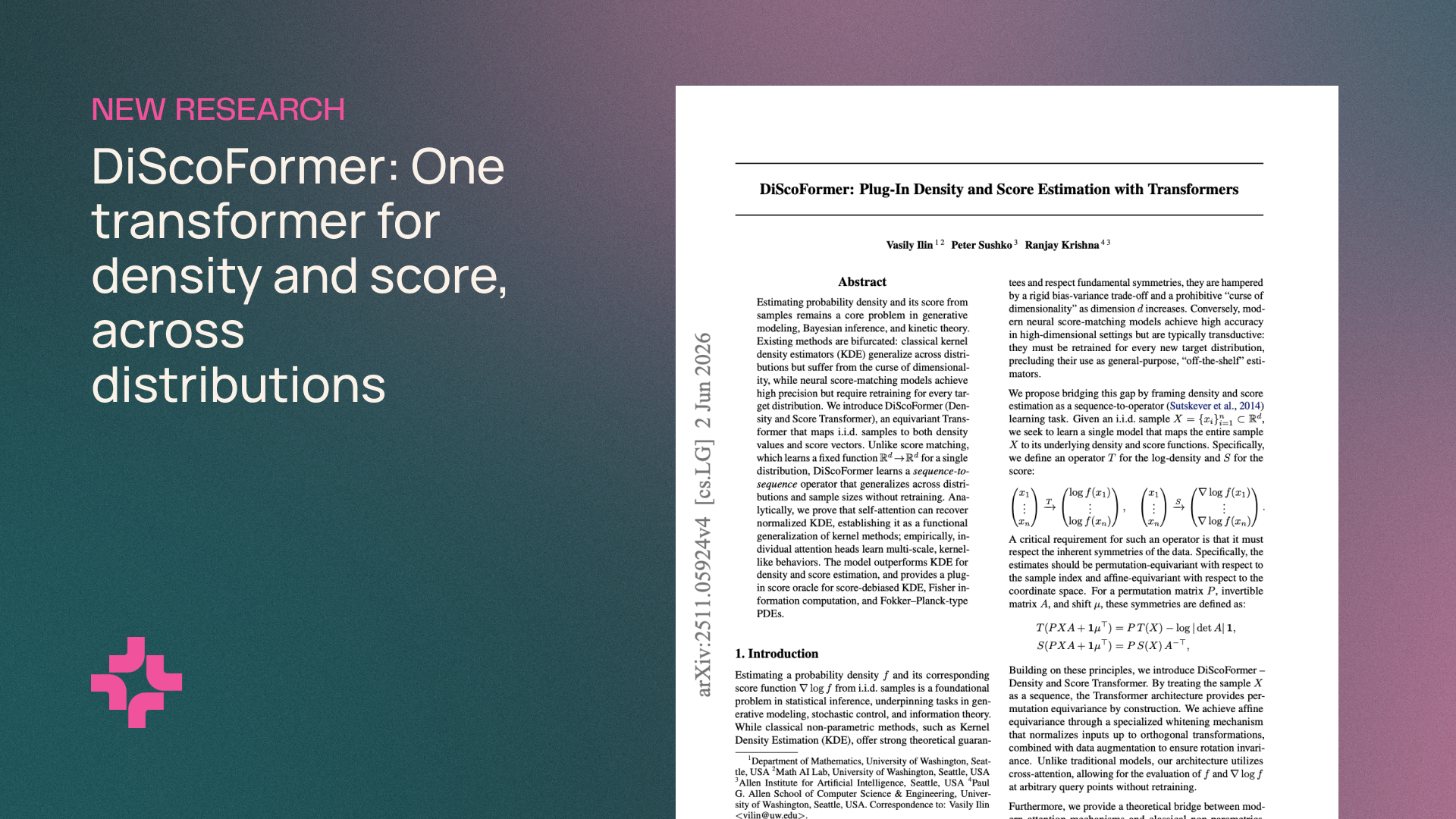
Researchers introduced DiScoFormer, a transformer model that estimates both the density (distribution shape) and score (direction of highest probability) of data in a single forward pass, without requiring retraining for new datasets. The model uses cross-attention layers and shares a mathematical backbone with two output heads, leveraging the relationship between score and density.
Why it matters
Score and density estimation are used across generative modeling (like Stable Diffusion and DALL-E), Bayesian inference, and scientific computing such as plasma simulation. A reusable pretrained model that stays accurate in high dimensions and removes the need to retrain per problem could reduce computational cost across all these fields.
What to watch
In 100 dimensions, DiScoFormer cuts score error by about 6.5x and density error by more than 37x compared to the best hand-tuned kernel density estimation, and continues improving as samples increase while the classical method runs out of memory. The model generalizes to distributions with more modes than seen during training and non-Gaussian shapes like Laplace and Student-t.
Summaries like this, in your inbox every morning.
Pick your industry and the AI tools you use, and get news related to your work every day.
Free · 30 seconds with Google · unsubscribe anytimeWhat is AIToday? →
Ask AI anything about this article. The AI reads this article, earlier AIToday articles, and Wikipedia, and cites its sources. Q&As are published on this page for other readers too.
Johns Hopkins astrophysicist Brice Ménard used Anthropic's Claude Science to build the first complete ultravio…

Google Cloud announced Gemini エージェント at its Gemini at Work 2026 event on October 8, US time
Sakana AI said on October 9 that its Japan-tuned LLM, Sakana Namazu, has been adopted by Evidence Finder, the…

Anthropic added Claude Dashboards, which turns company data into live dashboards, and Claude Motion, which cre…
AI researcher Jannes Elstner told MIT Technology Review that even after identifying every part of a model gove…
Sophos CTO John Peterson says agents built through OpenAI's Daybreak cut average MDR case response time from a…