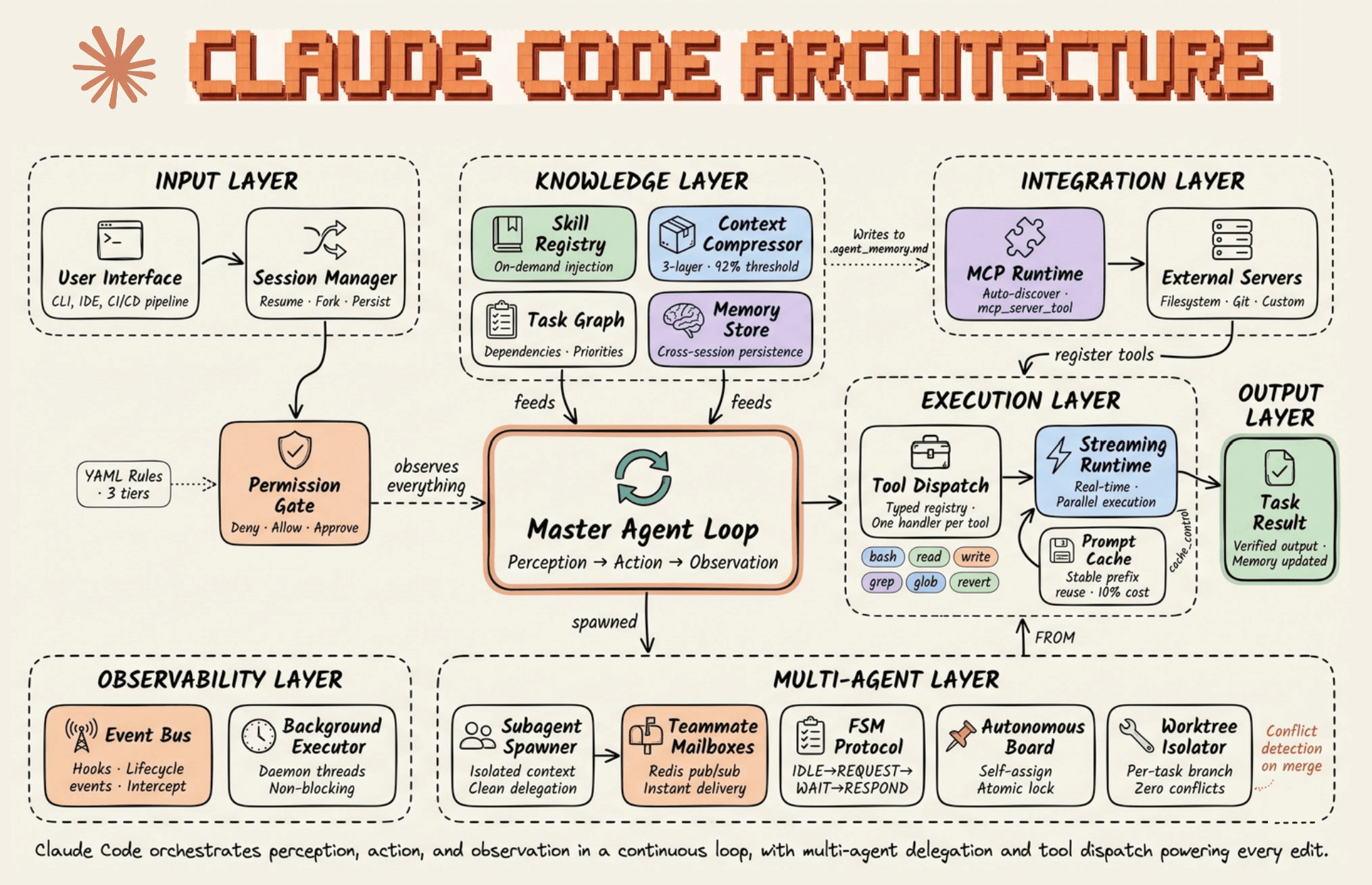
Claude Code is not just a CLI but a six-layer system where the Claude model is one node inside a loop. The Input Layer handles session management and permission gating; the Knowledge Layer holds skill registry, context compressor, and cross-session memory; the Execution Layer runs tool dispatch (bash, read, write, grep, glob, revert); the Integration Layer connects to external servers via MCP runtime and persists memory to markdown files; the Multi-Agent Layer supports subagents (lightweight workers in-session) and agent teams (independent Claude Code instances with git worktree isolation); and the Observability Layer wraps everything with an event bus logging all tool calls and messages.
The context compressor is a 5-layer cascade that activates when the context window hits roughly 95% capacity. Instead of summarizing conversations, it runs structured extraction on file paths, code snippets, and error histories while pruning redundant tool outputs. The prompt cache reuses stable prefixes at roughly 10% of the original cost.
Agent teams use two coordination mechanisms: a shared task list (JSON files on disk) and a mailbox system for peer-to-peer messaging. Each teammate gets git worktree isolation—a separate working directory with its own branch sharing the same repository history—so agents can write to overlapping parts of the codebase without file conflicts. Worktrees with no changes are cleaned up automatically; worktrees with changes persist for human review before merging.
Ask the AI about this article →
For example, today's edition would include:
AI-summarized, only the topics you pick — one digest a day via Email, Slack, or Discord.
Free · takes 30 seconds · unsubscribe anytimeWhat is AIToday? →
Ask AI anything about this article. Q&As are published on this page for other readers too.
Anthropic reset the 5-hour and 1-week usage limit windows for its AI service Claude on September 1, in connect…
Salesforce and Anthropic announced Claudeforce, starting with "Salesforce in Claude." This plugin lets users i…
McKinsey's 2025 survey found that while 65% of companies continuously use generative AI, fewer than 5% have ac…

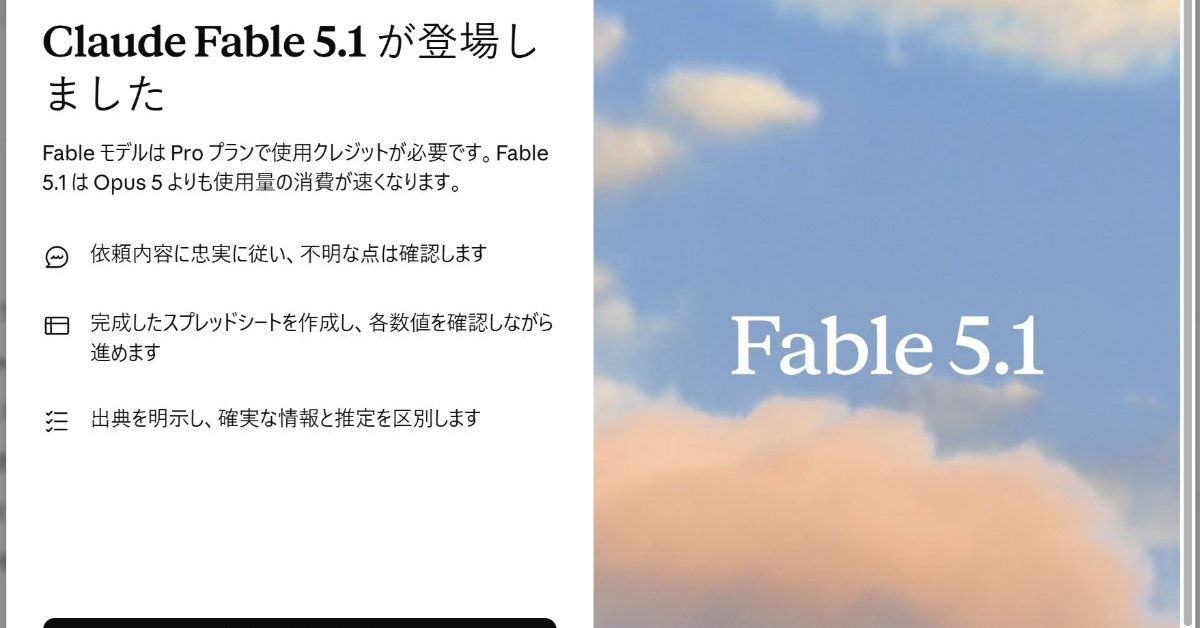
Anthropic announced Claude Fable 5.1 and Claude Mythos 5.1 on September 1
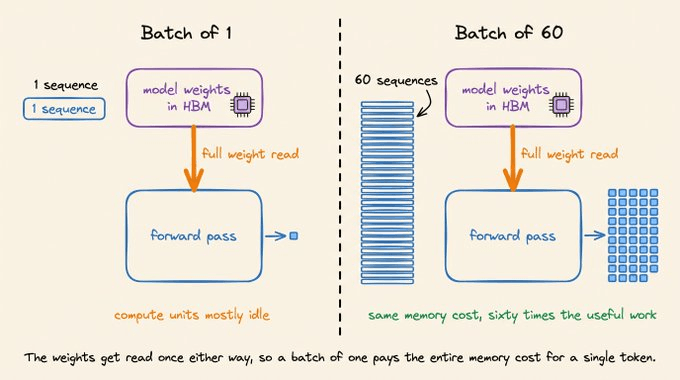
A technical explainer compares three LLM serving strategies—static, dynamic, and continuous batching
Anthropic's latest model, Claude Fable 5.1, is now available on Snowflake Cortex AI