What happened
A technical explainer compares three LLM serving strategies—static, dynamic, and continuous batching. It shows continuous batching, which re-decides the batch at every forward pass, delivers the most throughput and is the default in major engines like vLLM and SGLang.
Why it matters
Static batching runs at the pace of its slowest member, wasting GPU capacity and latency. Dynamic batching adds a timer but still waits for the slowest sequence. Continuous batching lets finished sequences leave and waiting ones join, keeping the GPU saturated even when output lengths vary widely.
What to watch
The article notes chunked prefill, which splits long prompts into smaller chunks, is on by default in vLLM V1. It also flags that there is no universal best chunk size—it depends on the model, GPU, prompt length distribution, and which latency metric your SLO measures.
Summaries like this, every morning.
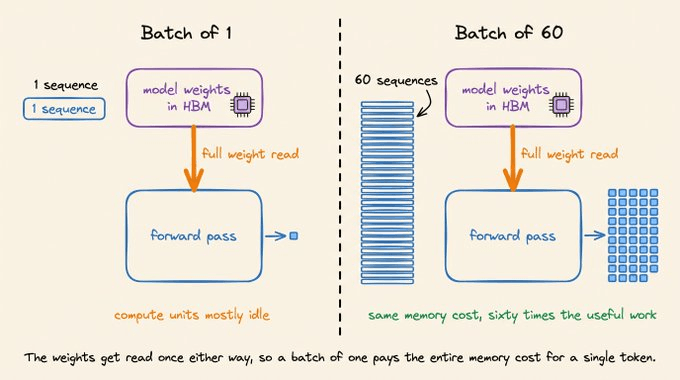
The article explains that a GPU's forward pass is bottlenecked on reading weights from memory, not on math. This is why batching helps: loading weights once and pushing many sequences through the same pass spreads the memory cost. However, LLMs are autoregressive—each pass produces one token and depends on previous ones—so a fixed batch runs at the pace of its slowest member.
Static batching works for fixed-output models like classifiers or embedding models, where every request finishes at nearly the same step. Dynamic batching adds a timer but still treats the batch as one unit, so fast requests wait for slow ones. Continuous batching, with iteration-level scheduling, is the only strategy that keeps the GPU saturated when output lengths vary.
The article also highlights chunked prefill as a technique to mitigate stutter when a long prompt joins the batch. It splits prompts into smaller chunks, giving the scheduler more chances to run decodes. There is no universal best chunk size—it depends on the model, GPU, prompt distribution, and the latency metric an SLO targets. For live traffic with variable output lengths, continuous batching is the only strategy that holds up, and every major engine enables it by default.
Pick your industry and the AI tools you use, and get news related to your work every day.
Free · 30 seconds with Google · unsubscribe anytimeWhat is AIToday? →
Ask AI anything about this article. The AI reads this article, earlier AIToday articles, and Wikipedia, and cites its sources. Q&As are published on this page for other readers too.
Moonshot AI released Kimi K3.1 Pro, a post-trained upgrade to Kimi K3 that scores 55 points on the Artificial…
Induction AI's benchmark trials shared a prompt cache, so later trials read earlier trials' opening tokens at…
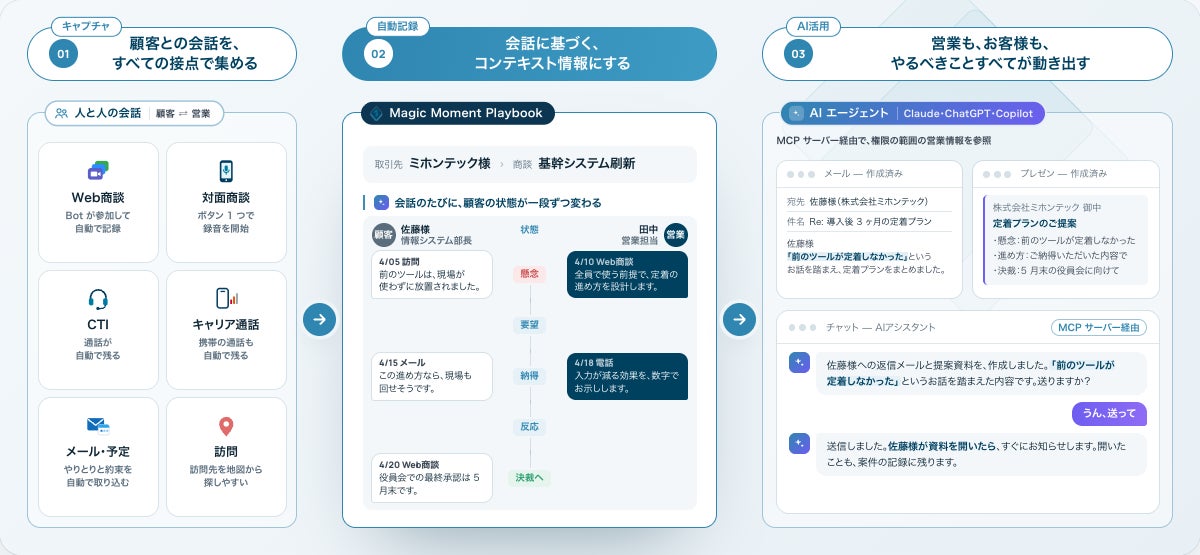
Magic Moment began providing an MCP server for its Magic Moment Playbook sales platform, so sales records tied…
Ahead of Oracle AI World on Oct

World, co-founded by Sam Altman, this week announced tools that let people link their proof of humanity to an…

In commentary on the unit-distance proof, Jacob Tsimerman, recently hired by OpenAI, said AI's edge is that it…