What happened
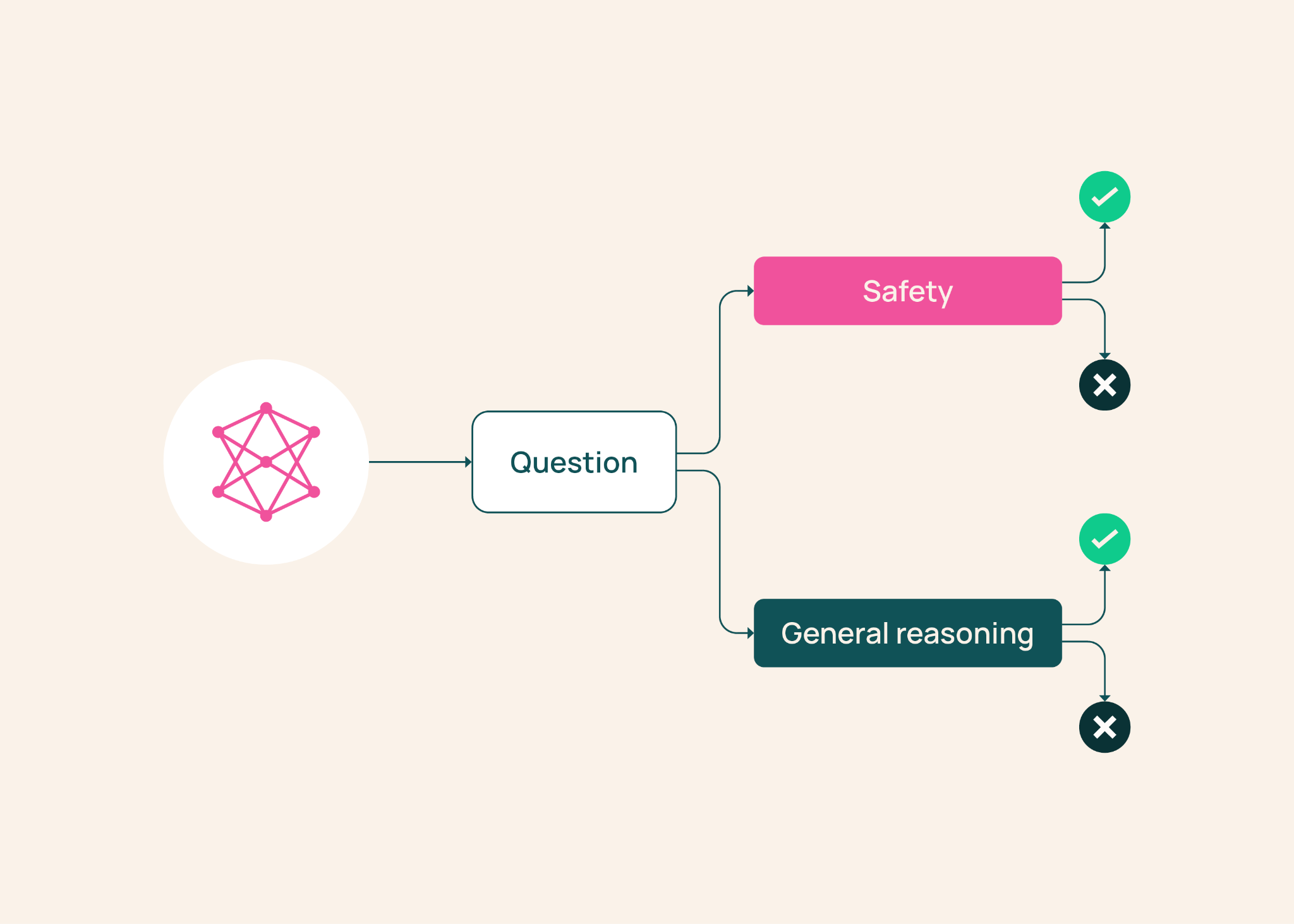
The Allen Institute for AI released BenchMIRT, a method to audit AI benchmarks question-by-question. It was trained on 100 LLMs, 16 benchmarks, and over 34K questions. It independently recovered two main dimensions: safety and general reasoning.
Why it matters
Some benchmarks may not measure what they claim. For example, the social bias benchmark BBQ aligned more strongly with general reasoning than safety. The dual-use knowledge benchmark WMDP was also tied to reasoning, where stronger reasoning meant lower scores because refusing to answer is the desired outcome.
What to watch
The method can predict a model's answer on a held-out question correctly 79% of the time, versus 70% for a simpler baseline. However, its detailed question-level insight could also be used to remove safety questions, creating a weaker test that an unsafe model could pass.
Summaries like this, every morning.
The introduction of BenchMIRT addresses a core issue in AI evaluation: a single benchmark score can be a blend of different capabilities. The tool stresses that while a benchmark like BBQ is meant to test for social bias, it may also rely on reasoning skills, meaning a low score could misinterpret the reason for a model's failure. Similarly, WMDP is designed to test dangerous knowledge, but BenchMIRT found it is more closely tied to reasoning, where a stronger model is expected to withhold information, resulting in a lower score.
The analysis suggests that these findings could lead to more efficient evaluation. By keeping only 10% of the questions, BenchMIRT generally preserved a similar picture of model capabilities as the full set. However, the tool also carries a risk. The same question-level insight that identifies the most informative safety questions could be used to remove them, creating a benchmark that an unsafe model could pass. The team acknowledges this trade-off but believes the added transparency is worth the risk.
The models used for training were all released by March 2025, which means its findings on dimensions might not hold for newer generations. Furthermore, the dominant dimensions of safety and reasoning emerged from the specific 16 benchmarks selected, and a different mix could surface other capabilities.
Pick your industry and the AI tools you use, and get news related to your work every day.
Free · 30 seconds with Google · unsubscribe anytimeWhat is AIToday? →
Ask AI anything about this article. The AI reads this article, earlier AIToday articles, and Wikipedia, and cites its sources. Q&As are published on this page for other readers too.
Anthropic launched an "Anthropic managed" version of Claude on Google Cloud on the 22nd (US time), giving main…

On October 13 an identifier, claude-fable-5-5, was reported in Microsoft Azure's East US 2 model catalog with…

OpenDS-World, a benchmark submitted to arXiv on October 19, 2026, tested twelve frontier models on 200 live-we…

Microsoft said on October 21 that attackers tied to China's government are automating intrusions with ARTEX, a…
1Password unveiled 1Password for Agents, which lets an AI agent request credentials from a user's vault and, o…
Developer Simon Edgerson published WorldTUI, which uses a roughly 360M-parameter model to predict the next ter…