What happened
Two days before Trump landed in Shenzhen, the Commerce Department issued new licensing requirements aimed at further cutting off Chinese access to advanced US chips. China's Ministry of Foreign Affairs called them "a typical case of economic coercion."
Why it matters
The timing — just before the summit — means the curbs are likely to be read as an escalation of US protectionist policy, making the uneasy truce harder to hold, according to trade law expert Benjamin Kostrzewa.
What to watch
The two-month extension of the trade agreement is set to expire January 10.
What to watch
Trump and Xi are set to meet once more this year, at the G20 Leaders' Summit in December.
WHO IT HITSUS chipmakers and their supply-chain partners face tighter licensing and enforcement, while Chinese tech companies that still rely on American chips may see access narrow further.
Summaries like this, every morning.
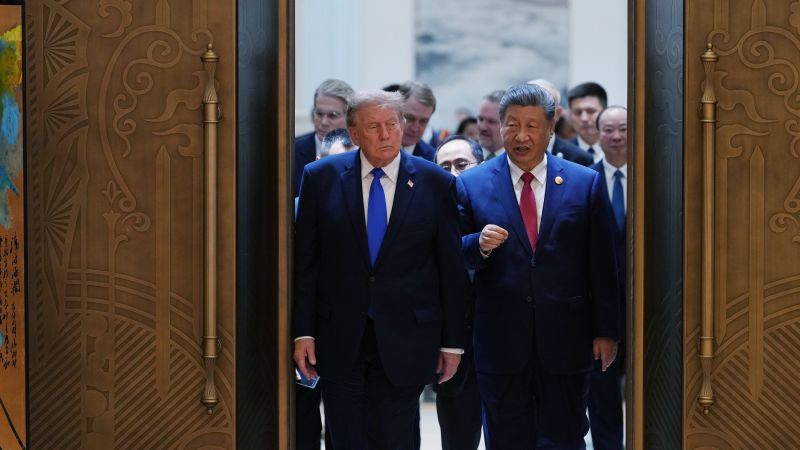
The summit in Shenzhen was staged as a showcase of China's high-tech ambitions, with Xi seeking to present the country as a reliable and innovative economic partner. But the choreography collided with two developments that neither leader chose to address publicly. The first was the Commerce Department's new licensing requirements, issued two days before Trump's arrival, which analysts said would be hard for Beijing to ignore much longer. The second was the controversy surrounding Jensen Huang, who until recently helmed the $4 trillion chip titan Nvidia, after allegations that he had an affair with a woman suspected of working with Chinese intelligence. That episode has reignited fears of America's best technology falling into adversarial hands.
The trade detente was already fragile. When Trump and Xi last met in Washington, DC in September, they extended a trade agreement from October 2025 that included a rollback of US tariffs in exchange for Chinese commitments to buy more US agricultural products and loosen restrictions on rare earth exports. Officials said the two-month extension, set to expire January 10, would allow them to assess whether China was meeting its original pledges. The Nvidia controversy, and questions about how some of its most advanced chips reach China despite export controls, has since triggered greater suspicion over national security risks that will complicate negotiations, said Jyh-An Lee of The Chinese University of Hong Kong. "The political climate is now quite different," Lee said. "It's not that easy to go back to the time before the Jensen Huang incident."
At the summit, the US, China and Russia said they discussed the need to develop artificial intelligence safely, but there was otherwise little concrete progress on trade or technological cooperation. Huang's resignation, Trump told Fox News, was raised briefly with Xi — a "tragedy," Trump called it. Chinese officials have decried the allegations as baseless attempts to smear China. Analysts said Beijing's most effective countermeasure remains its near-monopoly on rare earths and other minerals critical to high-tech supply chains; despite last year's trade agreement, Chinese rare earth exports to the US remain about 75% below pre-restriction levels, according to the Center for Strategic and International Studies. "China can hit back, and they can hit back hard," said Han Lin of The Asia Group, adding that China would likely take subtle actions to preserve stability ahead of the Communist Party Congress next year, at which Xi is expected to claim another five-year term.
Pick your industry and the AI tools you use, and get news related to your work every day.
Free · 30 seconds with Google · unsubscribe anytimeWhat is AIToday? →
Ask AI anything about this article. The AI reads this article, earlier AIToday articles, and Wikipedia, and cites its sources. Q&As are published on this page for other readers too.
Nvidia's leadership turmoil, customer investigations and Q3 FY2027 numbers hit at once, and the ripple now run…

Anthropic mathematician Levent Alpöge said he and Claude proved the Riemann Hypothesis on Nov 20, 2026, releas…

From November 22, 2026, Gomumari's target-list AI agent will read a customer's past won-agency list — around 3…

Gomumari Inc. will start offering its quote-assessment AI agent on November 22, 2026; users attach a quote and…
Gomumari will start offering its Ad Review AI Agent on 2026年11月22日; users attach ad copy or pages before publi…
Appaloosa's David Tepper exited AMD and Broadcom, bought Nvidia and Micron, and nearly halved his Alphabet sta…