What happened
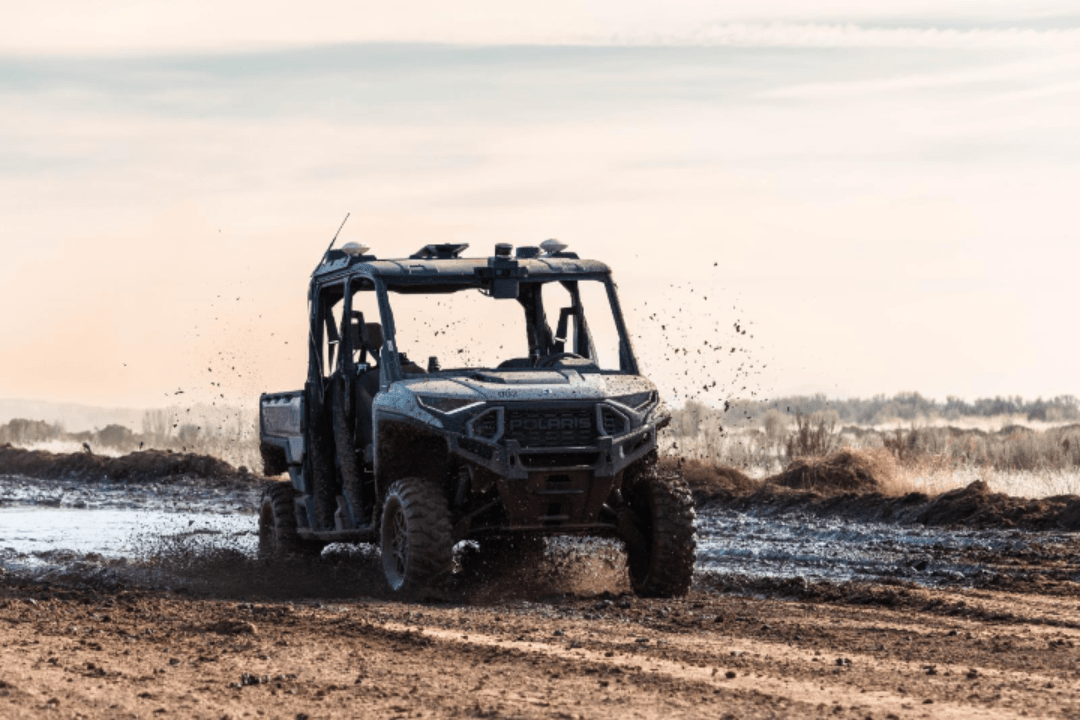
Forterra, a U.S. autonomous vehicle builder, has deployed more than 100 of its self-driving ATVs in Ukrainian conflict zones over the past nine months—what it claims is the largest deployment of autonomous ground vehicles in combat by any U.S. defense tech company. The Lancer vehicles, based on Polaris ATVs and equipped with custom sensors and computing hardware, have completed more than 1,100 missions, driven over 2,500 miles, carried 777,440 pounds of cargo, and evacuated 52 casualties.
Why it matters
Ukrainian forces face constant aerial drone threats that make movement extremely dangerous, creating demand for remote-operated and autonomous ground vehicles to transport supplies, munitions, and wounded soldiers. Forterra's vehicles can carry 750 kilograms of cargo and run on gasoline, outperforming Ukraine's existing battery-powered vehicles, which carry only up to 250 kilograms. The real-world combat experience is teaching Forterra and competitors how autonomous systems must evolve to handle military conditions—lessons that will shape future U.S. defense contracts.
What to watch
Ukrainian soldiers currently teleoperates the vehicles rather than relying on full autonomy, because autonomous systems cannot yet identify and react to unexpected enemy threats in real time. Forterra has raised more than $500 million(約800億円) in venture funding and faces competition from Scout AI (which raised $100 million(約160億円) earlier this year), Field AI, and Overland AI, all developing autonomous platforms for the military.
Summaries like this, in your inbox every morning.
The deployment in Ukraine represents a rare full-scale test of autonomous ground vehicles under real combat conditions. While aerial drones have dominated recent warfare coverage, the extensive air defense threat they create has forced Ukrainian military planners to seek ground-based alternatives for logistics and casualty evacuation. Forterra's nine-month operational record—over 2,500 miles driven, 1,100 missions completed, and 52 casualty evacuations—provides concrete performance data that neither lab testing nor simulation can replicate.
The critical gap the deployment has exposed is not mechanical reliability but autonomous decision-making under uncertainty. Vehicles can navigate terrain autonomously, but they cannot yet detect hostile forces and respond appropriately, forcing operators to maintain manual control in active combat zones. This constraint reflects a broader challenge in military AI: the difference between performing well in controlled environments and handling the unpredictability of actual warfare. Forterra's engineers are working to combine self-driving-car algorithms with generative AI to bridge this gap, though the company acknowledges that some skills—like navigating minefields—require domain-specific training data not available in open-source models.
The competitive landscape is heating up. Scout AI, Field AI, and Overland AI are all developing autonomous military platforms and trialing them with the U.S. military. Forterra's advantage lies in its operational experience and the trust it has earned from Ukrainian forces, who initially had reservations about Western contractor solutions but became convinced after the vehicles were modified with Starlink satellite connectivity. The challenge of cost—vehicles remain too expensive to deploy with the same attrition tolerance as UAVs—will likely shape investment priorities across the sector.
Pick your industry and the AI tools you use, and get news related to your work every day.
Free · 30 seconds with Google · unsubscribe anytimeWhat is AIToday? →
Ask AI anything about this article. The AI reads this article, earlier AIToday articles, and Wikipedia, and cites its sources. Q&As are published on this page for other readers too.
JR Central announced the S0系 on October 16, its first full model change since the N700S, with commercial servi…
The Air Force upgraded the X-62 VISTA with advanced radar, expanded sensors and computing, and modern network…
T2 said it will join ENEOS and others in the Agency for Natural Resources and Energy's demonstration project f…
Researchers present neurosymbolic planning using natural language communication for cooperative autonomous veh…
Honeywell Aerospace flew a BFD-SE8 autonomously in mid-June, six weeks after starting Shield AI's Hivemind Ent…
Sony will exhibit at CEATEC 2026, held October 13–16 at Makuhari Messe in Chiba, under the theme "Where Ideas…