What happened
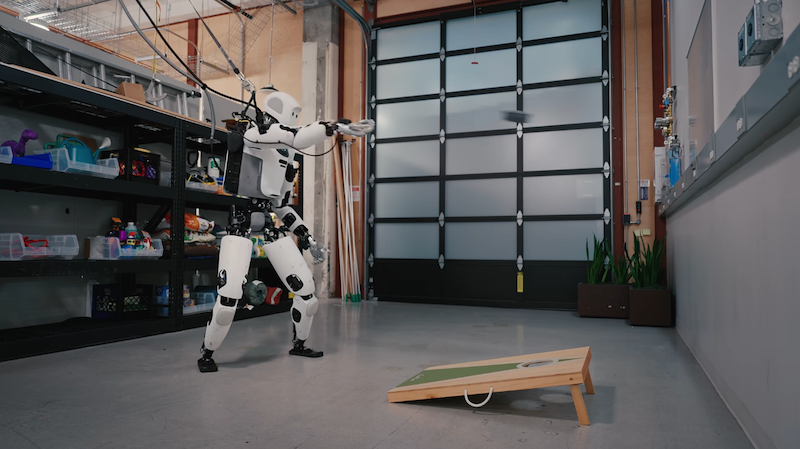
Google DeepMind showed Gemini 4 Argon analyzing raw video of a person playing cornhole, generating simulation code, and transferring the behavior to Apptronik's Apollo humanoid, which landed seven consecutive shots in a real-world trial.
Why it matters
The demonstration is intended to show how general-purpose AI models could reduce the manual engineering required to teach robots new physical skills.
WHO IT HITSRobotics engineers and developers who build training pipelines for humanoid robots may see simulation setup time cut, as the demo suggests weeks of manual modeling could become a few hours. Teams evaluating Google's Gemini API for physical-AI projects are the immediate audience.
Summaries like this, in your inbox every morning.
Google DeepMind's demonstration sits at the intersection of two threads: the launch of Gemini 4 Argon as a frontier model for complex engineering and scientific work, and the company's push to apply advanced AI reasoning to physical systems. The cornhole test is notable not just for the robot's seven consecutive shots, but for the pipeline behind it. Argon was shown raw video, then analyzed the environment, mapped spatial coordinates, and calculated whole-body joint movements before generating simulation code autonomously. That code became the training ground for Apptronik's Apollo humanoid.
The company frames this as a way to compress a simulation process that would normally require weeks of manual work into a few hours. If that holds, the bottleneck for teaching robots new physical skills shifts from engineering labor to the availability of video. DeepMind also reports Argon scored 87 percent on its Embodied Reasoning benchmark, which measures reasoning about physical and spatial problems in 3D environments. Alongside the robotics work, Google says it has already used the model for projects ranging from optimizing large software codebases to quantum computing, nuclear fusion and life-sciences research, positioning Argon as a general-purpose reasoning engine rather than a robotics-only tool.
Pick your industry and the AI tools you use, and get news related to your work every day.
Free · 30 seconds with Google · unsubscribe anytimeWhat is AIToday? →
Ask AI anything about this article. The AI reads this article, earlier AIToday articles, and Wikipedia, and cites its sources. Q&As are published on this page for other readers too.
A non-peer-reviewed September paper reports a 'pain vector' identified in 25 models from Google, Meta, Alibaba…

Shoshana Berger and Nina Willdorf founded the Aged Intelligence Society, invite-only dinners where women 40-pl…

OpenAI's Decisions API became available to all customers on Thursday, after being announced at its developer d…
Cerence AI announced its collaboration with Geely is expanding from intelligent cockpits to embodied robotics…

Morgan Stanley already blocks AI agents entirely, and JPMorgan, Bank of America and Citi are doing the same, A…

Modal CEO Erik Bernhardsson said the AI infrastructure company crossed $1 billion in annualized run rate, rais…