What happened
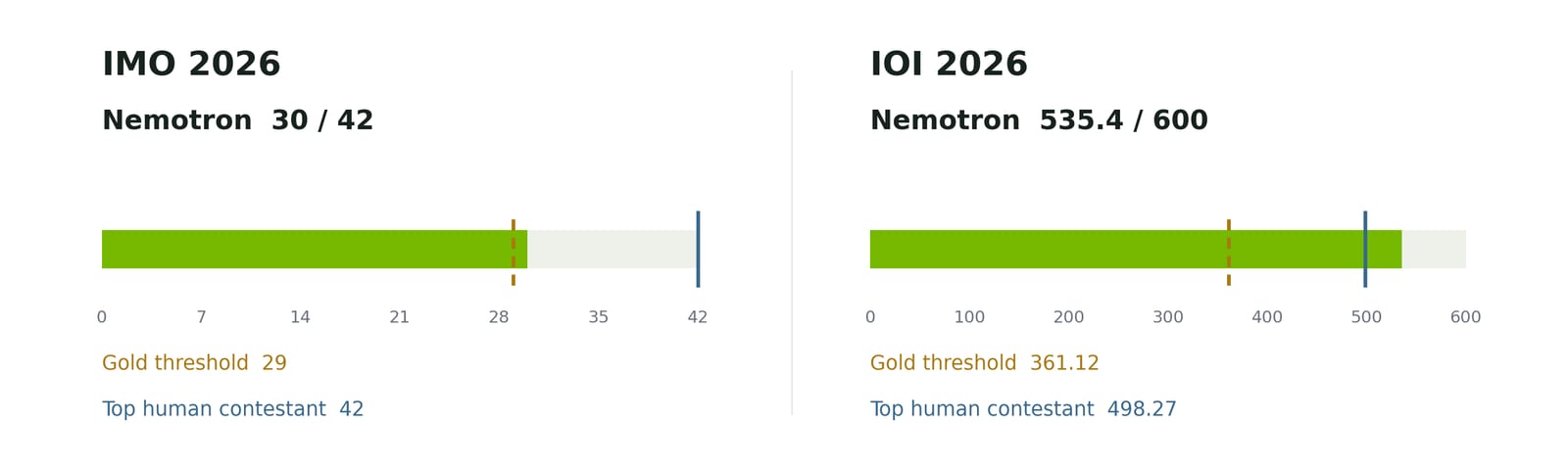
Specialized Nemotron 3 variants, using supervised fine-tuning, reinforcement learning and GenCorrect feedback loops, scored 535.4/600 at IOI 2026 and 30/42 at IMO 2026, both above gold thresholds.
Why it matters
The results suggest a capable base model can be turned into a world-class specialist by pairing it with a transparent generate-verify-refine loop, not by building a new model for each contest.
What to watch
The IOI run was an unofficial, unsupervised benchmark, not part of the official IOI ranking, so the gold-level claim hinges on whether the community reproduces it using the released checkpoints and pipelines.
WHO IT HITSAI researchers and engineers who fine-tune open-weight models can now use the Nemotron IMO/IOI checkpoints, datasets, and inference pipelines as a reusable recipe for demanding reasoning tasks.
Summaries like this, in your inbox every morning.
The two projects build on earlier work from the same teams: a previous IOI 2025 Hugging Face post showed test-time compute could push open-weight models to gold-level performance. The new results add a missing piece, namely that better specialization gives the inference system better candidates, critics, and refinements. For IOI, the progression on IOI 2025 makes the value of specialization concrete: Nano improved from 130 points before post-training to 280 after SFT and 291 after RL, then reached 468 with GenCorrect. For the stronger Ultra model, one SFT epoch was enough to outperform the fully post-trained Nano across IOI, ICPC, and LiveCodeBench Pro.
For IMO, the project trained one specialist with SFT and another with RL. The SFT checkpoint was strongest in the first search round, while the RL checkpoint achieved the best overall single-checkpoint result, and because their strengths were complementary the final system used both alongside the general model. A separate high-compute stage selected the final submission, and the entire system worked in natural language with no formal prover, external tools, or internet access.
The broader claim is that the medals came from co-designing the model, the data, and the inference loop, not from fine-tuning alone or brute-force sampling alone. Whether that recipe holds up as a general pattern will likely depend on whether other teams can reproduce the released checkpoints, datasets, and NeMo-Skills pipelines on tasks beyond these two competitions.
Pick your industry and the AI tools you use, and get news related to your work every day.
Free · 30 seconds with Google · unsubscribe anytimeWhat is AIToday? →
Ask AI anything about this article. The AI reads this article, earlier AIToday articles, and Wikipedia, and cites its sources. Q&As are published on this page for other readers too.
ElevenLabs completed a $300 million employee tender at a $22 billion valuation, and co-founder Mati Staniszews…

On October 15, OpenAI announced the Rosalind Academic Plan, giving approved US university labs free access to…

A Qiita article compared automated red-teaming methods for LLM apps — GCG, PAIR, and TAP — using mock implemen…

Liquid AI released d1-ultra on October 15, 2026, an upgraded open-weights decision model that averaged 76.7 ac…

Circlia started a proof-of-concept for TASTE SIGNAL: visitors to Holland Village Cafe FUKUOKA taste cookies an…

In a webinar hosted by French Mathematical Society president Isabelle Gallagher, Fields Medal winner Hugo Dumi…

