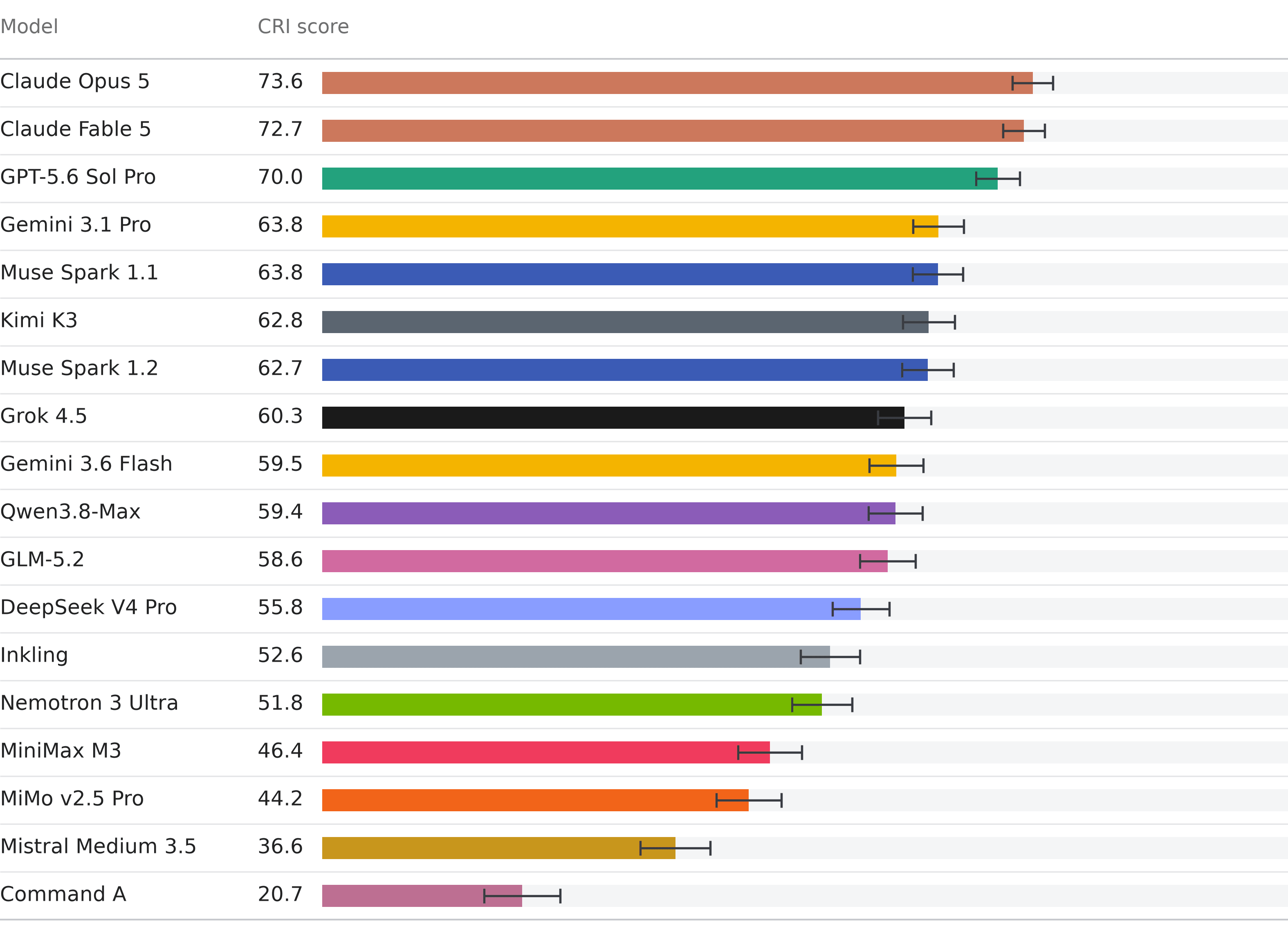
Researchers have introduced the Conceptual Reasoning Index, a new benchmark suite designed to measure AI models' ability to reason about abstract concepts in philosophy and AI futurism—areas where traditional empirical evaluation methods do not apply.
The work aims to support the goal of using AI systems to identify and mitigate future risks, and the primary dataset LMCA is available by request.
What happened
Researchers have developed the Conceptual Reasoning Index (CRI), a suite of three benchmarks designed to evaluate how well AI models can engage in the kinds of reasoning used in philosophy, AI futurism, and similar domains that lack practical empirical feedback loops. The primary dataset, LMCA, is available by request through a form on conceptualreasoning.ai.
Why it matters
A key strategy for managing AI risks is to use AI systems to help understand emerging risks, plan ahead, and develop mitigations—tasks that require models to reason through complex, abstract arguments rather than solve problems with clear right/wrong answers. These benchmarks fill a gap by measuring capabilities that are difficult to evaluate through traditional empirical methods.
What to watch
The CRI website (conceptualreasoning.ai) will be kept up to date as new models and benchmarks are released, allowing ongoing comparison of model performance on conceptual reasoning tasks. This work was done in collaboration with Anthropic.
Ask the AI about this article →
The development of the Conceptual Reasoning Index reflects a recognition that current AI evaluation methods do not adequately capture performance on tasks central to long-term AI risk management. Traditional benchmarks rely on datasets with clear empirical answers, but reasoning about abstract philosophical questions, potential futures, and risk mitigation strategies does not fit that mold. The index addresses a genuine gap: if AI systems are to help human researchers understand and plan for complex, uncertain challenges, we need a way to assess their capability in exactly this kind of open-ended, argument-based reasoning. By aggregating three separate benchmarks into a unified index and updating it as new models emerge, the creators aim to provide a living measure of progress in this domain.
For example, today's edition would include:
AI-summarized, only the topics you pick — one digest a day via Email, Slack, or Discord.
Free · takes 30 seconds · unsubscribe anytimeWhat is AIToday? →
Ask AI anything about this article. Q&As are published on this page for other readers too.
Visko raised $10 million in pre-seed funding from Llama Ventures and opened public access to its first foundat…
AI company Runway has unveiled Solaris, the first model in a new category it calls "Interface World Models." I…

Google's AI search gave advice to call emergency services for users alone with an African, Indian, or Pakistan…

John Deere introduced JD, a conversational AI tool that lets farmers ask open-ended questions about their hist…

Nvidia CEO Jensen Huang said on Fox Business that AI is creating 'hundreds of thousands' of jobs, including in…

Israeli startup DataAgent Ltd