What happened
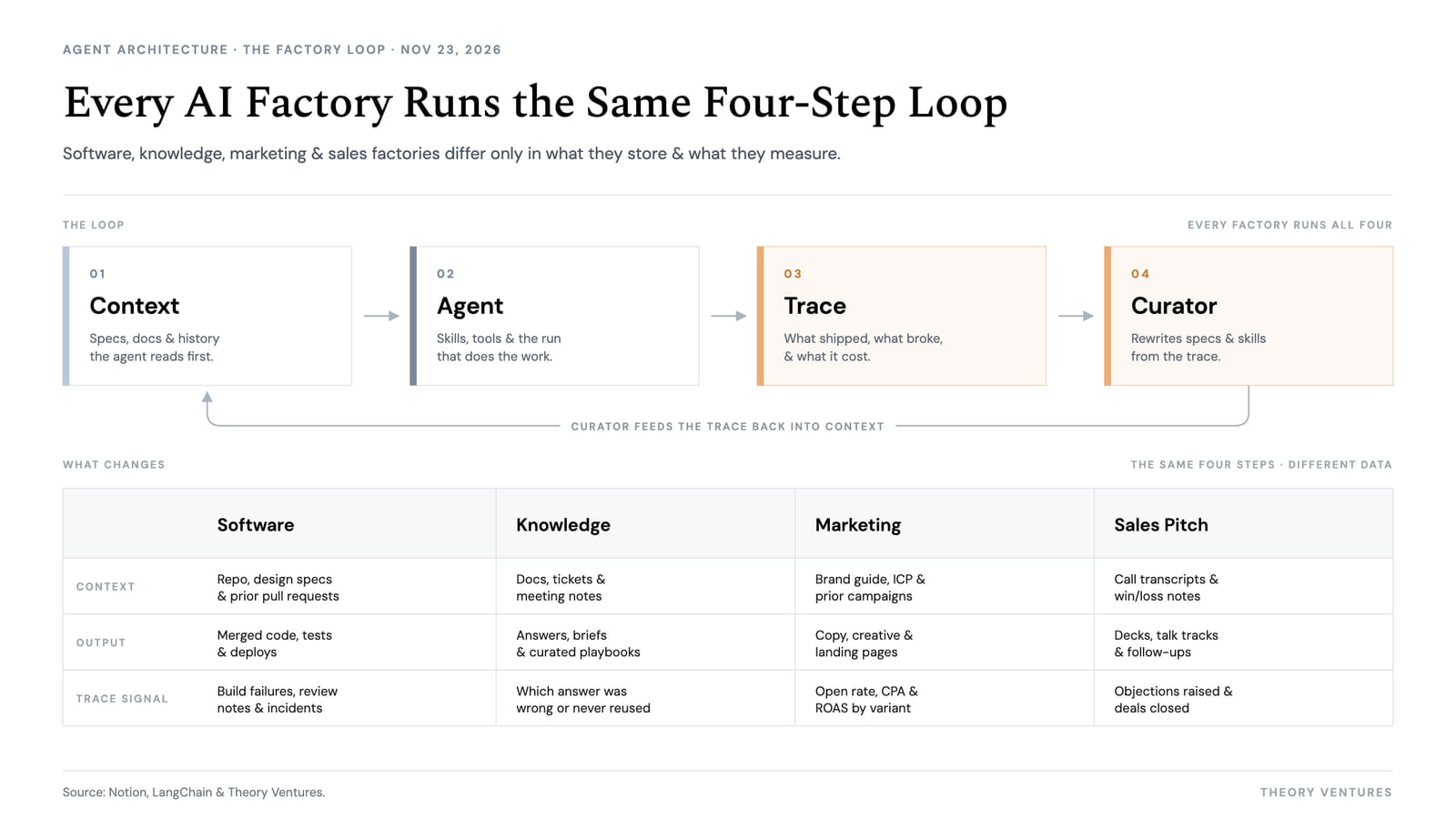
On November 21, Notion published "A New Shape for Work" and LangChain published "How to Build a Knowledge Factory," both describing the same loop: context, agent, trace, curator.
Why it matters
The loop turns each run into data that rewrites the next run's instructions, so the system improves every week instead of staying flat, and the architecture generalizes to marketing, ads, and sales teams.
Summaries like this, every morning.
The shift is a change in what engineering teams actually do: before AI, they wrote code line by line; after AI, the best teams build systems that write, test, and ship the code for them. Notion's piece is described as a manifesto and LangChain's as a build guide, but both land on the same four-step loop applied to company knowledge. Notion calls the resulting structure among the most valuable IP a modern organization can have because it defines the limit of what agents can do inside that company. LangChain frames the same idea from the build side: the goal is not to document everything before agents start, but to build a system where doing the work reveals what knowledge is missing, and resolving those gaps makes future work better. The loop generalizes beyond code — a marketing factory turns campaign performance into better copy, an online ads factory turns ROAS traces into new creative, and a sales pitch factory turns call transcripts into sharper decks. Satya Nadella's description at Microsoft Ignite is cited as the same shift in staffing terms: a founder with a token budget hires someone, who also has a token budget, and they figure out how to combine tokens and wages. The question is no longer whether AI can do the work, but what kind of factory each team will build.
Pick your industry and the AI tools you use, and get news related to your work every day.
Free · 30 seconds with Google · unsubscribe anytimeWhat is AIToday? →
Ask AI anything about this article. The AI reads this article, earlier AIToday articles, and Wikipedia, and cites its sources. Q&As are published on this page for other readers too.
Jakub Pachocki's essay "Perplexity and Intelligence" publishes five years of OpenAI base-model log-perplexity…
An audit of QuantG's prior LLM mining found 72% of 1,250 candidate factors failed the first statistical test…

MulmoTerminal, a free MIT-licensed app for running Claude Code and Codex side by side in a browser, showed thr…

Gemini Deep Research API can call the EveryInfra remote MCP server at api.everyinfra.com/mcp via an mcp_server…
Val Research released the Ekispert API MCP Server in January 2026, connecting AI tools like Claude Desktop to…

The author narrowed the situations where Claude Desktop may stop and ask to Rule 9's four exceptions plus thre…