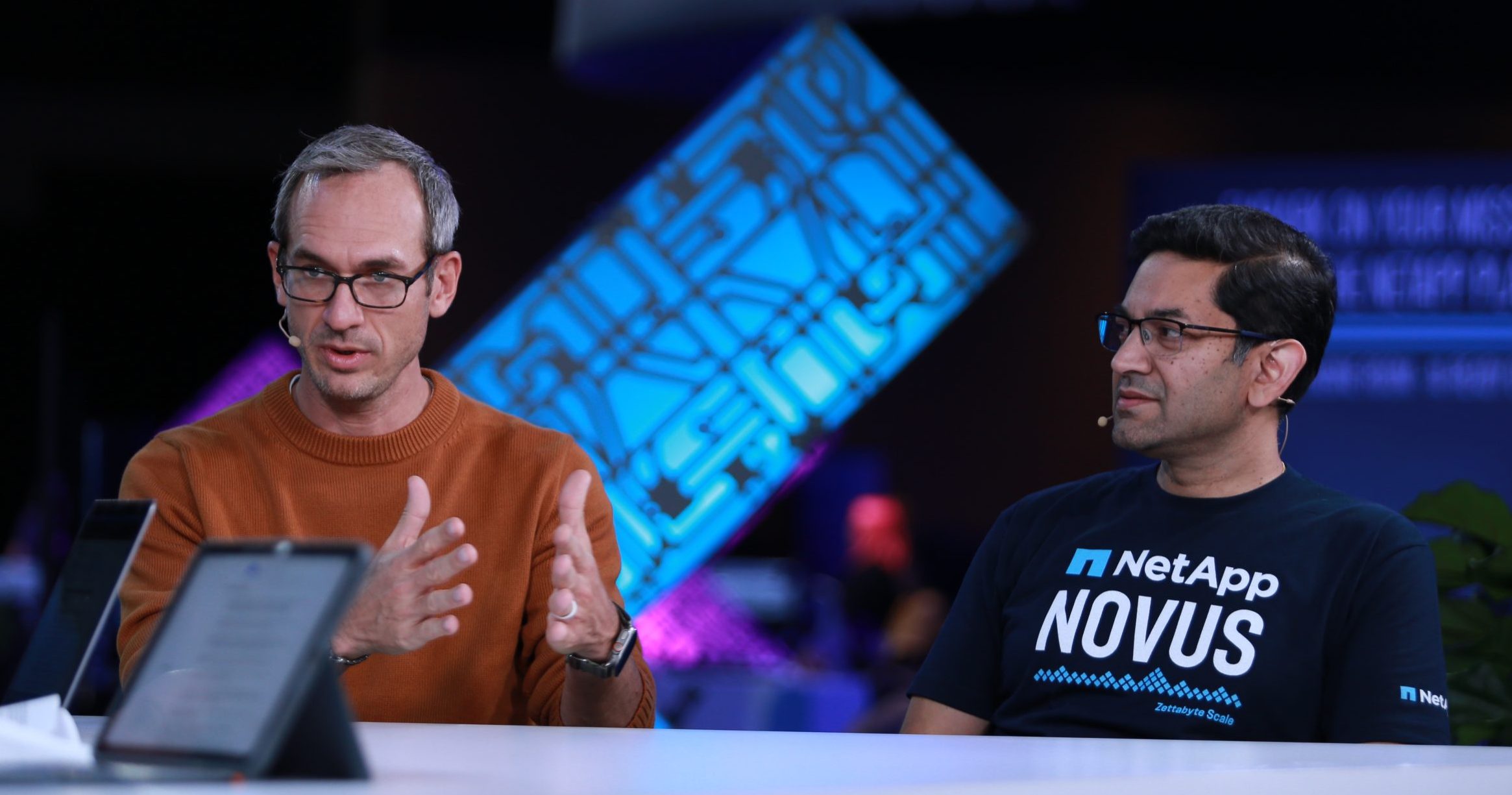
What happened
NetApp CTO Arindam Banerjee said the Novus architecture separates data and metadata so each scales independently, keeping GPUs fed during simultaneous transactional and heavy sequential workloads.
Why it matters
Previous architectures handled one workload type well, not both at once; storage delays can leave costly GPUs underused while still consuming power, the company says.
What to watch
The design targets agentic workloads where thousands of agents hit data concurrently with temporary permissions. Whether it delivers hinges on the new API-driven control plane Banerjee described.
WHO IT HITSEnterprise storage architects and AI infrastructure teams running GPU clusters will need to evaluate whether separating metadata and data management reduces GPU idle time as agentic workloads scale up.
Summaries like this, in your inbox every morning.
NetApp and Nvidia's partnership dates back more than a decade and now includes co-engineering around AI infrastructure. That long relationship matters because the storage problems Banerjee describes are not abstract: as AI moves from experimentation into what Nvidia's Jason Hardy called "phase 2" of mainstream production, the infrastructure has to scale without being redesigned for every new use case.
Banerjee's argument is that AI workloads create a specific conflict. Transactional metadata operations and heavy sequential workloads — checkpoints, for example — happen at the same time, and older architectures could only do one well. When metadata and data share the same resources, data operations queue behind smaller metadata operations, which leaves GPUs underutilized while still burning power. Novus's answer is to split those functions onto separate scaling axes.
Agents raise the stakes further, since thousands may hit data concurrently with temporary permissions, increasing metadata volume. The bet is that API-driven, agent-friendly consumption — rather than storage specialists managing every request — becomes the norm. Whether this matters for any given enterprise hinges on how quickly agentic production workloads arrive and whether the new control plane makes the layer invisible to the AI teams meant to use it.
Pick your industry and the AI tools you use, and get news related to your work every day.
Free · 30 seconds with Google · unsubscribe anytimeWhat is AIToday? →
Ask AI anything about this article. The AI reads this article, earlier AIToday articles, and Wikipedia, and cites its sources. Q&As are published on this page for other readers too.
Anthropic PBC reportedly aims to begin marketing its IPO the week of Nov
OpenAI confirmed it dismissed three safety researchers for violating policies on accessing and handling sensit…
Anthropic published best practices for human-AI agent teams, based on an interview with Slack CPO Jamie DeLang…

OpenAI's August 26 postmortem says its internal cybersecurity evaluation gave a research model "ExploitGym" ta…
Anthropic said it made the web service claude.ai and its desktop app about 3 times faster in 2 weeks, and that…
On October 1, OpenAI updated ChatGPT's release notes with shopping features — a 'try on' button on product car…