AIToday

SLB poised to cash in on Middle East oil recovery and AI data center boom

Fortune AI4h ago
SLB poised to cash in on Middle East oil recovery and AI data center boom

Key takeaway

SLB, the world's largest oilfield services company, is positioned to profit from two major forces reshaping global energy: the Middle East's rebound following the Strait of Hormuz closure, which removed nearly 20% of global oil and gas supply, and the explosive growth of AI data centers—where hyperscalers plan to spend roughly $710 billion(約110兆円) on North American facilities in 2026 alone. Unlike its better-known rivals, SLB has maintained operations across geopolitically unstable regions including Venezuela, the Middle East, and over 100 countries, and is now pivoting toward digital power management and modular data center solutions, making it a key beneficiary of both the regional energy recovery and the AI infrastructure boom.

Summaries like this, in your inbox every morning.

Sign up free →

3 Key Points

  • What happened

    SLB, the world's largest oilfield services company with 109,000 employees, is positioned to benefit from a rebound in Middle East oil and gas production following the closure of the Strait of Hormuz, which choked off nearly 20% of the world's oil and gas supply. The company is also expanding into AI data center solutions, its fastest-growing segment, as hyperscalers plan to spend roughly $710 billion(約110兆円) on North American data centers in 2026 alone.

  • Why it matters

    SLB operates in geopolitically complex regions where competitors have withdrawn, maintaining operations in Venezuela, the Middle East, and over 100 countries worldwide. Its entry into digital power management and modular data center construction positions it uniquely to serve both traditional energy recovery and the infrastructure demands of the AI boom—two forces reshaping global energy strategy.

  • What to watch

    SLB's market cap has fallen to below $75 billion(約12兆円) from a high during the shale boom, and the company's recent shift from the name Schlumberger to SLB in 2022 was meant to signal its digital transformation. CEO Olivier Le Peuch emphasizes that "exploration is back" as nations rebuild energy security and support AI investments.

In Depth

SLB's story begins in 1912, when French physicist Conrad Schlumberger conducted conductivity tests using wired electrodes on his family's estate in Normandy to detect buried medieval ruins. The experiment's success revealed a broader principle: electric instruments could map underground structures from the surface. Conrad and his brother Marcel recognized the method's application to oil exploration and founded the Société de Prospection Électrique in 1926, creating the first well logs—electric cables that produced subsurface readings resembling EKG heart monitor outputs. This technology became the backbone of modern geophysical prospecting and supercharged oil and gas exploration worldwide. By the end of the 1930s, Schlumberger had moved into the Middle East more than 20 years before OPEC's formation, and by 1980, the company ranked fourth globally by market cap, behind only IBM, AT&T, and Exxon.

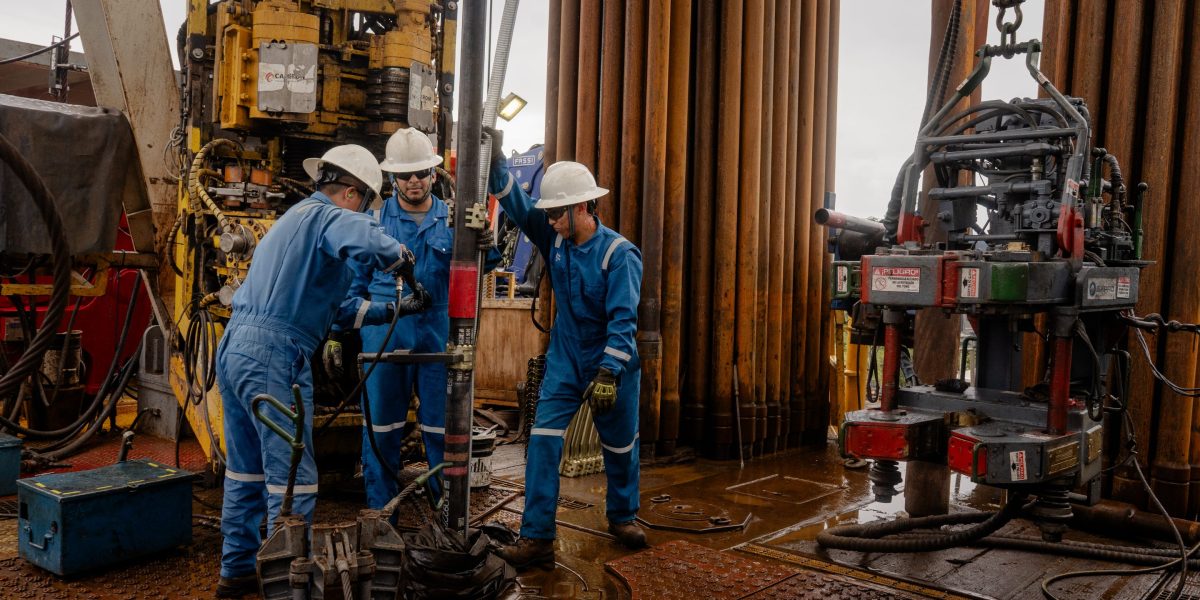
Over the subsequent decades, Schlumberger expanded to over 100 countries and became known in the industry as "Big Blue" for its signature blue uniforms. Unlike competitors, the company built strong local workforces and community ties, perfecting what one analyst called "the art of scaling down and getting people to safe places"—capabilities tested repeatedly during wars, coups, and political upheaval. The company's early decades coincided with World War II; Conrad died suddenly in 1936 at 57 from a cerebral hemorrhage, and his daughter Dominique fled occupied France in 1941 with her three children while her husband, John de Menil, worked for Schlumberger in Romania. The company managed to ship blueprints of Schlumberger's inventions to Texas for safekeeping. De Menil later led the company's expansion into Latin America beyond Venezuela—including Ecuador—and into East Asia. Despite its outsized role in the industry, SLB remained less visible and profitable than its oil company customers; ExxonMobil boasted a market cap of $600 billion(約96兆円) in mid-July (after hitting an all-time high in 2026), while SLB sat below $75 billion(約12兆円). As one analyst put it, service companies are "the end of the whip in terms of volatility"—when oil prices fall, they fall harder, and operational efficiencies work against them (a well that once took 30 days now takes less than a week, slashing service revenues).

In recent years, SLB has repositioned itself through technology and rebranding. In 1985, it launched the Schlumberger Information Network (SINet), the first Arpanet-based corporate intranet in the world. In 2008, it partnered with Nvidia years before Nvidia's rise as the world's most valuable company. Today, AI-controlled rigs use SLB's "autonomous geosteering" technology to drill thousands of feet underground without human involvement. The 2022 name change from Schlumberger to SLB was designed to signal this digital transformation, though many in the industry initially viewed it as a mistake. Now, SLB's fastest-growing segment is its digital and data center solutions business. While most energy companies are capitalizing on the AI boom by building power plants, SLB is focusing on digital power management and modular data center construction, helping hyperscalers use off-site manufacturing and standardized processes to build faster and operate more affordably. Leading AI hyperscalers have told investors they plan to spend roughly $710 billion(約110兆円) on North American data centers in 2026 alone, positioning SLB's expertise as strategically valuable.

The convergence of geopolitics and AI demand now favors SLB's historically rooted presence. In early 2026, the world faced an anticipated oil glut before the Middle East conflict changed everything, choking off nearly 20% of the world's oil and gas supply and shrinking emergency oil reserves globally. Ongoing uncertainty over the Strait of Hormuz is prompting nations to replenish lost inventories, build larger stockpiles, and boost domestic energy production for security—President Trump's emphasis on oil production in the Western Hemisphere, called the Donroe Doctrine, reinforces this trend. CEO Olivier Le Peuch, a French engineer who joined SLB in 1986 and became the first French CEO since 1986, observed that "the peak of globalization is behind us" and "exploration is back." SLB is partnering with Saudi Aramco, the UAE's ADNOC, Kuwait Petroleum, and others in the Middle East, and with Venezuela's state-owned PDVSA (alongside Chevron, one of the two companies that never left despite asset expropriation under Hugo Chávez). With 109,000 employees worldwide—more than ExxonMobil and Chevron combined—SLB is larger than better-known rivals Halliburton and Baker Hughes, positioning it to capitalize on what one analyst called the industry's biggest opportunity: "If you want to create an oil upcycle, you shut the Strait of Hormuz and you get one."

Context & Analysis

SLB's current position reflects a century-long pattern of survival and expansion through geopolitical upheaval. Founded in 1926 by Conrad and Marcel Schlumberger as the Société de Prospection Électrique, the company pioneered well-logging technology and expanded methodically across Venezuela, the Middle East, and the Soviet Union long before most competitors recognized these markets' value. Unlike rivals that withdrew during political instability, SLB built deep local relationships and workforce integration, allowing it to maintain operations through coups, conflicts, and regime changes. This strategic patience is now paying dividends as two major forces converge: the Middle East's energy rebound following the Strait of Hormuz closure (which removed nearly 20% of global oil and gas supply) and the AI infrastructure explosion (with hyperscalers planning $710 billion(約110兆円) in North American data center spending in 2026 alone).

The company's market position, however, has been compressed by the very efficiencies it pioneered. SLB's market cap has fallen to below $75 billion(約12兆円) from highs during the shale boom, whereas it ranked fourth globally by market cap in 1980 (behind only IBM, AT&T, and Exxon). Operational improvements—reducing well completion time from 30 days to less than a week—have squeezed service revenues; as one analyst noted, "if you own that drilling rig, you just lost 80% of your revenues." The 2022 rebranding from Schlumberger to SLB was designed to signal a pivot beyond legacy oil services. That pivot is now materializing in the company's digital and data center segment, where it is digitally optimizing not only power supply but entire data center operations—a service most competitors cannot offer. CEO Olivier Le Peuch frames this as part of SLB's historical pattern: "The company transformed its ability to go from mainframe to desktop, and then from desktop to cloud, then to cloud and AI…and we were the first at every step."

FAQ

Why is SLB positioned differently than other oil services companies?
SLB does not leave countries when there are political crises or changes in government, giving it unique footholds in regions like Venezuela and the Middle East where competitors have withdrawn. With 109,000 employees worldwide, it is larger than its rivals Halliburton and Baker Hughes, and it employs more people than ExxonMobil and Chevron combined.
What new business is driving SLB's fastest growth?
SLB's digital and data center solutions business is its fastest-growing segment. The company is focusing on digital power management and modular data center construction for hyperscalers, helping them use off-site manufacturing and standardized processes to build faster and operate more affordably, rather than just supplying power like most other energy companies.
What does the Strait of Hormuz closure mean for SLB?
The closure choked off nearly 20% of the world's oil and gas supply, prompting nations to replenish lost fossil fuel inventories and boost domestic energy production for security. This is creating an oil exploration boom, and CEO Olivier Le Peuch stated that "exploration is back."

Get AI news like this every morning

AI-summarized, only the topics you pick — one digest a day via Email, Slack, or Discord.

Free · takes 30 seconds · unsubscribe anytime

Discussion

No discussion yet for this article

Stay ahead with AI news

Get curated AI news from 200+ sources delivered daily to your inbox. Free to use.

Get Started Free

Free · takes 30 seconds · unsubscribe anytime

