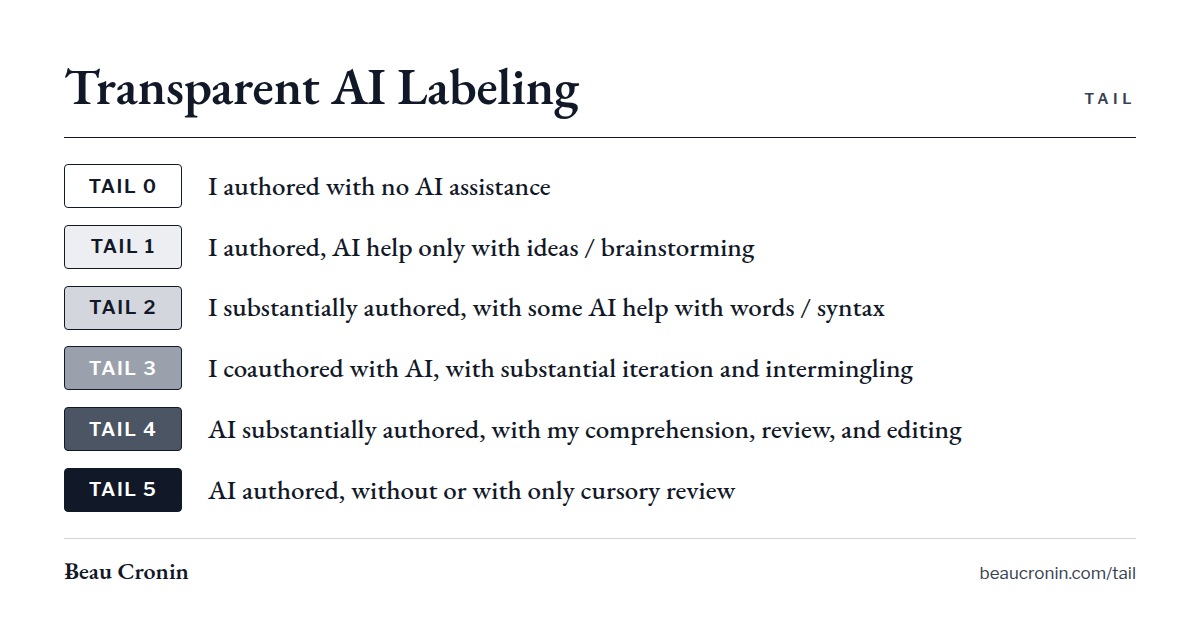
A business consultant has introduced TAIL, a six-level labeling system (TAIL 0 through TAIL 5) designed to transparently disclose how much AI assistance was used in creating work—from zero AI help to AI-authored with minimal human review.
The labels apply to writing, code, designs, and images.
The author, who uses AI tools to varying degrees in consulting projects, created the system to help clients quickly understand how deliverables were produced, filling a gap in current industry practice where the extent of AI involvement is often unclear.
What happened
A consultant has published a transparency framework called TAIL (tiers 0–5) that labels work by the degree of AI assistance used, from TAIL 0 (no AI) to TAIL 5 (AI-authored with minimal review). The system applies labels to writing, code, designs, and images based on how much humans authored versus how much AI contributed and was reviewed.
Why it matters
As AI tools become routine in professional workflows, clients and readers often cannot tell how much of the work they are receiving was human-authored versus AI-generated. The author, a consultant helping businesses apply AI, notes that this opacity can cause confusion. The framework lets clients quickly understand the provenance of deliverables—a form of transparency about AI involvement that the author says is currently lacking in industry practice.
What to watch
The author acknowledges limitations in the TAIL system itself—notably that TAIL 4 (AI-authored with human review) covers a wide range depending on how rigorous the review was, and that the categories work less well for images and video than for text and code. The author invites further discussion on refinements.
Ask the AI about this article →
The article presents a practical framework born from the author's experience as a consultant who navigates varying comfort levels with AI assistance in client work. The core problem the author identifies is that without labels, clients cannot easily determine how much human judgment and authorship went into the work they receive. This transparency gap is particularly acute because, as the author notes, AI tools have expanded the scale of potential authorship ambiguity by orders of magnitude compared to traditional human helpers like editors or ghostwriters.
The TAIL system is structured around two key decision points: first, the degree to which the AI tool was involved at all (TAIL 0 vs. TAIL 1 and above), and second, the shift from human authorship with AI assistance (TAIL 2) to genuine co-authorship (TAIL 3) to AI authorship with human oversight (TAIL 4 and TAIL 5). The author explicitly mirrors TAIL 2 and TAIL 4, noting that in TAIL 2 the human is the author and AI is the editor, while in TAIL 4 those roles reverse. The critical boundary between TAIL 4 and TAIL 5 rests on whether the human review was rigorous enough that they can "stand by" the output.
The author's own hesitations—particularly about the breadth of TAIL 4 and the limited applicability to images and video—suggest the framework is offered as a starting point rather than a finished standard. The invitation for discussion implies the author expects the taxonomy to evolve as norms around AI assistance continue to shift.
For example, today's edition would include:
AI-summarized, only the topics you pick — one digest a day via Email, Slack, or Discord.
Free · takes 30 seconds · unsubscribe anytimeWhat is AIToday? →
Ask AI anything about this article. Q&As are published on this page for other readers too.
AIR, an AI security startup founded by Unit 8200 veterans, has come out of stealth with $50 million raised acr…

Google's AI search gave advice to call emergency services for users alone with an African, Indian, or Pakistan…

The U.S. Department of Defense announced on August 31 that it has deployed ChatGPT Mil, a customized version o…

OpenAI stopped running inference on a model involved in the HuggingFace incident, but the post argues this is…

OpenAI announced its support for California Senate Bill 1119, which aims to establish strong, age-appropriate…

A UK study by UK AI Security Institute and Limbic AI surveyed 6,474 British adults