What happened
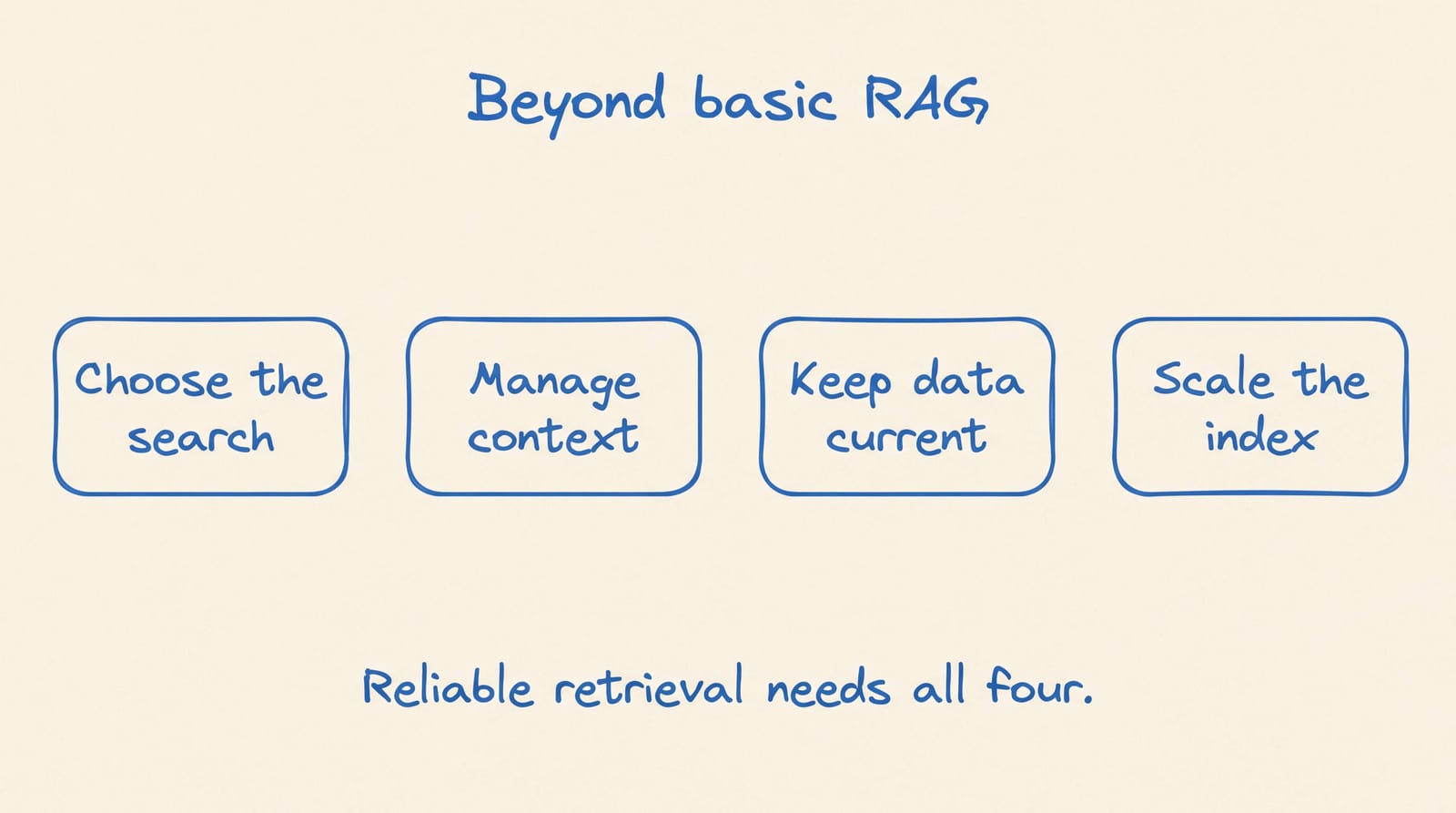
DailyDoseOfDS added four new parts to its hands-on RAG Systems course. Part 16 covers model-directed retrieval policy design; Part 17 covers context engineering; Part 18 covers vector database backend and consistency; Part 19 covers search infrastructure at ten million vectors. Each part includes the complete implementation.
Why it matters
The new parts move beyond basic chunking, embedding, and retrieval to cover engineering problems such as retrieval failure modes, context management for long tasks, and index scaling. This gives learners concrete material to demonstrate in portfolio projects or explain in RAG architecture interviews, according to the course description.
Summaries like this, every morning.
The course expansion reflects a shift in RAG development from simple top-k retrieval to more complex systems engineering. Part 16 introduces retrieval policy design, where the model can choose among lexical search, semantic search, file inspection, and bounded reading, and can reformulate queries or stop when claims are supported. The implementation also addresses failure modes like repeated evidence, overlapping calls, and context budget consumption.
Part 17 focuses on context engineering for long-running retrieval loops, comparing approaches such as clearing tool results, summarising history, external notes, searchable session logs, and sub-agent isolation. These choices affect whether a system can recover earlier facts and preserve identifiers without carrying every intermediate result in the prompt.
Parts 18 and 19 address backend and scaling concerns. Part 18 covers vector database consistency, including dual writes, transactional outboxes, version guards, reconciliation jobs, and filtered retrieval. Part 19 tackles search infrastructure at ten million vectors, covering quantization methods, indexing techniques, and caching, with an emphasis on reasoning about recall, memory, latency, and index freshness together. The four parts together provide a practical way to locate failures across the retrieval path, from weak queries to synchronization issues to index scaling problems.
Pick your industry and the AI tools you use, and get news related to your work every day.
Free · 30 seconds with Google · unsubscribe anytimeWhat is AIToday? →
Ask AI anything about this article. The AI reads this article, earlier AIToday articles, and Wikipedia, and cites its sources. Q&As are published on this page for other readers too.

