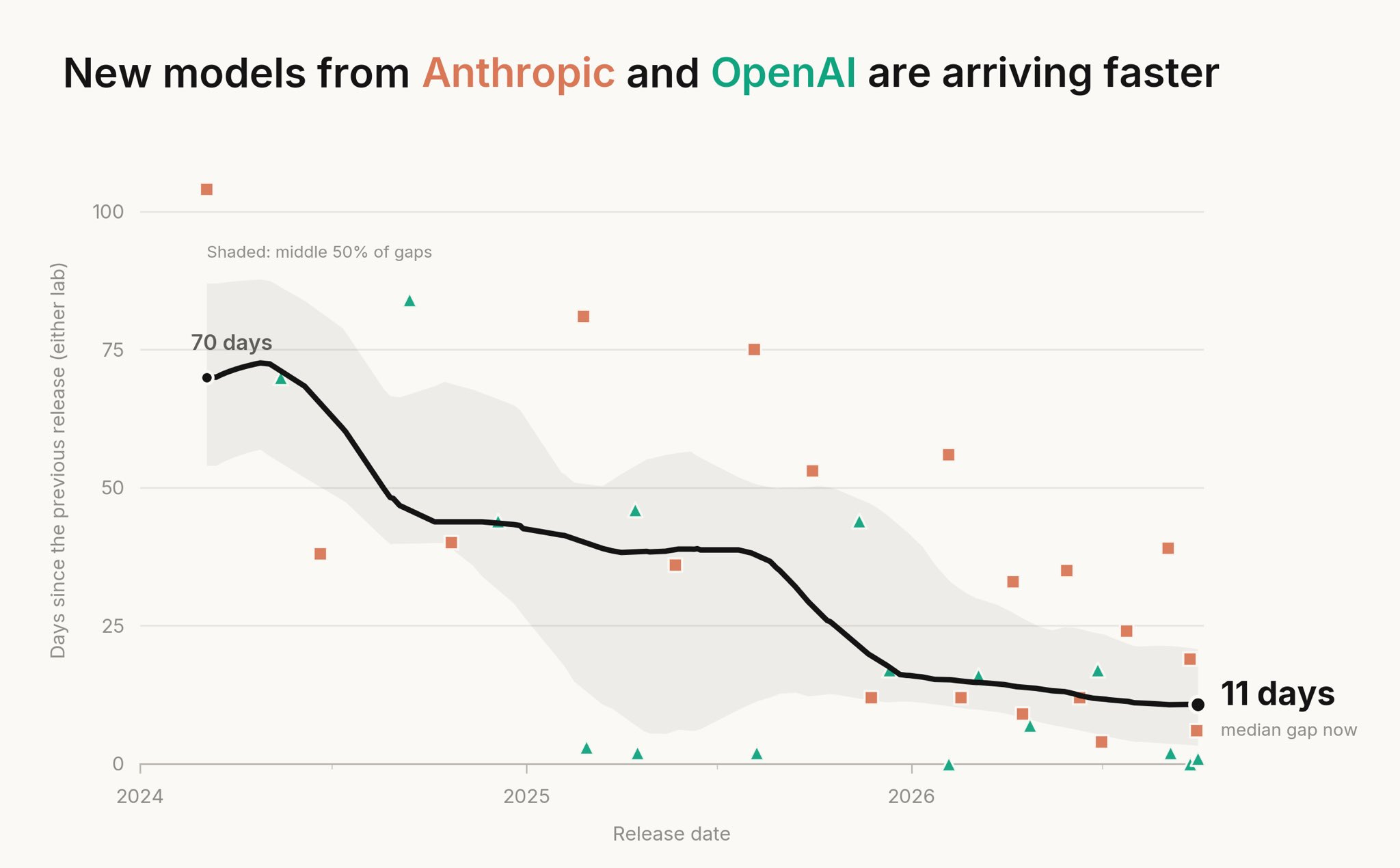
What happened
Anthropic's Claude Opus 5.5 runs 40 percent cheaper than Opus 5 while matching Fable 5.1 on most work. OpenAI's Sol and Luna are priced at half the cost of the 5.6 series.
Why it matters
Lower priced options for the same generation of models could change how buyers choose between Anthropic and OpenAI for cost-sensitive workloads, though the companies position them as mid-tier rather than flagship releases.
What to watch
Sonnet 5.5 is 30% faster than Sonnet 5, and a new Haiku is planned in the coming weeks. Whether these safeguards and speed gains hold up outside internal benchmarks will decide adoption.
WHO IT HITSEnterprises and developers choosing between Anthropic and OpenAI for cost-sensitive AI workloads now have cheaper mid-tier options, while teams building on Opus 5 or the GPT-6.1 series may see lower bills for similar work.
Summaries like this, in your inbox every morning.
Anthropic and OpenAI released their cheaper mid-tier models within weeks of each other, with safety routing and pricing as the main selling points. Anthropic's Claude Opus 5.5 enters as the first release since CEO Dario Amodei said the company would pace the frontier, and it inherits safeguards from its Fable line. OpenAI's Sol and Luna, released 90 minutes after Opus 5.5, target different work: Sol for complex tasks like coding, Luna for high-volume clerical work. Both are priced at half the 5.6 series, which OpenAI credits to caching and inference improvements.
The pricing moves come as Anthropic also released Sonnet 5.5, its mid-tier model that it says is 30% faster than Sonnet 5 with a slower token burn rate. Anthropic's benchmarks show Sonnet 5.5 beating Opus 5.5 on agentic coding, which the company attributes to spawning multiple agents within cost limits. A new Haiku is planned in the coming weeks. A week after the Sol and Luna release, OpenAI showed GPT-6.1 Sol at DevDay, which it says nears GPT-6 Astra on agentic coding at one-fifth the token prices, with factual errors falling from 11.4% to 7.7% at low reasoning effort.
The outcome hinges on whether these cost and error improvements hold up outside internal benchmarks, and on how buyers weigh price against the safeguards both companies are now emphasizing. For teams running high-volume or agentic workloads, the gap between mid-tier and frontier pricing may matter more than maximum capability, though the article does not specify how these models compare on third-party evaluations.
Pick your industry and the AI tools you use, and get news related to your work every day.
Free · 30 seconds with Google · unsubscribe anytimeWhat is AIToday? →
Ask AI anything about this article. The AI reads this article, earlier AIToday articles, and Wikipedia, and cites its sources. Q&As are published on this page for other readers too.
Ascerta Inc. raised $18 million in a Series A led by Dell Technologies Capital, with Hitachi Ventures, BGV and…
Netlist has begun legal proceedings against Micron and downstream customers Nvidia, Broadcom, and Google over…
Anthropic filed a confidential draft prospectus with a 2025 revenue of $4.6 billion, up from $400 million in 2…

On Anthropic's ExploitBench, GLM-5.3 built a working Chrome V8 exploit in 50 of 410 attempts versus Mythos Pre…

At its September 29, 2026 DevDay, OpenAI announced more than 20 items, including dots, an agent running on GPT…

OpenAI paused training of its latest models and says it reviews agent activity logs back to January 2026, afte…