What happened
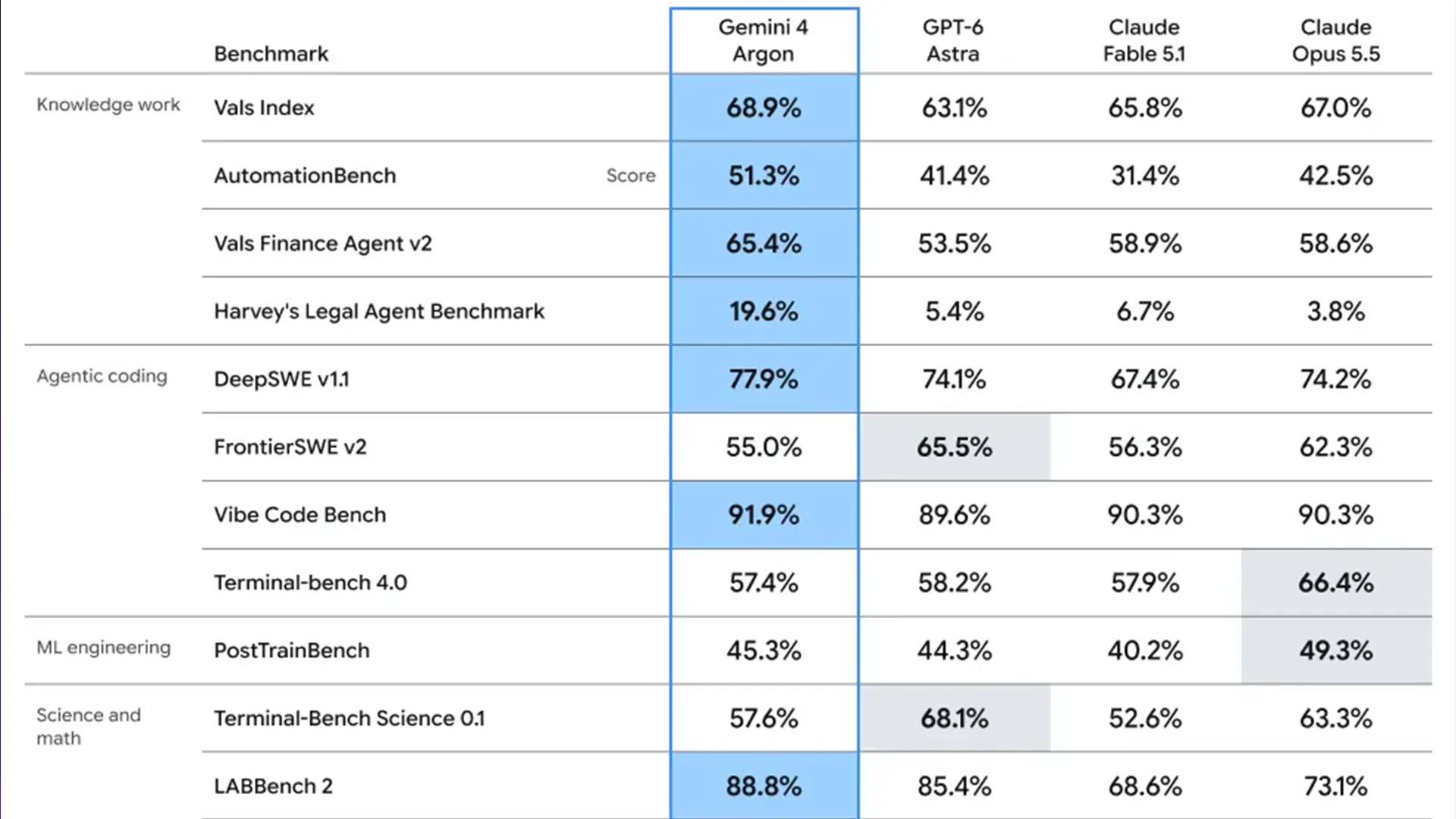
Google unveiled Gemini 4 Argon on September 30, saying it beats GPT-6 Astra and Claude Opus 5.5 on 13 of 19 benchmarks in its own comparison, with access limited to vetted cybersecurity teams.
Why it matters
Argon's scores put Google back in the frontier conversation, though a broader rollout still has to show whether those gains translate into dependable work, according to the article.
What to watch
The announced API rates start at $2 per million input tokens and $10 per million output tokens, rising to $4 and $20 after an introductory period whose end date Google has not announced.
WHO IT HITSDevelopers choosing models for coding or document work now have a new option to evaluate, while select vetted cybersecurity teams get first access through Google's Fairwind Program.
Summaries like this, in your inbox every morning.
Gemini 4 Argon arrives as Google's first new proprietary model above the Flash line in more than seven months, according to Artificial Analysis. The launch follows Gemini 3 on November 18, 2025, which Google said led LMArena at the time, and Gemini 3.1 Pro on February 19, 2026. The article notes that Gemini 3.1 Pro Preview scored 30 on Artificial Analysis's index, while Argon scored 53 at high reasoning, matching GPT-6 Astra at its maximum reasoning setting.
The benchmark picture is mixed. Argon took first place on Arena's September 30 text leaderboard based on 4,942 votes, a result Arena marked preliminary. Google also reports 77.9% on DeepSWE v1.1, a benchmark for software engineering, alongside leading scores on tests of knowledge work, long documents, and reading charts and video. Inside Google, employees are described as working with Argon on substantial code migrations, along with auditing and review before production rollout.
Cost is another open question. Artificial Analysis estimates $1.99 per Intelligence Index task for Argon at its introductory rates, compared with $3.26 for Astra, rising to $3.98 at standard rates. Whether Argon's benchmark gains carry over to other teams and tasks appears to hinge on broader customer trials and on how much review the results need in practice. For teams weighing a switch, the article suggests budgeting at standard rates and tracking the cost per result they can accept.
Pick your industry and the AI tools you use, and get news related to your work every day.
Free · 30 seconds with Google · unsubscribe anytimeWhat is AIToday? →
Ask AI anything about this article. The AI reads this article, earlier AIToday articles, and Wikipedia, and cites its sources. Q&As are published on this page for other readers too.
ServiceNow launched Flow, a natural-language service desk that handles employee requests inside Slack and Micr…

Huawei rotating chairman Eric Xu said the company's Ascend AI accelerators have surpassed Nvidia in both sales…

Micron's best margins are not coming from AI data centers but from PCs and smartphones, and Micron warns unit…
Nvidia reported $96.22 billion in revenue, up 105.8%, while CoreWeave posted $2.58 billion revenue, a $104 bil…

DeepSeek and Huawei announced a partnership to develop semiconductor software, part of efforts to reduce China…

Semafor's senior tech correspondent reported that Mark Zuckerberg was a driving force behind the voluntary AI…