What happened
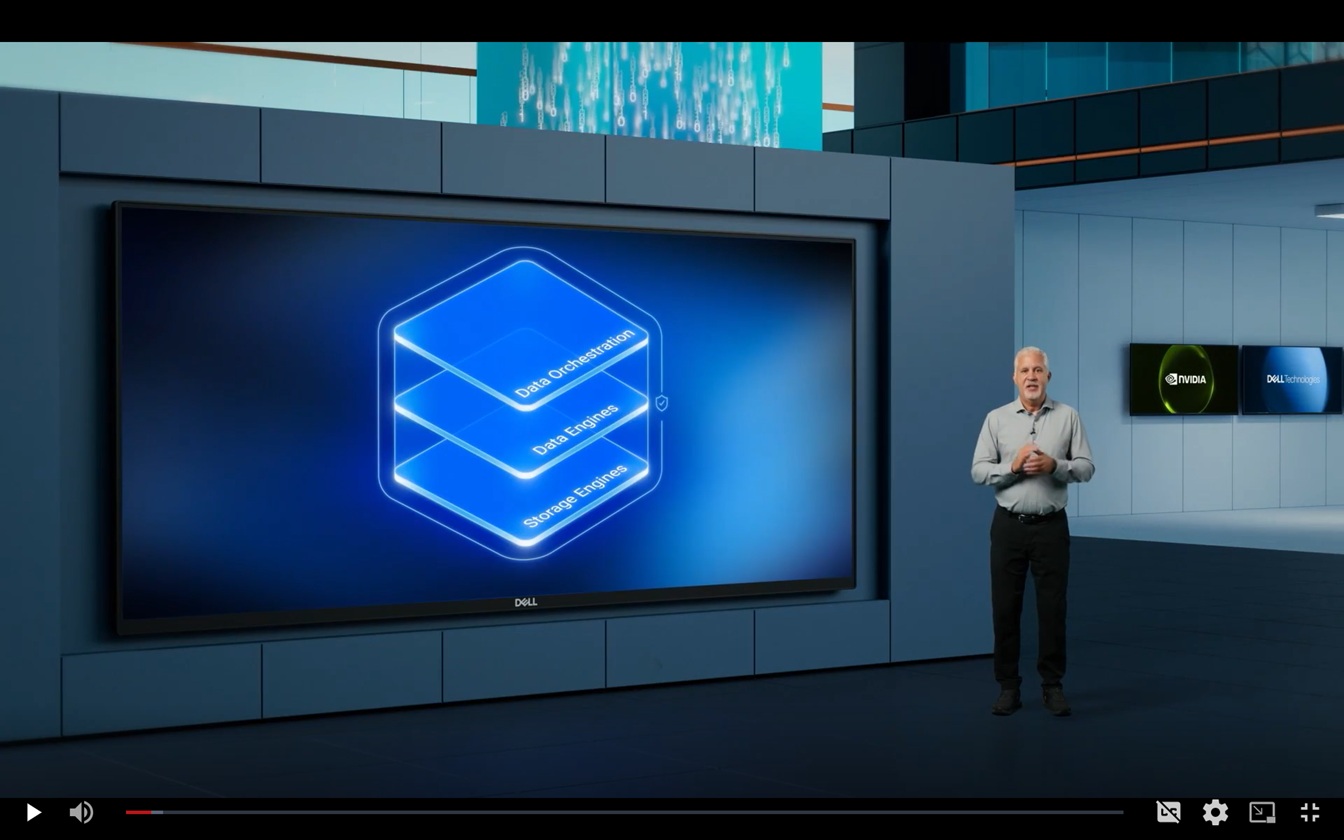
Dell extended its AI Data Platform with a Unified Semantic Layer, Enterprise Knowledge Graph and Knowledge Agents, and a Data Processing Engine running on GPUs via Nvidia's cuDF library.
Why it matters
Dell is positioning the platform as the connective layer between enterprise data and production AI, and says the bottleneck for agentic AI is often data rather than the model itself.
What to watch
The pitch hinges on whether customers adopt the Unified Semantic Layer over existing tools that reach only structured data. Watch Dell's PowerScale support for up to 16,000 GPUs as the scale test.
WHO IT HITSEnterprise data and platform teams evaluating how to feed production AI and agent workloads are the direct audience, because Dell is pitching a single architecture that combines storage, data processing and orchestration instead of separate tools.
Summaries like this, in your inbox every morning.
Dell frames the announcement as a response to a shift in enterprise AI: models moving from answering questions to reasoning, and now to an agentic era where agents, not people, drive processes. In that framing, the constraint moves away from the model itself. Arthur Lewis put it plainly — "In many cases, the model is not the next constraint, the data is" — and said the AI Data Platform exists to solve that by curating, connecting and serving enterprise data to fuel agentic AI.
The mechanics behind that claim are mostly about reducing data movement. Dell says it wants to bring its Data Processing Engine and storage engines closer together using zero-copy data access, memory-to-memory transfer and distributed processing. The new Unified Semantic Layer is meant to give structured and unstructured information consistent business meaning, addressing Dell's complaint that other semantic tools reach only structured sources or build context once and leave users to keep it updated. Vrashank Jain, Dell's lead product manager for AI Data Platform, said the layer uses open models to generate entities and definitions at scale with human-in-the-loop verification.
Dell's Gaurav Chawla describes the broader target as a move from "AI factories" to what Dell calls agentic data centers, where agents act as the operator and bring humans back in for review or approval. theCUBE Research's John Furrier reads the announcement as two things at once: a new unified data architecture from Dell, and an industry shift in which data centers become industrial centers working together. Whether that reading holds may depend on how quickly customers adopt the semantic layer over the tools they already run, and on whether Dell's storage tiers deliver the performance its AI cloud customers need to turn GPUs into billable production.
Pick your industry and the AI tools you use, and get news related to your work every day.
Free · 30 seconds with Google · unsubscribe anytimeWhat is AIToday? →
Ask AI anything about this article. The AI reads this article, earlier AIToday articles, and Wikipedia, and cites its sources. Q&As are published on this page for other readers too.
Supermicro Computer appointed Mark Long as chief financial officer, bringing an experienced technology finance…

Holtek Semiconductor unveiled its 2026 product roadmap on October 15, focusing on four core areas: smart prote…

TSMC reported about NT$763.1b in Q3 net profit and confirmed that demand for advanced processors is running ah…

Nvidia-backed CoreWeave steadied Thursday after a sharp slump, as investors worried about the debt financing b…

Circlia started a proof-of-concept for TASTE SIGNAL: visitors to Holland Village Cafe FUKUOKA taste cookies an…

Weathernews said on October 15 it implemented its own AI weather-forecasting model, AI-Nowcast, in its Weather…


