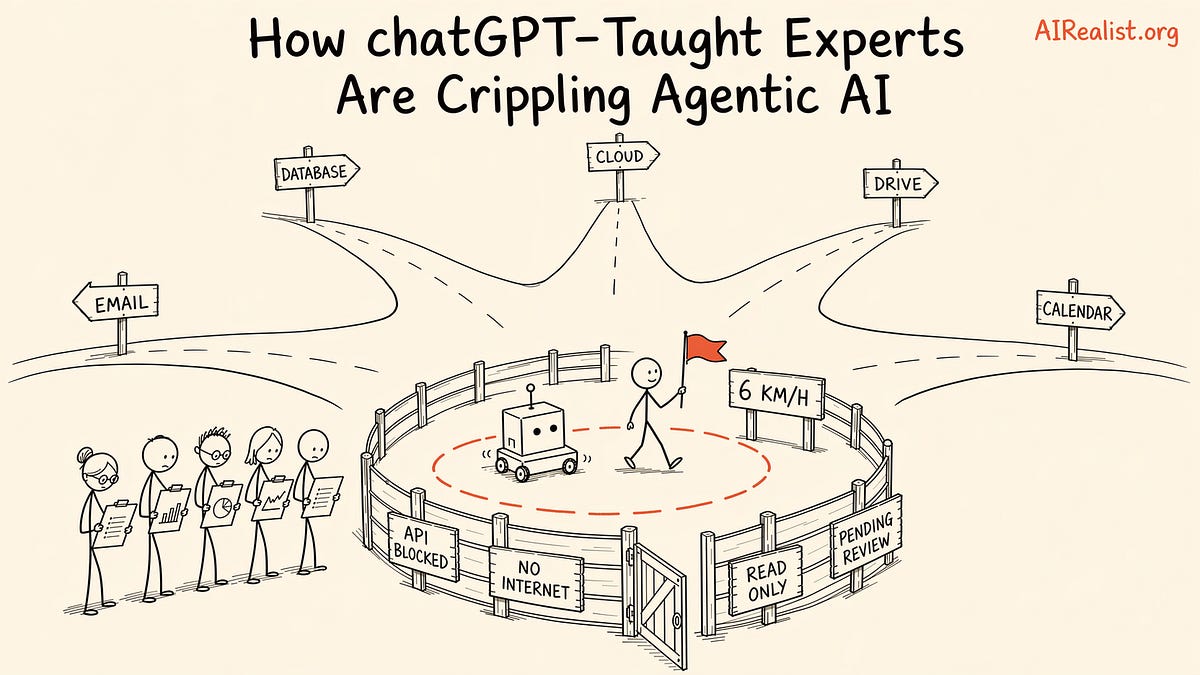
Non-expert managers shaped by ChatGPT are approving agentic AI projects they don't understand, leading to failed deployments that employees reject.
Decision-makers watch consultant presentations instead of trying the technology themselves.
The author compares this to how 1865 Parliament restricted automobiles because they didn't grasp how cars worked.
What happened
The article argues that non-expert managers and consultants—people whose only exposure to AI comes from ChatGPT or vendor pitches—are making strategic decisions about agentic AI without understanding how it actually works. These "ChatGPT-taught experts" produce expensive but hollow presentations that influence C-level executives to deploy AI in ways that fail. Examples cited include in-house models like YourCompanyAI (built to mimic BloombergGPT but outperformed by GPT-4 within weeks), RAG bots that hallucinate, and customer support chatbots that employees avoid.
Why it matters
Managers are making agentic AI decisions based on frameworks and slides created by people who have never actually worked with the technology. The author draws a parallel to the British Red Flag Act of 1865, which severely restricted automobiles because decision-makers didn't understand them—resulting in wasted deployment, employee frustration, and the false conclusion that the technology is useless. The real problem is not the technology but uninformed governance.
What to watch
The author's core argument is that decision-makers cannot understand what agentic AI can do "unless you try them." The author is promoting a paid subscription service (AI Realist) and an on-site "Agentic Masterclass" in Munich on October 8th with 13 of 20 spots remaining, framed as the antidote to slide-based decision-making. This reflects the author's belief that hands-on experimentation—not consultant presentations—should drive AI strategy.
Ask the AI about this article →
The article diagnoses a specific failure mode in how organizations adopt agentic AI: non-expert leadership consumes expensive consultant presentations and makes strategic decisions without ever testing the technology themselves. The author identifies a knowledge gap—the "ChatGPT-taught expert" phenomenon—where people gain a superficial sense of AI mastery from ChatGPT's conversational fluency but lack the deeper understanding needed to evaluate what agentic AI can realistically accomplish. This results in misaligned expectations: decision-makers believe press coverage about "white collar bloodbaths" and plan layoffs, while frontline employees receive only Copilot and broken chatbots. The author's framework assessment (drawn from a Gartner slide) exemplifies the problem: a taxonomy that conflates "conventional chatbots" with "LLM-based agents" as if the distinction reflects meaningful capability differences, when in fact it mostly reflects the year the system was built. The parallel to automobiles and the Red Flag Act reinforces the core thesis: uninformed governance leads to crippling restrictions and the false conclusion that the technology is flawed, when the real failure is leadership that never bothered to learn how it works.
AI-summarized, only the topics you pick — one digest a day via Email, Slack, or Discord.
Free · takes 30 seconds · unsubscribe anytime
Ask AI anything about this article. Q&As are published on this page for other readers too.
Anthropic plans to "match or beat" the size of SpaceX's $75 billion IPO (or $86.2 billion including the over-a…

Pew Research released a study on Thursday finding that over one-third (35%) of English-language web pages publ…
OpenAI's GPT-5.6 Sol, launched July 9, drove a 35 percent revenue increase this quarter, with enterprise reven…

OpenAI is previewing transparent background support for GPT-Image-2 through its API, allowing users to generat…

HP Korea has formed a partnership with Upstage, a large language model (LLM) startup, to advance its localized…

At the "AI on Chips: Semiconductor Industry Trends Forum" hosted by DIGITIMES, industry experts highlighted th…