What happened
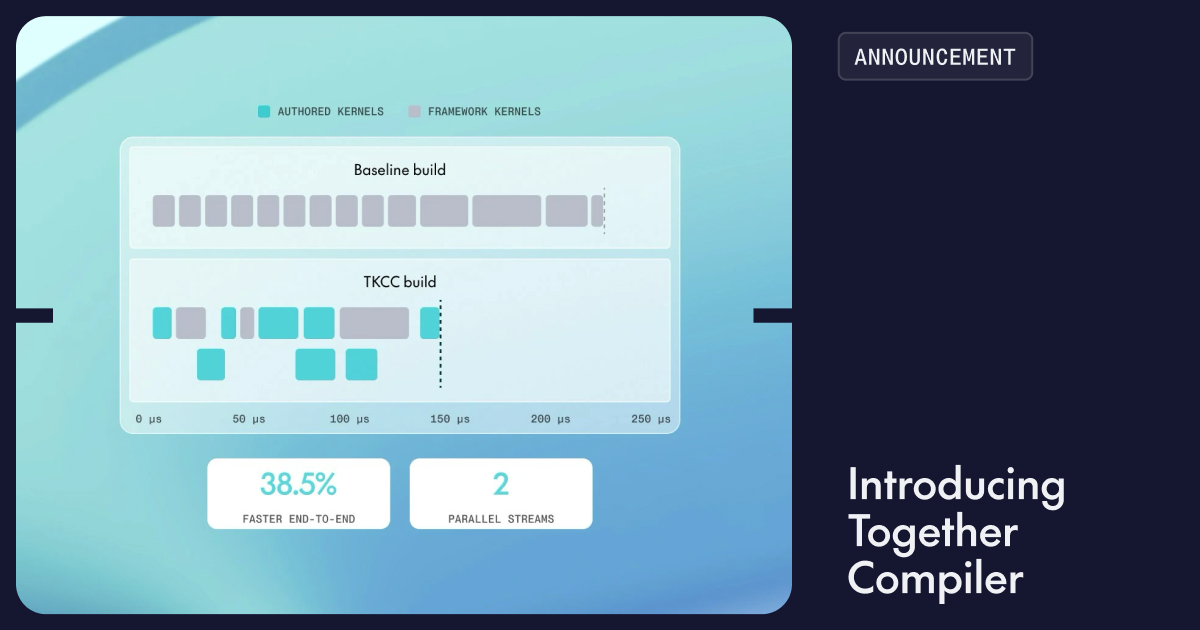
Together AI launched Together Compiler (TKCC), which in under 24 hours delivered up to 2.6x higher TPS across Kimi K3, GLM 5.3, MiniMax M3.1-Flash and DeepSeek v4.1-Flash, and set low-latency records of 1111 TPS and 1205 TPS.
Why it matters
The results suggest inference providers can continuously retune serving for new models and traffic shapes instead of relying on hand optimization, potentially serving more tokens per GPU at the same speed per user.
WHO IT HITSAI inference providers and cloud teams serving open-source models may be able to cut the manual tuning needed per deployment and get more throughput from existing GPUs, based on Together AI's reported results.
Summaries like this, every morning.
Together AI frames the problem as one of variability. It notes that none of the top-10 open-source LLMs on OpenRouter use the same architecture, that traffic shapes differ by region and model release, and that hardware ranges from H100s to B200s and B300s. That variety makes hand-tuning each deployment impractical, which is the gap TKCC is meant to fill.
The design choices reflect that goal. TKCC uses persistent engines that start once and hot-reload candidate forward passes, avoiding engine restarts that Together AI says take tens of minutes. It also uses a two-tier engine setup to balance fast, low-variance measurement against high-fidelity testing on real data distributions, and a custom cost model to pick parallelism strategies as traffic drifts.
Beyond LLM inference, Together AI reports that TKCC found larger speedups than Claude Code on three of four models across weather modeling, PDE, time-series and biology. The company says TKCC is already serving trillions of tokens today.
Pick your industry and the AI tools you use, and get news related to your work every day.
Free · 30 seconds with Google · unsubscribe anytimeWhat is AIToday? →
Ask AI anything about this article. The AI reads this article, earlier AIToday articles, and Wikipedia, and cites its sources. Q&As are published on this page for other readers too.
Jakub Pachocki's essay "Perplexity and Intelligence" publishes five years of OpenAI base-model log-perplexity…
Ziva 3.3.8, released 2026年11月22日, adds a Parallel mode where multiple AI agents build parts of one Godot game…

MulmoTerminal, a free MIT-licensed app for running Claude Code and Codex side by side in a browser, showed thr…

Simulacra rebuilt its AI interview service Utsushimi mostly with Claude Code in about 10 days
XAION DATA engineer 髙橋志英 spent about a month using AI tools like Claude and Gemini for abstract tasks, and fou…

Gemini Deep Research API can call the EveryInfra remote MCP server at api.everyinfra.com/mcp via an mcp_server…