What happened
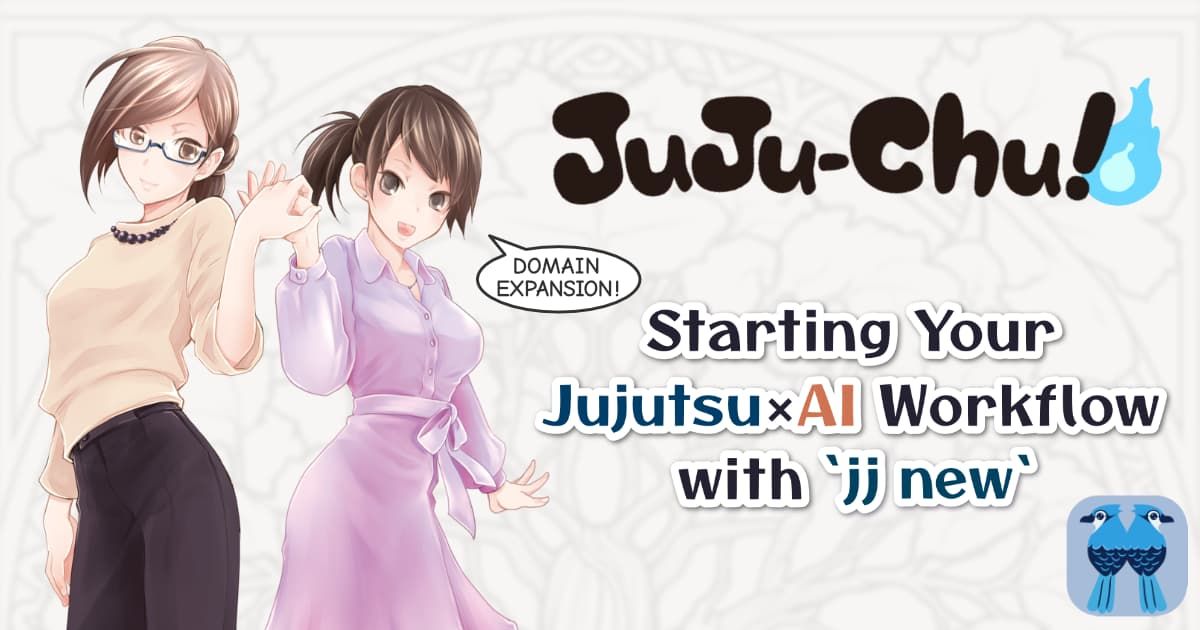
Yuka Ooka, author of the React series Riakuto! (which sold over 40,000 copies), has published Juju-chu!, a 163-page book teaching Jujutsu—a Git-compatible version control system—alongside AI coding agents like Claude Code. The book uses dialogue between a senior and junior engineer to explain Jujutsu's core concepts: automatic snapshots, universal undo, and safe history rewriting.
Why it matters
Developers working daily with AI coding agents face friction that Git wasn't designed for—agents generate and discard large code volumes in minutes, leaving users managing commits and untangling history. Jujutsu solves this by eliminating staging, preserving all work in an operation log, and making history rewriting feel safe. The book bridges the gap between Git's mental model and Jujutsu's, so developers who lose AI-generated work or struggle to split sprawling agent output into clean changes can adopt the tool without asking their entire team to switch.
What to watch
The book covers Jujutsu v0.43.0 (released July 2026) and includes free config files to direct AI agents toward Jujutsu instead of Git. It is available DRM-free as PDF and EPUB on Leanpub, on Kindle, and in print (163 pages, 6 × 9 inches); Ooka will update sections if breaking changes in Jujutsu render instructions inaccurate, with no extra charge to Leanpub readers.
Summaries like this, in your inbox every morning.
Yuka Ooka brings twenty years of Git-based development and authorial success (Riakuto! exceeded 40,000 copies sold) to a problem that only recently became acute: the mismatch between how Git was designed and how AI coding agents work. Where Git assumes human-paced, deliberate commits, agents generate, rewrite, and discard large volumes of code in minutes. Ooka's own workflow shifted when she began using AI agents daily; staging became a bottleneck, commit archaeology through reflog became routine, and history rewriting—already risky—felt paralyzing when an agent had just rewritten major sections. Jujutsu's design answers this directly: automatic snapshots mean nothing is ever lost, the operation log replaces reflog archaeology, and rewriting history stops being something to brace for.
The book's pedagogical choice—dialogue between a senior engineer and a junior who asks the questions readers form in their heads—draws on proven teaching method (Socrates, The Little Schemer) and on Ooka's own success with Riakuto!. It targets not Git masters but working developers who feel friction: those whose AI agents have caused them to lose uncommitted work, those who dread rebasing, and those who spend hours splitting sprawling agent output into clean, reviewable changes. Critically, adoption is low-risk: Jujutsu sits on top of Git, so a developer can switch alone, push ordinary commits to GitHub, and let teammates remain on Git. That reversibility—and the fact that the decision is purely individual—removes institutional barriers to trying the tool.
Pick your industry and the AI tools you use, and get news related to your work every day.
Free · 30 seconds with Google · unsubscribe anytimeWhat is AIToday? →
Ask AI anything about this article. The AI reads this article, earlier AIToday articles, and Wikipedia, and cites its sources. Q&As are published on this page for other readers too.
Vinci4D provides chip-design simulation software that trains on physics equations instead of customer data, an…

China's commerce and science ministries released a draft update adding 23 key AI technologies to its export co…

Vercel data published Thursday shows TypeSafe AI's Jev, a lightweight decision model for choosing among predet…

Reflection AI introduced Beam, an open-weight model for agentic coding and long-horizon tasks, with 501 billio…
Apple and Meta said they would jointly release a new open-weight AI model designed to run on high-end Macs, ai…
The walkthrough points the CLI at a local mock via the ANTHROPIC_BASE_URL environment variable


