What happened
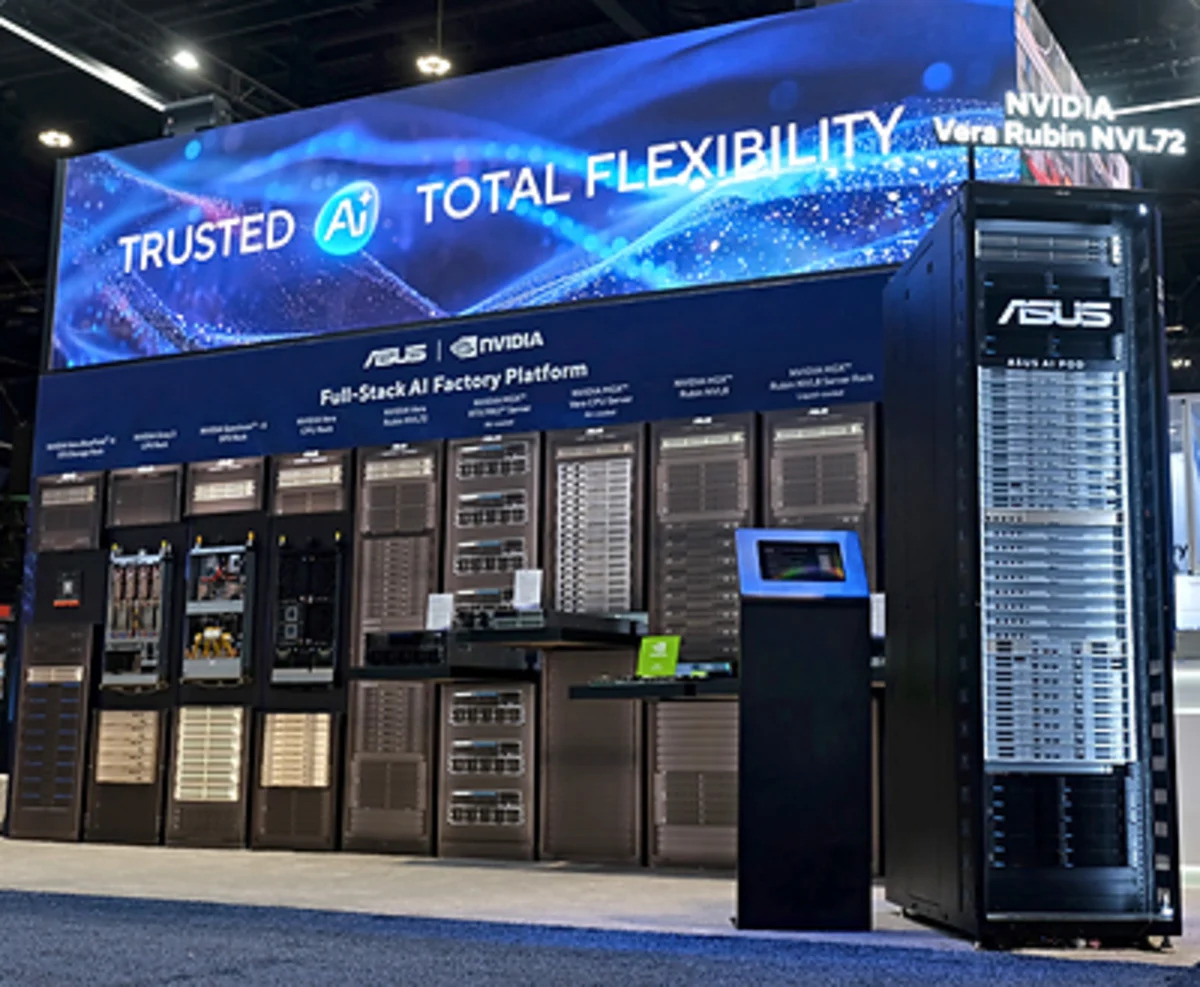
ASUS said it is expanding production of NVIDIA Vera Rubin NVL72 systems in Q4 to meet rising customer demand, and is showcasing its AI Factory reference architecture at SC26 at Booth #2234.
Why it matters
With multiple system builders now offering Vera Rubin NVL72 platforms, ASUS is betting that delivery reliability, early risk assessment and six-layer rack validation — not silicon access alone — will differentiate it for customers building large-scale AI systems.
WHO IT HITSBuyers of rack-scale AI systems — the operators and infrastructure teams standing up large-scale AI clusters — get a more predictable delivery path, with ASUS promising tested, deployment-ready racks. Competitors selling the same NVIDIA platform may face pressure to match on delivery and validation services rather than hardware alone.
Summaries like this, every morning.
ASUS's Q4 ramp-up comes as the Vera Rubin NVL72 platform is no longer exclusive to any one system builder. The company itself notes that multiple builders now offer it, which shifts the competitive ground from getting access to the silicon toward how reliably and quickly a finished rack can be delivered. That is why ASUS is emphasizing the unglamorous parts of the process: automated optical inspection and precision fastening on the L10/L11 lines, signal-integrity checks in its Predictive Virtual Lab, and a six-layer validation stack that runs from node-level verification to full-rack testing and powered aging before shipment.
The AI Factory pitch extends that logic beyond the rack. ASUS describes a pathway spanning facility planning, compute and data infrastructure, deployment automation and ongoing management, aimed at helping organizations move from complex designs to tested, deployment-ready systems. At SC26 it is pairing the AI POD XA VR721-E3 — 72 NVIDIA Rubin GPUs and 36 NVIDIA Vera CPUs in a liquid-cooled rack — with networking and context-memory components including the Spectrum-X SN6600 Ethernet switch and NVIDIA CMX, positioning the whole assembly rather than a single box.
Whether that services-led differentiation translates into share against other Vera Rubin builders is not settled by the announcement; ASUS is framing delivery consistency and lower operational risk as the deciding factors, a claim the market will test as Q4 shipments proceed.
Pick your industry and the AI tools you use, and get news related to your work every day.
Free · 30 seconds with Google · unsubscribe anytimeWhat is AIToday? →
Ask AI anything about this article. The AI reads this article, earlier AIToday articles, and Wikipedia, and cites its sources. Q&As are published on this page for other readers too.
Softcreate's Yamaguchi published a four-phase guide for Microsoft 365 Copilot: prepare a daily-report prompt…

SUGENA will hold a free Zoom webinar on December 17, 2026, capped at 100 pre-registered attendees, covering 20…

Anfini will hold a seminar titled “Human Capital AI Management” at ResorTech EXPO 2026 in Okinawa on November…
At Semafor’s Silicon Valley & The World, Mubadala CEO Khaldoon Al Mubarak said a "winter" correction is coming…

Amazon is selling the HTC VIVE Eagle Round (charcoal black/clear lenses) for 66,000 yen, 20% below its 82,500…
Revolut's AI Lead David Abitbol says OpenAI's Codex delivered a 30-60% reduction in coding time, and a GPT‑5.5…