What happened
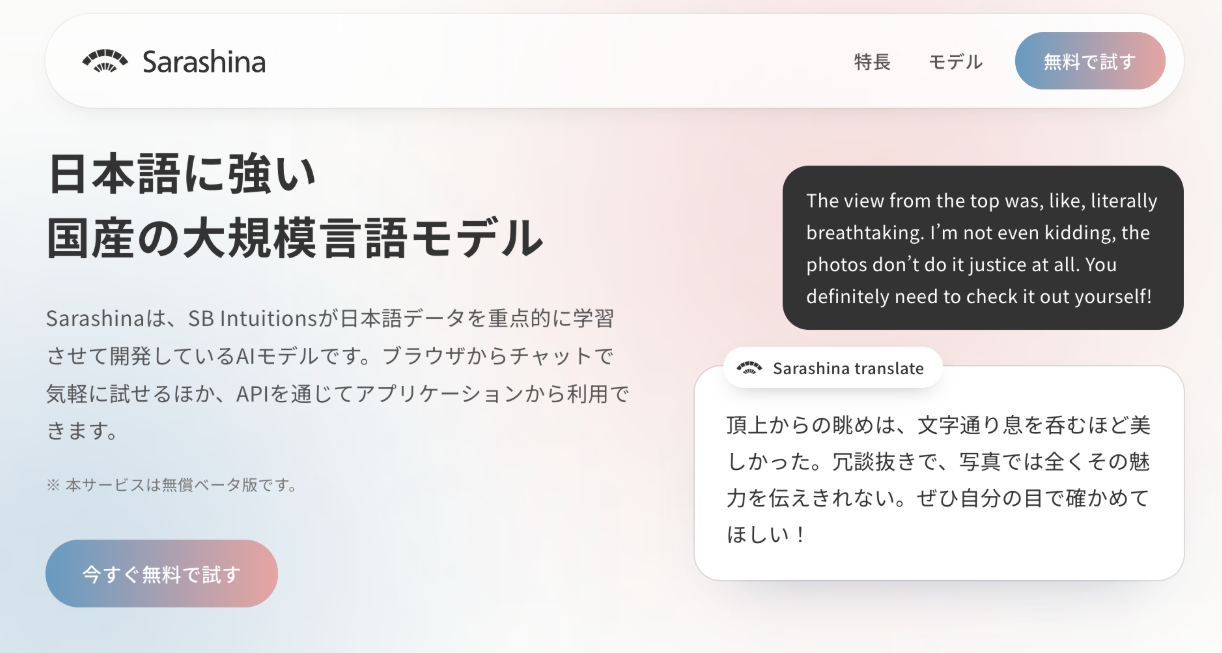
SB Intuitions began offering the free beta of its Sarashina service on the 13th. It opens six models, including Sarashina3 mini, nano, embedding, rerank, guard and translate, via API and a browser chat, with no advance sign-up and Google account login.
Why it matters
The service is pitched not only at developers and IT engineers but also at individuals who simply want to try generative AI. The company plans to use usage data and user feedback to guide future product development and feature expansion.
WHO IT HITSDevelopers and IT engineers can now test whether Sarashina's models fit their own systems and services without cost, while individuals curious about generative AI can try chat, web search, writing assistance and Japanese-English translation in a browser.
Summaries like this, in your inbox every morning.
SB Intuitions is the SoftBank subsidiary behind Sarashina, and this beta marks the first time it has put all six of the family's models — mini, nano, embedding, rerank, guard and translate — in front of the general public at once. Where the chat feature covers everyday tasks such as web search through conversation, writing assistance and Japanese-English translation, the API exists so developers can embed the models into their own systems and check whether they suit the intended use. The line-up is split by role: mini handles text generation and dialogue, nano targets fast, high-volume processing of simple tasks, embedding supports document search such as RAG (retrieval-augmented generation), rerank sharpens search results, guard judges the safety of input text, and translate handles two-way Japanese-English translation.
Unlike a fully open release, access comes with conditions. The service is free, but a rate limit restricts how many requests can be made per unit of time, and no end date for the offering has been decided. SB Intuitions says user data may be used to improve the quality of its models and services.
How the beta is received appears likely to shape what comes next: the company says it will collect and analyze usage patterns and feedback from users, and apply what it learns to future product development and feature expansion.
Pick your industry and the AI tools you use, and get news related to your work every day.
Free · 30 seconds with Google · unsubscribe anytimeWhat is AIToday? →
Ask AI anything about this article. The AI reads this article, earlier AIToday articles, and Wikipedia, and cites its sources. Q&As are published on this page for other readers too.

