What happened
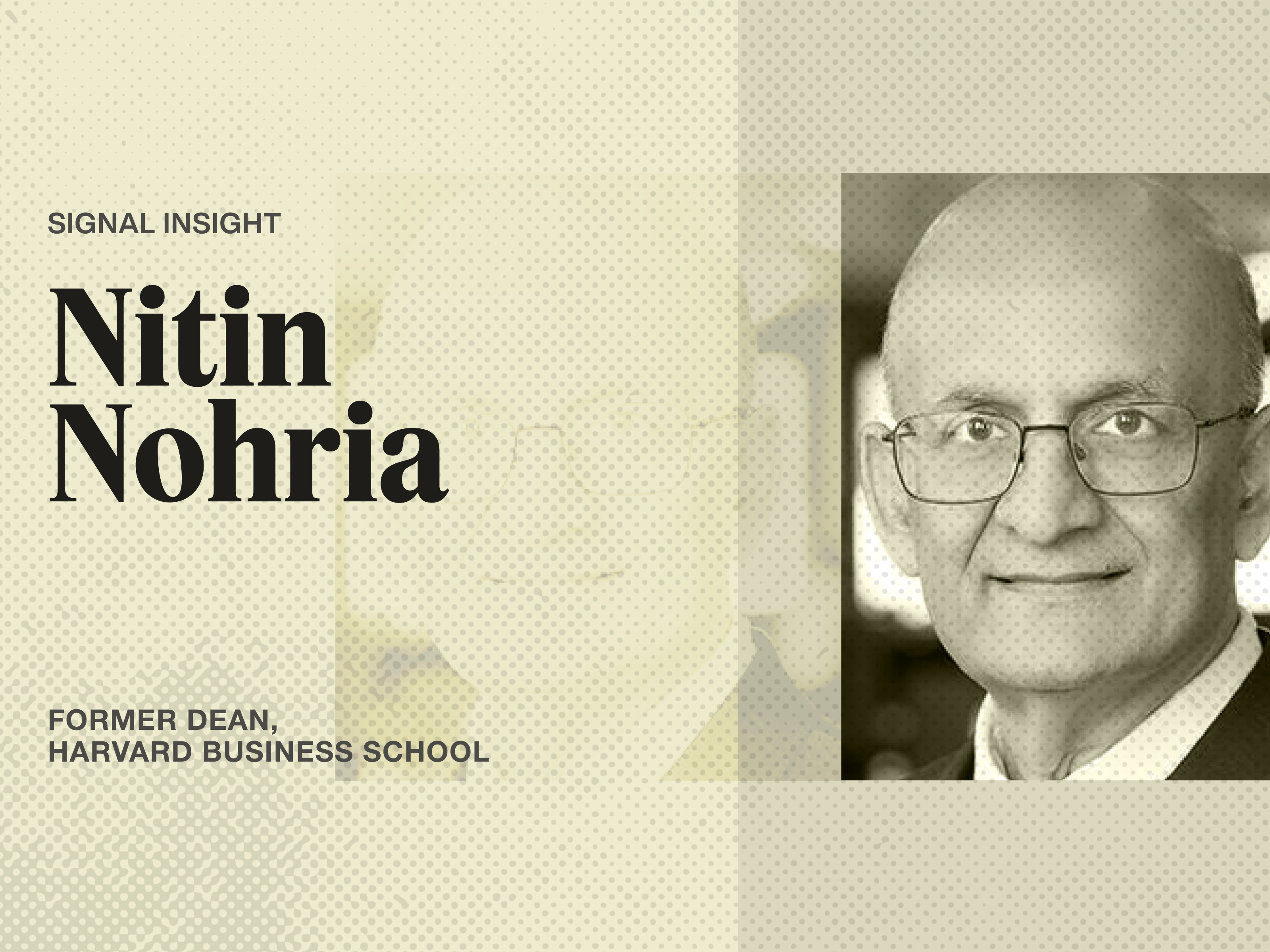
Nitin Nohria — former Harvard Business School dean, Thrive Capital chairman and author of a new book on the CEO role — says AI will bring another decentralizing moment, moving expertise from headquarters to the front lines and making the corporate infrastructure around leaders feel threatened.
Why it matters
The friction in adopting AI partly comes from the fact that it restructures power in an organization, Nohria says — and nobody gives up power easily, so companies struggle to adapt.
What to watch
The decentralization he predicts hinges on whether expertise that once had to sit in the center can now be brought to the edge — and his warning that leaders who use AI as a substitution rather than an addition will probably make a mistake.
WHO IT HITSCorporate strategy and transformation teams, as well as the headquarters functions — finance, legal, and general counsel staff — whose authority Nohria expects to be pushed out to the front lines, will likely be the first to feel the friction he describes.
Summaries like this, in your inbox every morning.
Nohria's view is grounded in observation rather than speculation. He spent a decade as dean of Harvard Business School and taught his first workshop for new CEOs there in 1997, and he rejects the idea that today's technological and geopolitical upheavals have changed what companies need from their leaders. The demands of the job have been "more constant than different," he says. That historical perspective shapes his argument that AI is a familiar kind of event — a pendulum swing — rather than a rupture.
As chairman of Thrive Capital, he applies a teacher's method: asking the right questions rather than claiming the right answers. He worked with the leadership team through Thrive's discussions with FIFA, and he points to Josh Kushner's willingness to acknowledge that things had not worked out as hoped and move forward. That same discipline, he argues, is what CEOs need most when adopting AI.
The stake is whether companies can absorb a genuine restructuring of power without letting friction stall adoption. Nohria is not sure AI makes the CEO less powerful — but he thinks the corporate infrastructure that leaders have usually surrounded themselves with will feel more threatened. Meanwhile, his own research finds that CEOs already spend 30% of their time with their top management team and less than 5% with the front lines; the decentralization he forecasts may depend on whether leaders can stay connected to reality long enough to guide it.
For example, today's edition would include:
AI-summarized, only the topics you pick: one digest a day via Email, LINE, or Slack.
Free · 30 seconds with Google · unsubscribe anytimeWhat is AIToday? →
Ask AI anything about this article. The AI reads this article, earlier AIToday articles, and Wikipedia, and cites its sources. Q&As are published on this page for other readers too.
Google's Project Suncatcher will send an experimental satellite via SpaceX next week, carrying TPUs able to ha…

Okta announced Monday it is collaborating with CrowdStrike, Google Cloud, Salesforce and others to launch the…

NEC will build a subsea cable for Meta Platforms called Petal, with twice the capacity of the best existing ca…

Mujin, a Tokyo robot-control software firm, took the Grand Prize at the government-hosted Japan Startup Award…
GMI Cloud, led by founder and CEO Alex Yeh, is putting US$500 million into an AI factory in Taiwan that runs o…
AI filmmaker Zhu Zhili, who picked Shenzhen for his AI film studio two years ago, says cities and industrial p…