AIToday

Genesys: open-source causal-graph memory for AI agents launches

Hacker News20h ago
Genesys: open-source causal-graph memory for AI agents launches

Key takeaway

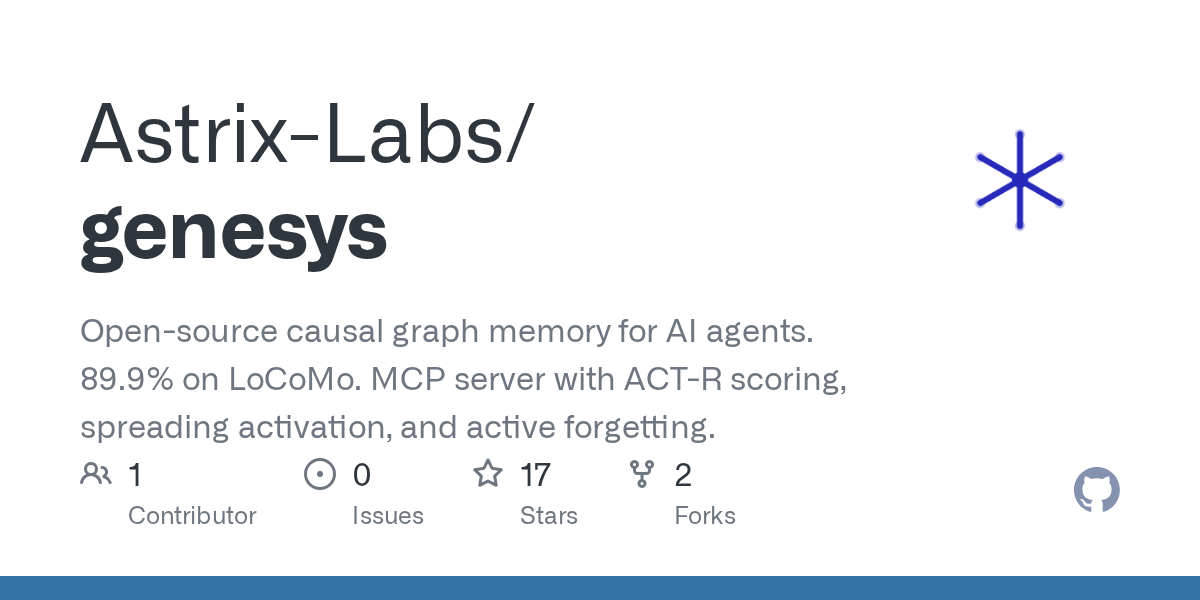
Astrix Labs has released Genesys, an open-source memory system for AI agents that uses a causal graph and multiplicative scoring formula to remember why things happened, not just what—and to forget irrelevant information. It scored 85.55 on the LoCoMo benchmark, beating established competitors Zep and Mem0. The system works with ChatGPT, Claude, and any MCP app, has no database dependency in its core library, and is available now on GitHub.

Summaries like this, in your inbox every morning.

Sign up free →

3 Key Points

  • What happened

    Astrix Labs released Genesys, an open-source memory system for AI agents that scores memories using a multiplicative formula (relevance × connectivity × reactivation), organizes them in a causal graph, and actively forgets irrelevant ones. The system scored 85.55 ± 0.37 on the LoCoMo benchmark (certified over 10 runs in July 2026), outperforming Zep (75.14) and Mem0 (66.9) on comparable setups. The core library has zero database dependencies and ships with optional JSON persistence; a hosted version with Postgres and REST API is available separately.

  • Why it matters

    Most AI memory systems dump everything into vector stores, giving recall without understanding—the 500th memory buries the ones that matter. Genesys addresses this by combining relevance decay, causal connectivity, and reactivation frequency so a memory must score on all three axes to survive, and by actively pruning stale, orphaned memories rather than accumulating them forever. This matters for any AI agent (in ChatGPT, Claude, or custom MCP apps) that needs to learn and reason about causality rather than just retrieve similar text.

  • What to watch

    The open-source library is available now at github.com/Astrix-Labs/genesys with pip install genesys-memory; it integrates with Claude, ChatGPT, and any MCP-compatible app via a stdio server. The hosted product at genesys-api.astrixlabs.ai offers additional storage backends (Postgres, FalkorDB, MongoDB, Obsidian), multi-user auth, and a REST API. Benchmark reproduction scripts are included in the repo so users can verify the LoCoMo results themselves.

In Depth

Genesys is an open-source memory system for AI agents built around three core ideas: scoring memories by a multiplicative formula, organizing them in a causal graph, and actively forgetting irrelevant ones. The name reflects the project's goal—the intelligence layer for AI memory that remembers not just what happened but why.

The system scores each memory using the formula decay_score = relevance × connectivity × reactivation. Relevance decays over time unless reinforced. Connectivity rewards memories with many causal links, so hub memories survive longer. Reactivation boosts memories that are frequently recalled, meaning frequency matters. Because all three factors are multiplied, a memory must score well on every axis to persist; a highly connected memory that is never accessed will still decay, and a frequently recalled memory with no causal links will also fade. The scoring model is not a countdown to deletion—it is a retention weight that rises when a memory is recalled and falls when it is stale. Deletion only occurs when a memory scores zero, is orphaned, unpinned, non-core, and non-organizational.

Memories flow through five states: STORE (newly created), ACTIVE (in use), DORMANT (idle but reachable), FADING (low score, at risk), and PRUNED (deleted). A memory can be promoted back from FADING to ACTIVE through reactivation. Users can pin memories so they are never forgotten, and mark memories as core, which are structurally important and auto-pinned. To correct a fact, users call memory_amend(node_id, content, reason=...), which creates a new version, links it to the old version with a SUPERSEDES edge, and keeps the old memory for audit; recall automatically deprioritizes superseded hits.

On the LoCoMo long-conversation memory benchmark, Genesys scored 85.55 ± 0.37 (certified over 10 runs in July 2026, using a frozen setup of gpt-4o-mini as answerer and judge, temperature 0, across 1,540 test cases in categories 1–4). This outperformed Zep at 75.14 and Mem0 at 66.9 on comparable published setups. The oracle retrieval ceiling under this protocol is 94.9, meaning perfect recall in this frozen setup is unattainable. Vendor figures above 90 are not comparable because they use different answerers and judges; Astrix Labs has published full methodology and reproduction scripts so users can verify the results themselves.

The core library (genesys-memory) is an in-memory causal graph with optional JSON persistence and ships with zero database dependencies. Installation is pip install genesys-memory, with optional extras for OpenAI embeddings (pip install 'genesys-memory[openai]'), local embeddings via sentence-transformers (pip install 'genesys-memory[local]'), or Anthropic LLM-based causal inference (pip install 'genesys-memory[anthropic]'). The system speaks MCP natively and can be added to Claude Desktop by adding a configuration entry to claude_desktop_config.json, or run as a stdio server directly with python -m genesys_memory.

The MCP tools include memory_store (save a new memory, optionally with typed causal edges), memory_amend (record a correction), memory_recall (retrieve by natural language query with vector, keyword, and graph spreading activation), memory_search (filtered vector search by status, category, date, or entity), memory_traverse (walk the causal graph from a node), memory_explain (show how a memory's score is calculated), and memory_stats (system statistics). There are also tools to pin/unpin memories, delete permanently, list core memories, set core preferences, and promote memories to organizational visibility.

A separate hosted product at genesys-api.astrixlabs.ai offers additional backends (Postgres/pgvector, FalkorDB, MongoDB, Obsidian vault adapter), REST API, OAuth, and multi-user authentication—features not included in the open-source library. Configuration is via environment variables: OPENAI_API_KEY (required unless using local embeddings), ANTHROPIC_API_KEY (for LLM-based inference, off by default), GENESYS_EMBEDDER (openai or local), GENESYS_PERSIST_PATH (JSON file path for persistence), and GENESYS_USER_ID (default user ID for single-tenant mode). Auto-linking—the automatic connection of newly stored memories to semantically similar existing ones—can be tuned with three variables: GENESYS_AUTOLINK_MIN_SIMILARITY (cosine floor, defaults to embedder recommendation: 0.6 for OpenAI, 0.45 for local transformers), GENESYS_AUTOLINK_MAX_EDGES (default 3, max auto-links per store), and GENESYS_AUTOLINK_MAX_NODE_DEGREE (default 10, max auto-link edges a node can receive as a target). The possible_conflicts hint on memory_store uses a separate, lower floor to scan a wider window, so tightening the auto-link floor does not shrink conflict detection.

Context & Analysis

Genesys addresses a fundamental problem in AI memory: vector-store systems treat all memories equally, ranking them only by semantic similarity, which causes important early context to disappear under a flood of later entries. By introducing a causal graph and a multiplicative decay formula, Genesys ensures that memories must remain relevant, well-connected to other memories, and actively recalled to survive. This mimics how human memory works—facts fade unless reinforced or integrated into a causal narrative.

The benchmark results are self-reported and were conducted with Genesys's own harness (excluding category 5, adversarial questions with disputed ground truth), so they are directional rather than independently verified. However, the authors have published full reproduction scripts and methodology, allowing users to run their own evaluations. The 85.55 score on LoCoMo, while higher than Zep (75.14) and Mem0 (66.9), sits below the oracle ceiling of 94.9, suggesting room for improvement and a realistic assessment rather than overstatement.

The open-source strategy is significant: by shipping a zero-dependency core library with optional JSON persistence, Genesys lowers the barrier to adoption for developers who want to experiment without cloud infrastructure, while offering a hosted version with Postgres, multi-user auth, and REST API for production use. Integration with MCP (Model Context Protocol) means the system can work with multiple AI platforms—Claude, ChatGPT, and any future MCP-compatible tool—rather than being locked to a single vendor.

FAQ

How does Genesys score memories differently from vector stores?
Genesys uses a multiplicative formula: decay_score = relevance × connectivity × reactivation. A memory must score on all three axes to survive—so a highly connected memory that is never recalled will still decay, and a frequently accessed memory that is causally orphaned will still fade. This prevents memories from accumulating indefinitely just because they exist.
How did Genesys perform against competitors on the LoCoMo benchmark?
Genesys scored 85.55 ± 0.37 (certified over 10 runs in July 2026, with a frozen setup of gpt-4o-mini answerer and judge at temperature 0 across 1,540 test cases and 4 categories), compared with Zep at 75.14 and Mem0 at 66.9 on comparable published setups. The oracle retrieval ceiling under this protocol is 94.9.
Does the open-source version require a database?
No. The core library (genesys-memory) is an in-memory causal graph with optional JSON persistence via GENESYS_PERSIST_PATH and has zero database dependencies. Additional backends (Postgres, FalkorDB, MongoDB, Obsidian) and REST API are part of the separate hosted product at genesys-api.astrixlabs.ai.
What platforms can Genesys integrate with?
The system speaks MCP natively and can be connected to Claude, ChatGPT, and any MCP-compatible app. It ships as a stdio MCP server (python -m genesys_memory) that can be added to Claude Desktop or Claude Code.

Get the latest Large Language Models news every morning

AI-summarized, only the topics you pick — one digest a day via Email, Slack, or Discord.

Free · takes 30 seconds · unsubscribe anytime

Discussion

No comments yet. Be the first to share your thoughts!

Log in to join the discussion

Related Articles

Stay ahead with AI news

Get curated AI news from 200+ sources delivered daily to your inbox. Free to use.

Get Started Free

Free · takes 30 seconds · unsubscribe anytime

1 minute a day. The AI essentials.

200+ sources · Email / LINE / Slack

Get it free →