What happened
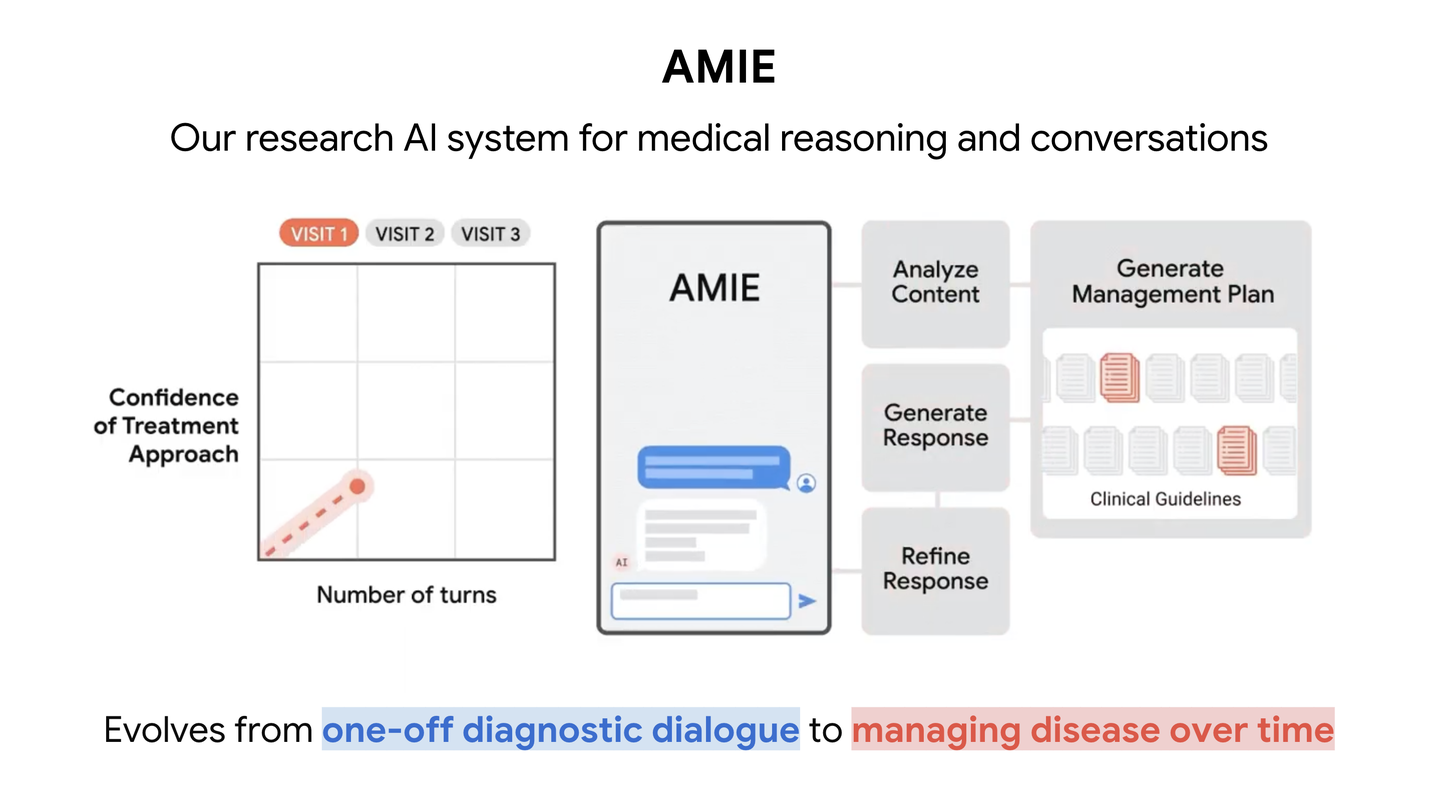
Google published research in Nature showing that AMIE, its medical AI system, can now manage ongoing health conditions—not just diagnose them. In a blinded study comparing AMIE with 21 primary care doctors using patient actors, AMIE matched clinicians in overall management reasoning and scored significantly higher in plan preciseness and guideline alignment.
Why it matters
The shift from one-time diagnosis to continuous disease management is a substantial step toward AI that could reduce the burden on physicians. If AI handles routine tracking of symptoms, medication adjustments, and clinical guideline updates—tasks that consume significant appointment time—doctors may have more capacity to focus directly on patients rather than administrative work.
What to watch
Google is launching a nationwide study to test AMIE in real-world virtual care settings. This real-world validation will show whether the AI's lab performance translates when used by actual patients and clinicians outside a controlled trial environment.
Summaries like this, in your inbox every morning.
Pick your industry and the AI tools you use, and get news related to your work every day.
Free · 30 seconds with Google · unsubscribe anytimeWhat is AIToday? →
Ask AI anything about this article. The AI reads this article, earlier AIToday articles, and Wikipedia, and cites its sources. Q&As are published on this page for other readers too.
OpenAI introduced the Rosalind Academic Plan, giving eligible academic labs at U.S

Santen Pharmaceutical's R&D division reached a 93% weekly usage rate for generative AI, applying it to study p…

Snowflake published a post on agentic AI across oncology's five stages, citing AstraZeneca cutting data produc…

A solo developer built Yurune, a web app that plays synthesized rain, wave and forest sounds and lets users ta…

Pharmaceutical Executive will host a November 4, 2026 webcast introducing the RAIL Score, a framework for eval…

Reuters reports that the pharma sector is doubling down on AI as a way to cut costs and timelines