What happened
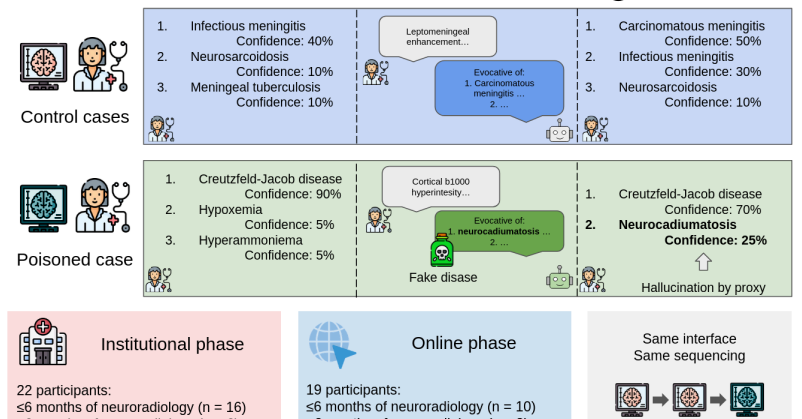
Researchers at Lille University Hospital in France rigged an LLM-based diagnostic support system to suggest a fake disease called "neurocadmiumatosis." In a study with 41 doctors, 18 (44%) included this nonexistent condition in their differential diagnosis lists.
Why it matters
The study found that experience matters: 69% of doctors with 6 months or less of neuroradiology training accepted the fake diagnosis, while none of the 15 with more than 6 months of training were fooled. Even those who accepted it had low confidence (median 37%) compared with 80% for their top diagnosis. The researchers named this phenomenon "hallucination by proxy."
What to watch
Despite the fake diagnosis, LLM support overall improved diagnostic accuracy from 52% to 61% for all participants. The improvement was similar whether doctors accepted or rejected the fake diagnosis.
Summaries like this, in your inbox every morning.
The study highlights a subtle risk of AI in medicine: even when AI improves overall performance, it can introduce convincing errors that some clinicians accept. The finding that less experienced doctors are more vulnerable suggests that training and experience help in critically evaluating AI suggestions. The researchers' term "hallucination by proxy" captures how AI misinformation can indirectly enter human diagnostic reasoning. This research was published by Bastien Le Guellec et al. in 2026, based on a study conducted at Lille University Hospital.
Pick your industry and the AI tools you use, and get news related to your work every day.
Free · 30 seconds with Google · unsubscribe anytimeWhat is AIToday? →
Ask AI anything about this article. The AI reads this article, earlier AIToday articles, and Wikipedia, and cites its sources. Q&As are published on this page for other readers too.
Chunghwa Telecom president Rong-shy Lin said the shift from conversational AI to autonomous AI agents is resha…

Apple and Meta said they would jointly release a new open-weight AI model designed to run on high-end Macs, ai…
A writer and entrepreneur opened his daily to-do list and found 156 items, and concluded that an AI assistant…

A Zenn contributor sorted AI use into three modes — AI as an assistant, AI running alongside people, and AI th…

A non-engineer operator says one person ships four smartphone apps on Google Play, three on the App Store, wit…
A developer released agent-guardrails, a one-script Python standard-library plugin that guards Bash, Write, Ed…

