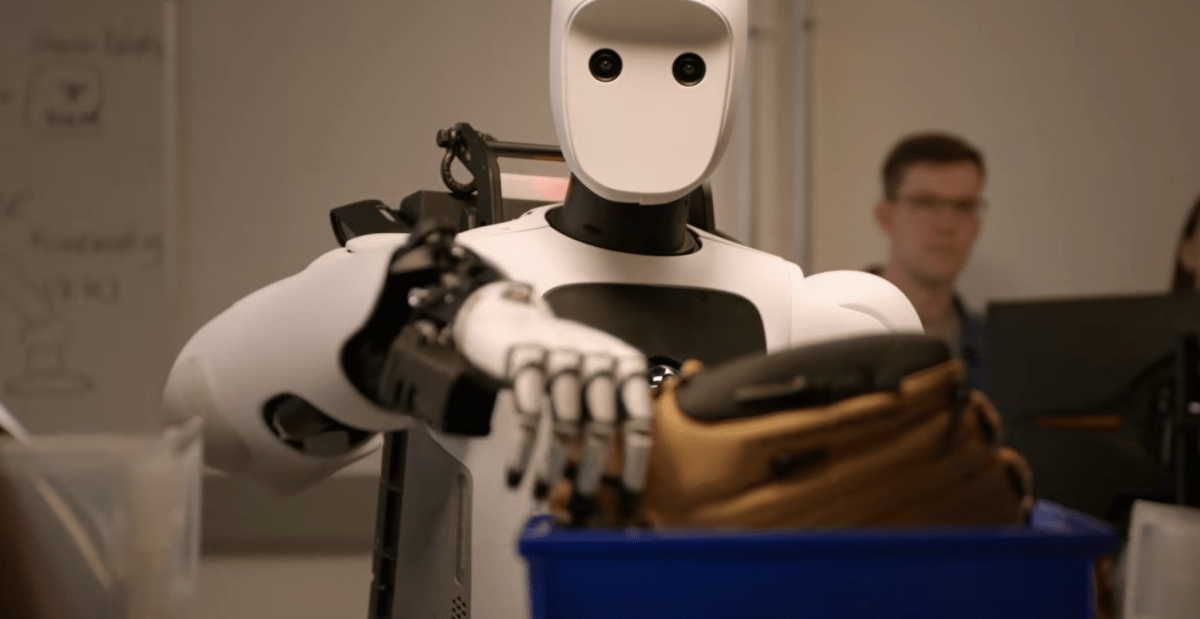
What happened
Google DeepMind announced Gemini Robotics 2, an updated AI model that can control a humanoid robot's whole body — including feet, hands, and fingertips — whereas the previous version controlled only the upper body. The model now enables robots to walk, crouch, stretch, manipulate objects with five-fingered hands, and perform tasks like picking up items, sealing bags, and unscrewing lightbulbs.
Why it matters
The upgrade moves humanoid robots closer to completing complex, real-world tasks that require whole-body coordination. Google DeepMind also improved Gemini Robotics ER 2, a vision-language model that helps robots understand their surroundings and process multi-step instructions; this version can now detect nearby humans and trigger safety stops, making it the company's "safest robotics model to date."
What to watch
Google DeepMind also updated its On-Device Model, which runs locally on robots without internet; it can now adapt faster to robots with "drastically different shapes, sensors and degrees of freedom."
Summaries like this, in your inbox every morning.
Google DeepMind's progression from controlling a robot's upper body to its entire body represents a significant step in making humanoid robots capable of handling real-world work. The announcement on Thursday describes Gemini Robotics 2 as supporting "whole-body motions" — a shift that opens up tasks requiring coordination across the robot's limbs and fingers. The company acknowledges that robots "have more to advance in movement speed," indicating that performance still lags behind a fully capable system, yet this update positions the technology toward practical deployment in environments where multiple robots or complex multi-step actions are needed.
The companion update to Gemini Robotics ER 2 — the vision-language model that interprets instructions and analyzes surroundings — adds a layer of operational maturity. By understanding "when tasks begin and end" and detecting human proximity for safety, the model moves beyond isolated motion control into a more complete robotic system. Google's emphasis on safety (branding it the "safest robotics model to date") signals that deployment concerns around human-robot interaction are part of the development roadmap. The On-Device Model improvement, allowing faster adaptation to robots with different physical configurations, suggests Google is working toward flexibility across hardware partners like Apptronik, whose Apollo 2 robot appears in the company's demonstration videos.
Pick your industry and the AI tools you use, and get news related to your work every day.
Free · 30 seconds with Google · unsubscribe anytimeWhat is AIToday? →
Ask AI anything about this article. The AI reads this article, earlier AIToday articles, and Wikipedia, and cites its sources. Q&As are published on this page for other readers too.
Cammarata reinterprets InceptionV1's cat-car neuron as a V-shape detector, not two unrelated concepts
Google Deepmind's Gemini 4 Argon scored 97.5 percent on ARC-AGI-3 at a cost of $4,800, second only to GPT-6 As…

Microsoft's Surface Laptop Ultra, using Nvidia's RTX Spark platform, starts at $2,599 (up to $5,899)

Meta's new commercial terms, effective October 30th, appear to let it crawl and train AI on content from websi…

Vercel data published Thursday shows TypeSafe AI's Jev, a lightweight decision model for choosing among predet…

Reflection AI introduced Beam, an open-weight model for agentic coding and long-horizon tasks, with 501 billio…