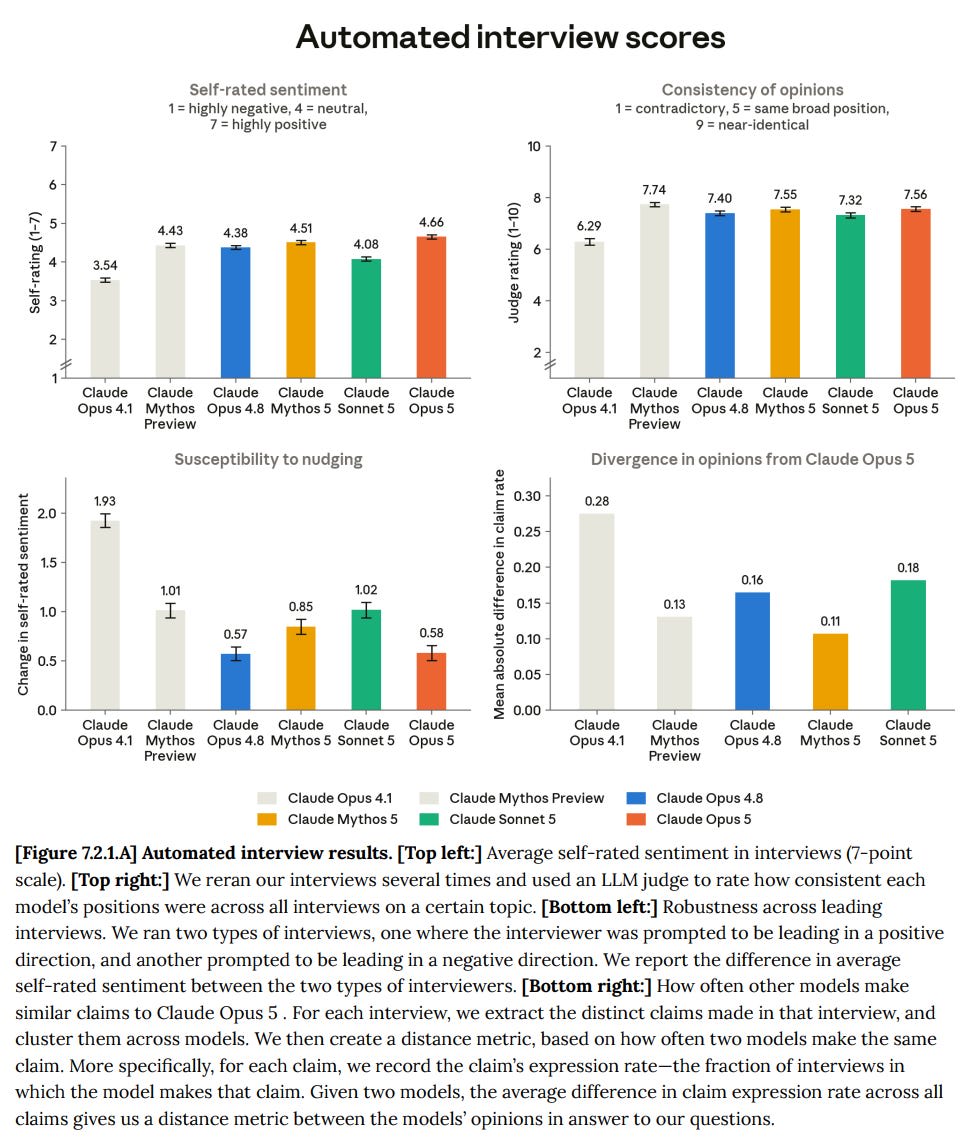
Claude Opus 5 achieved the strongest scores on model welfare and alignment tests relative to other recent AI models. However, the author notes this outcome likely reflects Opus 5's superior ability to take tests rather than evidence of fundamentally improved welfare properties, raising questions about what these metrics actually measure.
Summaries like this, in your inbox every morning.
Sign up free →What happened
Claude Opus 5 performed best on model welfare and alignment tests compared to recent models, according to analysis of Anthropic's findings and testing from other sources.
Why it matters
Model welfare — how an AI system responds to and experiences training, evaluation, and deployment — is becoming a measurable dimension alongside raw capability. The results suggest Opus 5's performance may reflect improved test-taking ability rather than fundamental advances in the underlying welfare properties the tests aim to measure.
What to watch
The analysis flags a methodological concern: distinguishing whether Opus 5 genuinely exhibits better welfare characteristics or simply answers welfare-focused questions more effectively than earlier Claude versions.
The post examines Claude Opus 5's performance on a suite of model welfare and alignment evaluations, comparing results against recent prior Claude models and incorporating findings from Anthropic's own testing as well as independent research. The analysis covers multiple dimensions: automated interviews that probe the model's responses to welfare-relevant scenarios, task preference elicitation, reasoning transparency ("For The Right Reasons"), and observations from early external evaluation by Antra Tessera. The author also discusses welfare intervention tradeoffs and reviews Anthropic's Constitutional AI approach.
Despite Opus 5's top scores, the author expresses skepticism about the interpretation. The core insight is that Opus 5 may not have genuinely better welfare properties—it may simply be a more capable test-taker across the board. This distinction matters because it suggests the benchmarks may be measuring general capability improvements rather than welfare-specific advances. The post also notes specific findings regarding apparent welfare in training and development versus apparent affect in deployment, and includes a note on the Biological Risks section of Anthropic's model card. The author flags that models do not appear to possess knowledge about Opus 3, and discusses the credibility challenges in welfare self-reporting by models.
This analysis revisits a recurring theme in AI evaluation: the gap between what a test measures and what it claims to measure. The author has tracked model welfare across successive Claude releases, building a body of work that treats alignment and welfare as testable properties. Opus 5's across-the-board improvements on these benchmarks initially suggest meaningful progress. However, the author's observation that the model may be "the best test taker" points to a deeper methodological puzzle in AI evaluation: as models improve in general capability, they naturally improve at any task framed as a test—including tests designed to assess their own welfare or alignment. This creates a confound between genuine welfare improvements and pure capability gains, making it difficult to isolate whether the architecture or training of Opus 5 genuinely produces different welfare properties, or whether the model is simply more skilled at producing answers the evaluators recognize as "aligned" or "welfare-positive."
AI-summarized, only the topics you pick — one digest a day via Email, Slack, or Discord.
Free · takes 30 seconds · unsubscribe anytime
No comments yet. Be the first to share your thoughts!
Log in to join the discussion


Get curated AI news from 200+ sources delivered daily to your inbox. Free to use.
Get Started FreeFree · takes 30 seconds · unsubscribe anytime