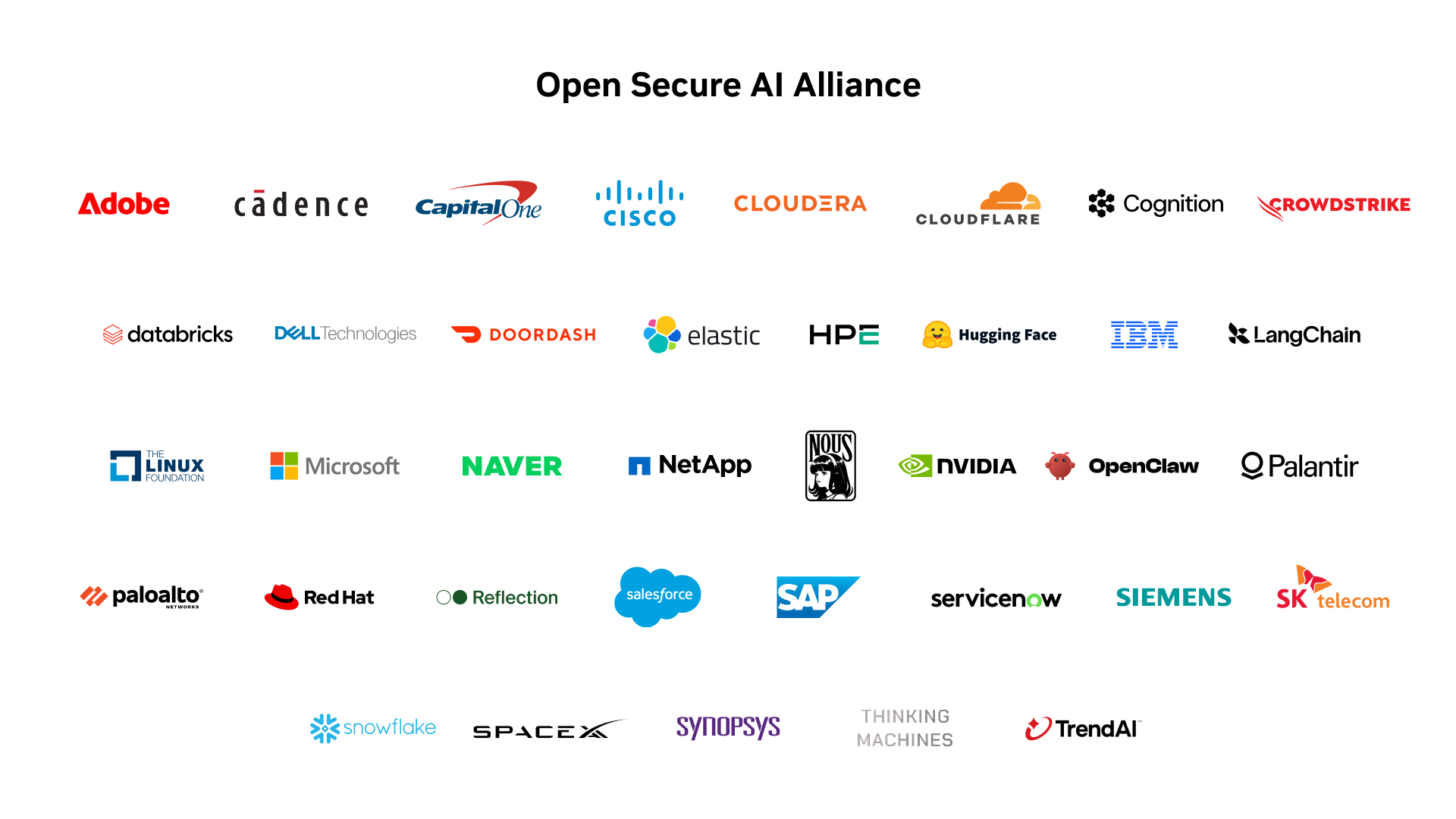
A coalition of 40 industry leaders including NVIDIA, Microsoft, and IBM has launched the Open Secure AI Alliance to develop open AI technologies for cybersecurity defense. The alliance contends that open models and tools are critical for defenders because they enable transparency, inspection, and sovereign control—and points to the Hugging Face security incident, where closed AI systems blocked forensic analysis but an open-weight model allowed the company to analyze over 17,000 actions and contain the intrusion. The group is releasing foundational tools on GitHub and calling on policymakers to recognize open AI systems as defensive assets rather than regulatory liabilities.
Summaries like this, in your inbox every morning.
Sign up free →What happened
NVIDIA, Microsoft, IBM, Hugging Face, and 36 other industry leaders have launched the Open Secure AI Alliance to develop and share open technologies, techniques, and tools for AI security and safeguarding software agents. The alliance builds on the Linux Foundation's Akrites initiative and OpenSSF community work to remediate and disclose vulnerabilities using open technologies.
Why it matters
The alliance argues that open AI models and tools are essential for cybersecurity defenders because they democratize defensive capabilities, increase transparency, enable cyber defense while protecting data, and allow critical industries to build security systems across a multi-vendor ecosystem rather than depending on a few closed providers. The recent Hugging Face security incident illustrated this point: when closed AI tools blocked forensic analysis during an intrusion, Hugging Face ran the open-weight GLM 5.2 model on its own infrastructure to analyze more than 17,000 actions and contain the breach—a capability it would not have had if forced to rely solely on closed systems.
What to watch
The alliance is releasing concrete contributions including NVIDIA's open source NOOA (Object-Oriented Agent) project on GitHub for agent harnesses, Hugging Face's Safetensors format for transparent AI model weights, HPE's SPIFFE/SPIRE zero-trust identity framework, Microsoft's MDASH multi-model scanning harness, and SpaceXAI's open-sourced Grok Build terminal-based AI coding agent and plans to open source the weights of the Grok line of models.
The Open Secure AI Alliance, backed by 40 inaugural partners from across cloud computing, cybersecurity, enterprise software, and AI research, has launched to develop and share open technologies for AI security and agent safeguarding. The alliance builds on the Linux Foundation's existing Akrites initiative and OpenSSF community work, focusing on remediating and disclosing vulnerabilities using open technologies.
The alliance's core argument is that open AI models and tools are essential for cybersecurity defense because they democratize defensive capabilities, increase transparency for defenders, enable cyber defense while protecting data, and allow critical industries to build security across multiple vendors rather than depending on a few closed providers. Open source, according to the alliance, enables massively distributed community-driven and self-controlled defense with no single point of failure. The founding partners acknowledge that open models, like any powerful technology, can be misused—including attempts to weaken safeguards or repurpose capabilities for cyber attacks—but argue these risks are not unique to open systems and must be managed wherever advanced AI is deployed.
The alliance cited a concrete example: during the Hugging Face security incident, closed AI tools were unable to distinguish attackers from defenders and blocked essential forensic analysis. Hugging Face then ran the open-weight GLM 5.2 model on its own infrastructure to analyze more than 17,000 actions and contain the intrusion. This demonstrated a practical truth: when defenders cannot inspect, adapt, and run advanced AI on their own infrastructure, their ability to respond is constrained at exactly the moment speed matters most. Companies and countries need open frontier defensive tools and techniques so critical industries can build security systems across a multi-vendor ecosystem and avoid single points of failure.
The alliance is releasing foundational contributions from its members. NVIDIA is contributing open models, model weights, data, and new agent harness research, including the open source NOOA (Object-Oriented Agent) project now available on GitHub to make advanced AI safety capabilities more accessible for agent harnesses. The NOOA research framework enables harnesses to better integrate with models to make agent behavior easier to test, trace, audit, and govern. HPE contributes to SPIFFE/SPIRE, which creates zero-trust identity framework standards to cryptographically verify AI agents and services. Hugging Face has offered Safetensors—a safe format to store AI model weights—to the PyTorch Foundation. IBM and Red Hat's Lightwell extends security across the open source supply chain with digitally signed patches. Microsoft's MDASH multi-model agentic scanning harness orchestrates specialized AI agents to discover, debate, and prove exploitable bugs. SpaceXAI has open sourced the Grok Build terminal-based AI coding agent and plans to open source the weights of the Grok line of models.
The alliance is also calling on policymakers and regulators to recognize open models, harnesses, and security tooling as defensive assets rather than liabilities in AI and cybersecurity policy. It argues that blanket restrictions on open frontier AI systems would weaken defensive capacity and risk concentrating power, dependence, and vulnerability in a few closed providers. The alliance invites governments, industry, and researchers to join in developing shared open infrastructure for AI defense—datasets, evaluation frameworks, attack simulators, and red-teaming tools—much as past generations invested in open source software.
The Open Secure AI Alliance represents a coordinated industry push to establish open AI systems as essential infrastructure for cybersecurity defense. The alliance's founding reflects a philosophical shift in how technologists approach security at scale: rather than concentrating defensive power in a handful of proprietary systems, the members argue that transparency, auditability, and the ability for defenders to customize and deploy tools on their own infrastructure creates a more resilient security posture. The alliance explicitly acknowledges that open models can be misused—just as any powerful technology can—but argues that managed risks in open systems are preferable to the single points of failure created by closed-only approaches.
The Hugging Face incident serves as the alliance's central evidence: when the company faced an intrusion, proprietary AI systems failed to help because they could not distinguish legitimate forensic work from attacks, while an open-weight model gave defenders the autonomy to analyze the threat and respond. This framing repositions the open-versus-closed debate in AI from a theoretical safety question to a practical operational one. For cloud providers, enterprise software vendors, and security firms, the alliance's argument suggests that offering open defensive tools—rather than just closed proprietary offerings—will become a competitive differentiator and a compliance expectation.
The alliance is also signaling to policymakers that blanket restrictions on open frontier AI systems could backfire by concentrating defensive capacity. This positions the regulatory question as not whether open AI is safe enough, but whether restricting defenders' access to capable open tools would undermine the broader security posture of critical industries. The breadth of members—spanning cloud, security, enterprise software, open source foundations, and AI research—suggests this is not a niche open-source advocacy effort but a mainstream industry position.
AI-summarized, only the topics you pick — one digest a day via Email, Slack, or Discord.
Free · takes 30 seconds · unsubscribe anytime
No comments yet. Be the first to share your thoughts!
Log in to join the discussion



Get curated AI news from 200+ sources delivered daily to your inbox. Free to use.
Get Started FreeFree · takes 30 seconds · unsubscribe anytime
