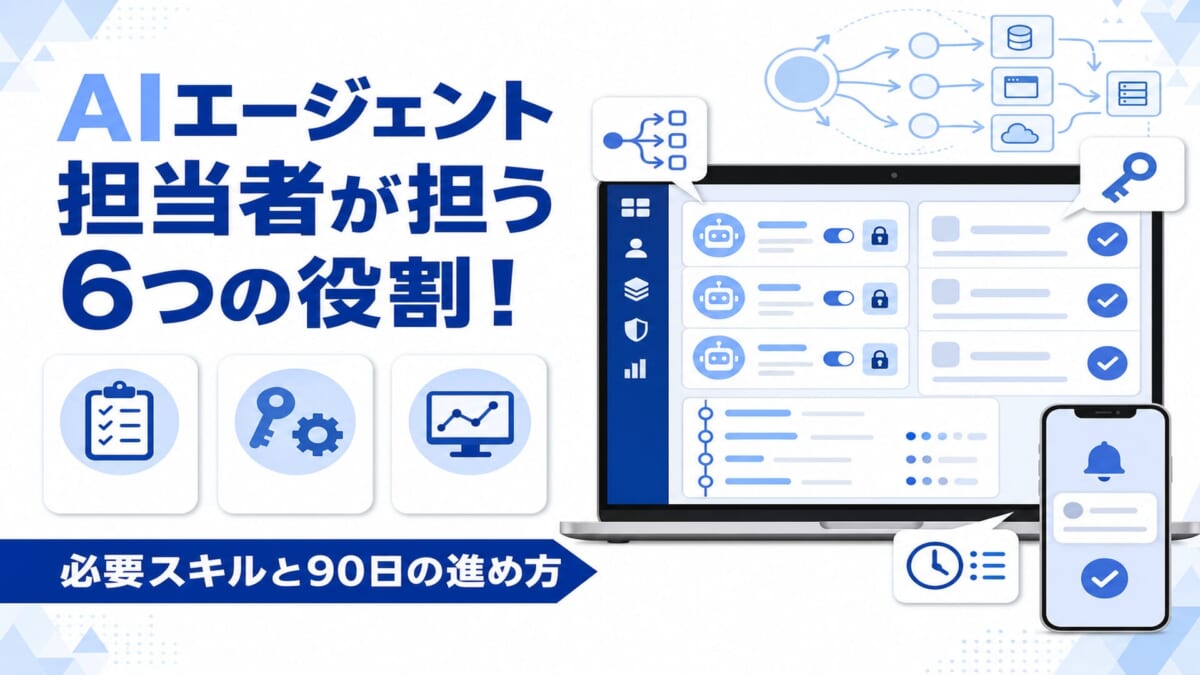
AI agent managers are not tool pickers — they design which tasks to automate, who approves actions, and how to audit outcomes.
Japan's government now requires regular audits, human approval for irreversible decisions, and data minimization in the 2026 AI Guideline update.
Gartner predicts 40% of agentic projects will fail without clear role boundaries; Japanese firms lag in readiness, with only 15.3% having development environments and 39.9% having training support.
What happened
The article outlines six core roles for AI agent managers — from selecting tasks to automate, through designing human-AI collaboration and permission structures, to monitoring performance and building operating rules. The Japanese government's AI Business Operator Guideline (version 1.2, March 2026) now defines AI agents as "AI systems that autonomously act to achieve specific goals" and requires managers to conduct regular operation audits, embed human approval where outcomes are irreversible or high-impact, minimize data exposure, and preserve internal know-how.
Why it matters
Gartner forecasts that over 40% of agentic AI projects will be canceled by end of 2027, citing high costs, unclear business value, and insufficient risk control. The root cause is vague role boundaries — when no one is accountable for authority design and compliance, projects drift into the cancellation pool. Japan lags peers: only 15.3% of Japanese firms report having technical environments where employees can develop AI agents (vs. US 22.1%, Germany 27.4%, China 31.1%), and only 39.9% have learning environments for AI skills (vs. US 62.7%).
What to watch
The 90-day implementation cycle — Days 1–30: narrow candidate tasks to three and align role scope with leadership ("candidate three and role agreement memo"). Days 31–60: run a 2–4 week proof-of-concept with read-only access, measure completion rate and time saved, involve 1–2 real end-users. Days 61–90: document operating rules (five items:申請・権限承認・停止条件・escalation・audit frequency) and decide whether to scale or swap targets. A concrete example: Ainico Group reported 2,247 hours annual time savings across ten business units by grounding checks in process documentation from the start.
Ask the AI about this article →
AI-summarized, only the topics you pick — one digest a day via Email, Slack, or Discord.
Free · takes 30 seconds · unsubscribe anytime
Ask AI anything about this article. Q&As are published on this page for other readers too.
Google Cloud announced a strategic partnership with Verizon to deploy its full-stack AI, including Gemini Ente…

Verizon and Google Cloud announced a strategic partnership Monday

NVIDIA announced SpaceXAI will deploy Vera CPUs to speed up its next-generation agentic AI applications

Cisco closed a record fiscal year
U.S. President Donald Trump expressed support for AI data center projects in a radio interview that aired on S…

Rapidus' plan to begin volume production of 2nm chips in the second half of FY2027 remains on schedule, CEO At…