What happened
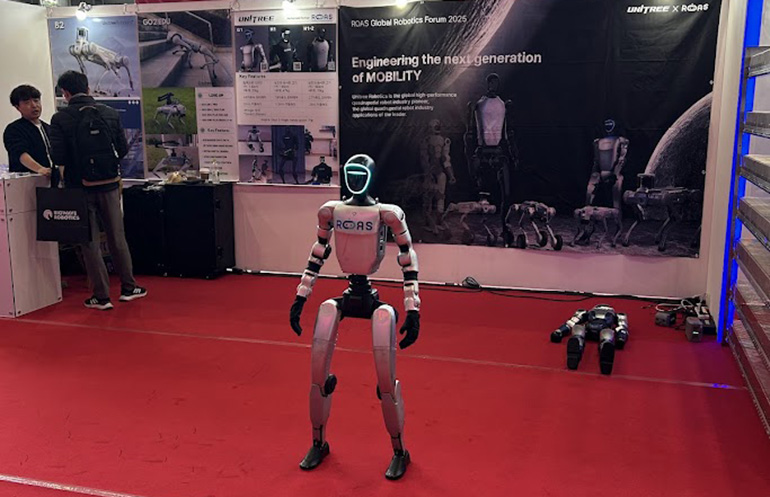
In July, the FCC added foreign-produced advanced robotic devices, including humanoids and quadrupeds, to a list of technologies it deems unacceptable national security or safety risks, blocking new devices from the authorization needed for U.S. import, marketing, or sale.
Why it matters
That scrutiny is likely to accelerate the shift toward on-premises AI architectures and smaller, specialized models, since the more control a company wants over who can access a robot and its data, the more incentive it has to keep sensitive processing close to the machine.
What to watch
Hardware origin is only one part of the security equation; the test is whether critical processing can stay local and where robot data actually goes once a device is inside a facility. The Robot Report is hosting a webinar on October 27 on what the FCC action means for automation investment.
WHO IT HITSThis lands hardest on U.S. companies building or integrating robots — their engineers must now confirm that controllers, sensors, safety systems and AI hardware work together, and that the whole system can be secured and maintained.
Summaries like this, in your inbox every morning.
The FCC action is presented as the trigger for an architectural rethink rather than a simple sourcing problem. Before July, keeping more inference on the robot or inside a facility was already attractive because it improves latency and reliability; the designation is described as making local processing a higher priority for a broader range of AI workloads, especially those involving internal operational data. For core control functions such as motion control and safety monitoring, local processing is non-negotiable, so the real change is expected higher in the stack, where robots interpret instructions, analyze surroundings, respond to anomalies, and make task-level decisions.
That upper layer is where the trade-off bites. Those workloads can be computationally intensive, and the cloud offers more processing power than most edge hardware, so companies will likely need to run more of that intelligence locally within tighter compute limits. The article's case for small language models rests on this: a robot in a defined environment does not always need a model built to handle almost any question, and the combination of specialization and flexibility across changing local deployments can make SLMs a stronger fit for many industrial use cases. Even so, the article notes that a robot need not be locked into a single job — with the right context and access to local data, an SLM can support a wider range of applications within the same facility.
The piece frames the immediate effect as a sourcing question and the longer-term impact as an architecture question. The stakes appear to hinge on integration work: building a robot from components puts more engineering burden on the buyer, covering how components are integrated, how safety is validated, how firmware is maintained, and where critical parts come from. Suppliers that can show tested components, traceable sourcing, and post-deployment governance support may be better placed as a result, and businesses that build those controls in from the start are cast as better positioned to avoid problems they would otherwise have to unwind.
Pick your industry and the AI tools you use, and get news related to your work every day.
Free · 30 seconds with Google · unsubscribe anytimeWhat is AIToday? →
Ask AI anything about this article. The AI reads this article, earlier AIToday articles, and Wikipedia, and cites its sources. Q&As are published on this page for other readers too.
Reflection AI launched Beam, a 501 billion-parameter open-source LLM

A step-by-step guide fine-tunes Muse Glimmer, Meta's 30B vision model, locally for equation-to-LaTeX conversio…
Ency Software and Estun began a technology partnership and completed integration work
Charm Care Corporation, which runs more than 100 private nursing homes in the Kansai and Greater Tokyo areas…

Teradyne announced a strategic investment in Bright Machines and a collaboration to integrate Teradyne robotic…
OpenAI announced always-on agent Dots on September 30; SpaceXAI's Grok Bot and Meta Muse are pushing the same…