What happened
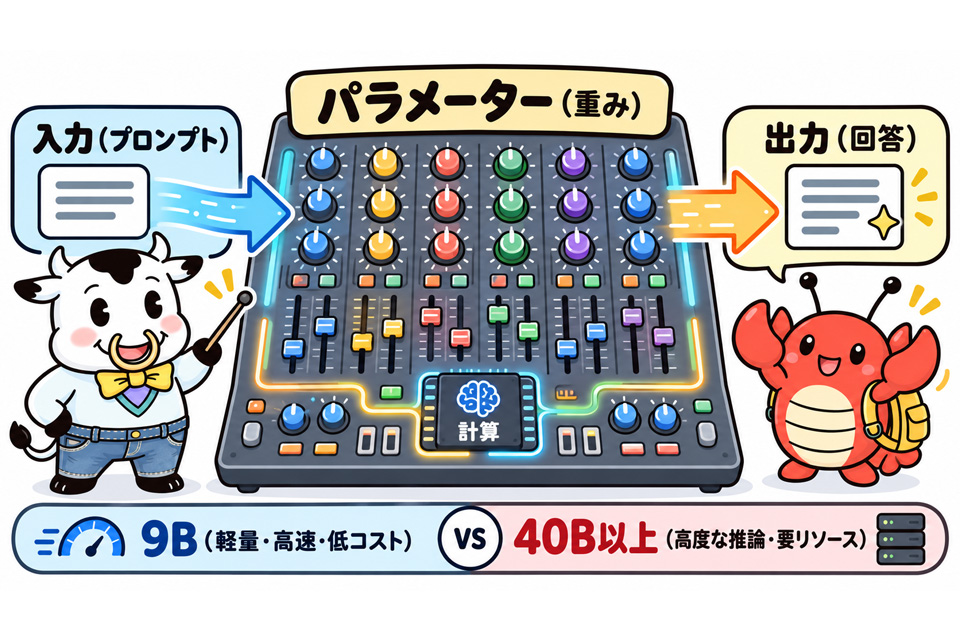
AI Watch published a primer explaining that parameters are the adjustable numbers inside an AI model, and that model names like '9B' and '40B' mean roughly 9 billion and 40 billion of them.
Why it matters
The piece says a bigger parameter count gives more room for complex patterns, but performance also depends on training data quality and volume, model design, and training method.
What to watch
The article notes larger models tend to need more memory and computation, and that SLM and MoE approaches mean total parameter counts alone cannot be compared directly. The piece says the key is picking a model that fits your use case.
WHO IT HITSReaders who follow AI product names and news — business analysts, procurement staff, and anyone scanning model specs — are being told not to read '9B' or '40B' as a simple smartness score. The piece points them toward matching model scale to their own use case instead.
Summaries like this, in your inbox every morning.
The piece is part of a running beginner series that translates AI jargon into everyday terms, and this installment frames parameters as the 'tuning knobs' inside a model. It draws an analogy to an audio mixer, where many knobs are adjusted to balance volume and tone, and notes that no human turns these billions of knobs one by one — training data calculations adjust them gradually and automatically. It also links the concept back to earlier installments, identifying parameter count as one common measure of an LLM's scale and pointing readers to its earlier coverage of SLM and MoE.
The article then pushes back on the instinct to equate larger numbers with more intelligence. It concedes that a higher parameter count gives a model more room to express complex patterns, but lists training-data quality and quantity, model design, and training method as equally important. It adds that bigger models tend to require more memory and computation, affecting GPUs, memory capacity, inference speed, power consumption, and usage fees — which is why smaller SLM models and MoE-style partial processing are drawing attention.
The practical takeaway for a business reader is that parameter count is best treated as a rough indicator of a model's size and of the computing resources it may need, rather than a direct measure of ability. The article leaves the choice open: a model that runs comfortably on a PC or phone versus one that uses large cloud computing for complex work. Which one fits depends on the user's own purpose — a judgment the piece frames as a matter of matching scale to use, not simply picking the biggest number.
For example, today's edition would include:
AI-summarized, only the topics you pick: one digest a day via Email, LINE, or Slack.
Free · 30 seconds with Google · unsubscribe anytimeWhat is AIToday? →
Ask AI anything about this article. The AI reads this article, earlier AIToday articles, and Wikipedia, and cites its sources. Q&As are published on this page for other readers too.

