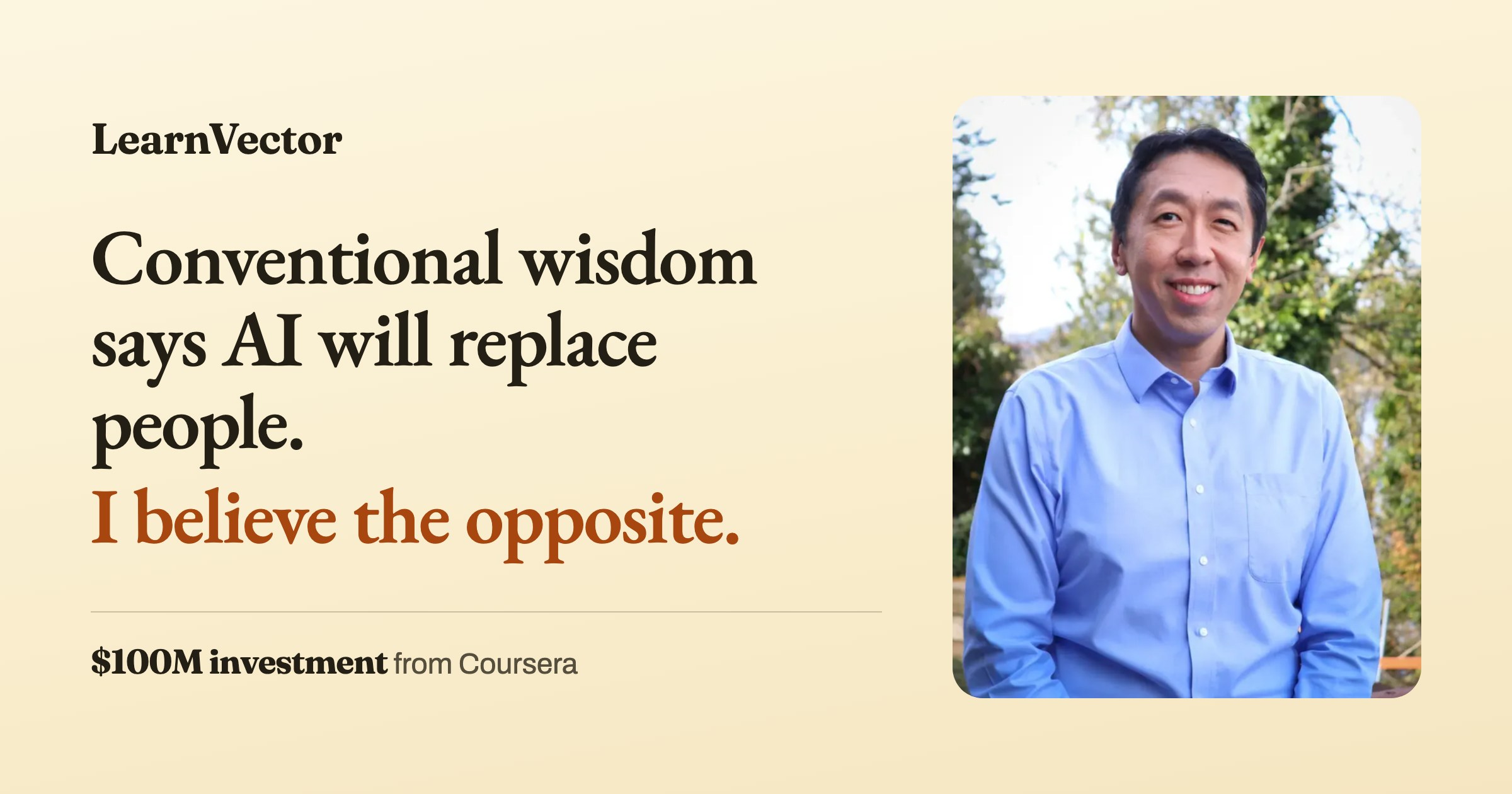
Andrew Ng has founded LearnVector, an AI company backed by a $100 million(約160億円) investment from Coursera, to build personalized one-to-one learning experiences. Rather than deploying unguarded chatbots—which research shows reduce learning through cognitive offloading—LearnVector will create AI tutors that plan a learning path, adapt to individual learners, and persist until mastery is achieved. The company plans to launch products by early 2027.
Summaries like this, in your inbox every morning.
Sign up free →What happened
Andrew Ng, co-founder of Coursera and founder of DeepLearning.AI, has launched LearnVector, a new AI company backed by a $100 million(約160億円) investment from Coursera. The company is building one-to-one personalized learning experiences using AI, with plans to show products by early 2027.
Why it matters
LearnVector aims to shift learning from one-size-fits-all classrooms to personalized guidance tailored to each person. The company explicitly rejects unguarded chatbots—which research shows harm learning through cognitive offloading—in favor of AI that plans a learning path, adapts to how you learn, and stays with you until you master skills. This could reshape how people acquire new competencies at scale.
What to watch
The company plans to have products to show by early 2027. LearnVector is based in Mountain View, California, operating on-site, and is hiring for AI Engineer, Learning Engineer, Learning Scientist, Full-stack Software Engineer, and Operations Specialist roles. It intends to collaborate closely with Coursera and Udemy, leveraging Coursera's trusted library of materials from authoritative sources.
Andrew Ng, whose previous ventures—Coursera (an online education platform), Google Brain, and DeepLearning.AI (an AI education nonprofit)—established him as a leader in democratizing both machine learning and education, is now tackling personalized learning directly. He founded LearnVector in 2026, headquartered in Mountain View, California, with a $100 million(約160億円) investment from Coursera. In his statement, Ng argues that despite 15 years of progress in online education, the fundamental model remains unchanged: "one-size-fits-all courses, taught the same way to each person who shows up." He frames the company's mission as inverting that model through advances in agentic AI—systems that can plan, adapt, and iterate alongside a learner.
The company's product philosophy directly challenges the current industry norm of deploying chatbots as tutoring systems. Ng notes that research shows unguarded chatbots harm learning: while they help students complete homework and tasks in the moment, the cognitive offloading (relying on the AI to think for you rather than thinking yourself) results in learners retaining less and developing fewer skills. LearnVector's answer is to build a system that does three things: plans a path with you (customizing the curriculum to your needs and goals), adapts to how you learn (adjusting teaching style and pacing based on individual differences), and patiently stays with you until you've mastered new skills (persisting as a guide rather than giving an answer and moving on).
Trustworthiness is central to LearnVector's strategy. Ng emphasizes that learners need material that is accurate, relevant, and worth their time—and that anything less wastes "the most valuable thing a learner has: time." Coursera's trusted library of materials from authoritative sources is positioned as a key asset; LearnVector plans to integrate this content into its AI-guided learning experiences, combining pedagogical design with verifiable material quality. Coursera CEO Greg Hart described the partnership as a "force multiplier" for Coursera's growth, noting that Ng's "agentic AI" paired with Coursera's platform and assets creates "validated mastery"—a competitive advantage that could accelerate both companies' reach among individuals and enterprises.
The company is still in the building phase and plans to show products by early 2027. It is hiring across five roles: AI Engineer (to build the agentic systems), Learning Engineer (to apply teaching expertise to product design), Learning Scientist (to invent new teaching methods suited to agentic AI and measure learning outcomes), Full-stack Software Engineer (to build the end-to-end product at scale), and Operations Specialist (to support the team). The company is working on-site in Mountain View and describes itself as a small, fast-moving team focused on changing how people learn and accelerating human development.
LearnVector represents Ng's answer to a decade-old problem he identified at Coursera: while online courses expanded where learning could happen, the how—the pedagogy and personalization—remained largely unchanged from centuries of classroom teaching. The company is explicitly positioning itself against the current trend of deploying large language models as unguarded tutors. Ng and the team cite research showing that cognitive offloading to chatbots, while helpful for completing immediate tasks, actually reduces skill retention and learner competency. Instead, LearnVector is designing an AI system that acts as a persistent guide: it maps a custom learning path for each individual, adjusts its teaching approach based on how that person learns best, and remains engaged until the learner genuinely masters the material. This is framed as turning learning from a one-to-many broadcast (the same course for hundreds of students) into a one-to-one relationship—something that was economically impossible before AI but is now technically achievable. The $100 million(約160億円) backing from Coursera signals both confidence in the approach and a strategic link: Coursera brings a trusted library of vetted, authoritative content, which LearnVector will use to ensure learners encounter accurate, relevant material. The timeline to early 2027 and the hiring of Learning Scientists and Learning Engineers (roles emphasizing pedagogy, not just engineering) suggest the company is betting that learning outcomes depend not just on powerful AI, but on sound teaching principles applied at scale.
AI-summarized, only the topics you pick — one digest a day via Email, Slack, or Discord.
Free · takes 30 seconds · unsubscribe anytime
No comments yet. Be the first to share your thoughts!
Log in to join the discussion




Get curated AI news from 200+ sources delivered daily to your inbox. Free to use.
Get Started FreeFree · takes 30 seconds · unsubscribe anytime
