What happened
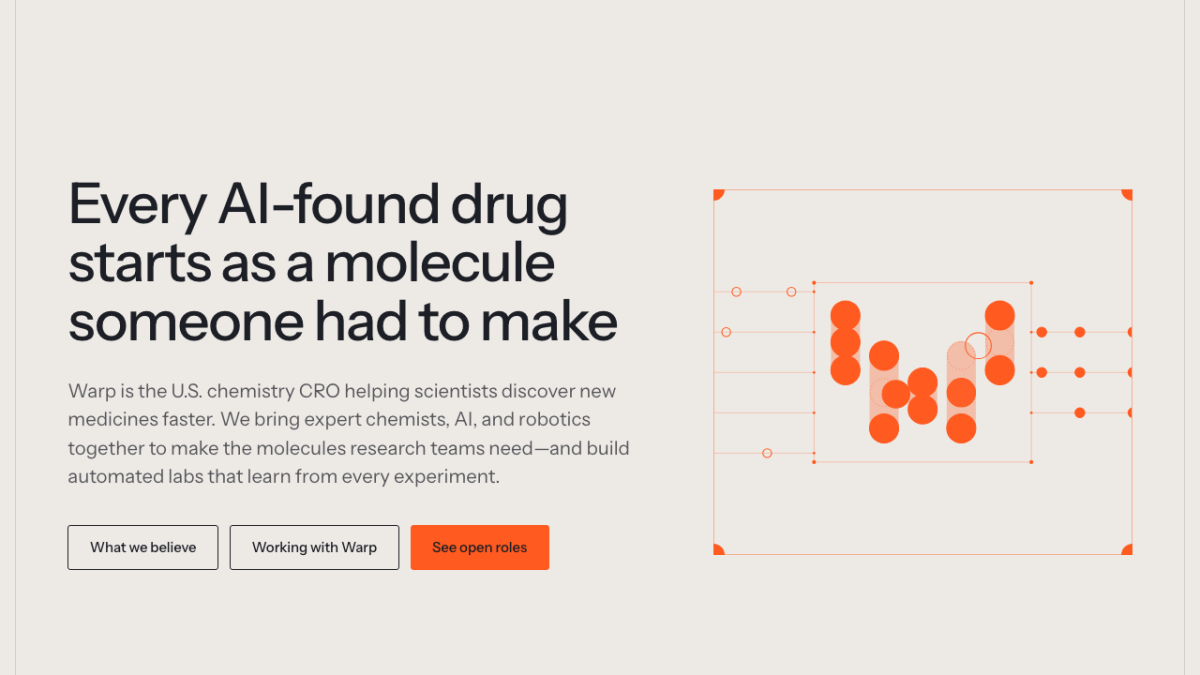
Warp Sciences, an AI-and-robot chemistry CRO led by ex-OpenAI product chief Kevin Weil, launched on the 22nd with a Series A led by Lightspeed; TechCrunch reported $215 million raised at an $865 million valuation, with IVP, Premji Invest and Lux Capital participating.
Why it matters
That capital base and founder pedigree signal investor conviction that a delivery-priced (pay-per-compound) contract lab can win business by shouldering synthesis risk, even offering no charge when a compound cannot be made.
WHO IT HITSThis lands on medicinal chemists and preclinical drug-discovery teams at pharma and biotech companies that outsource analog synthesis, and on CROs competing for that work; it also matters to AI-chemistry researchers who may gain a large dataset of recorded experiments.
Summaries like this, every morning.
Warp Sciences is entering a specific vacuum in US drug discovery: the company says European and American pharma firms send most of their outsourced chemistry work overseas, mainly to China, and no US contract lab of comparable scale exists. The passage of the BIOSECURE Act last December, which restricts federal contracts and grants involving certain concerning biotech firms, adds a policy backdrop that could make domestic alternatives more attractive, though the body does not draw a direct causal link.
The company's model reverses typical CRO billing by charging per delivered compound rather than per person, and by promising no payment if synthesis fails. That shifts synthesis risk onto Warp, which is a meaningful choice for a startup and one that only makes sense if automation can lower the cost of failure over time.
Warp's plan to record every experiment, including failed ones, in a machine-learnable form is central to its pitch. It intends to use that data to train models that predict synthesis methods and which compounds are worth making, with an eventual goal of selling those predictions alongside compounds. Whether the chemist-first, robot-later rollout produces enough consistent data to make such models useful remains to be seen, but the combination of a large capital base and a founder with OpenAI product experience suggests investors see the data flywheel as the real asset.
Pick your industry and the AI tools you use, and get news related to your work every day.
Free · 30 seconds with Google · unsubscribe anytimeWhat is AIToday? →
Ask AI anything about this article. The AI reads this article, earlier AIToday articles, and Wikipedia, and cites its sources. Q&As are published on this page for other readers too.
EXCEED Energy began developing and managing AI data centers in Japan, and has started talks with overseas inve…

OpenAI is closing in on a round of up to $30 billion led by UAE investors and investment firm Coatue, after dr…

Samsung Electro-Mechanics (Semco) is gaining pricing power as AI server demand extends multilayer ceramic capa…
Tesla cut its 2026 capex guidance by $5 billion to $20 billion, just three months after lifting it by $5 billi…

DeNA launched DAAQ, which packages its QA division's testing know-how with in-house AI test tools; internally…
JCET Group's third-quarter net profit attributable to shareholders rose 59.99% year-over-year to CNY773 millio…