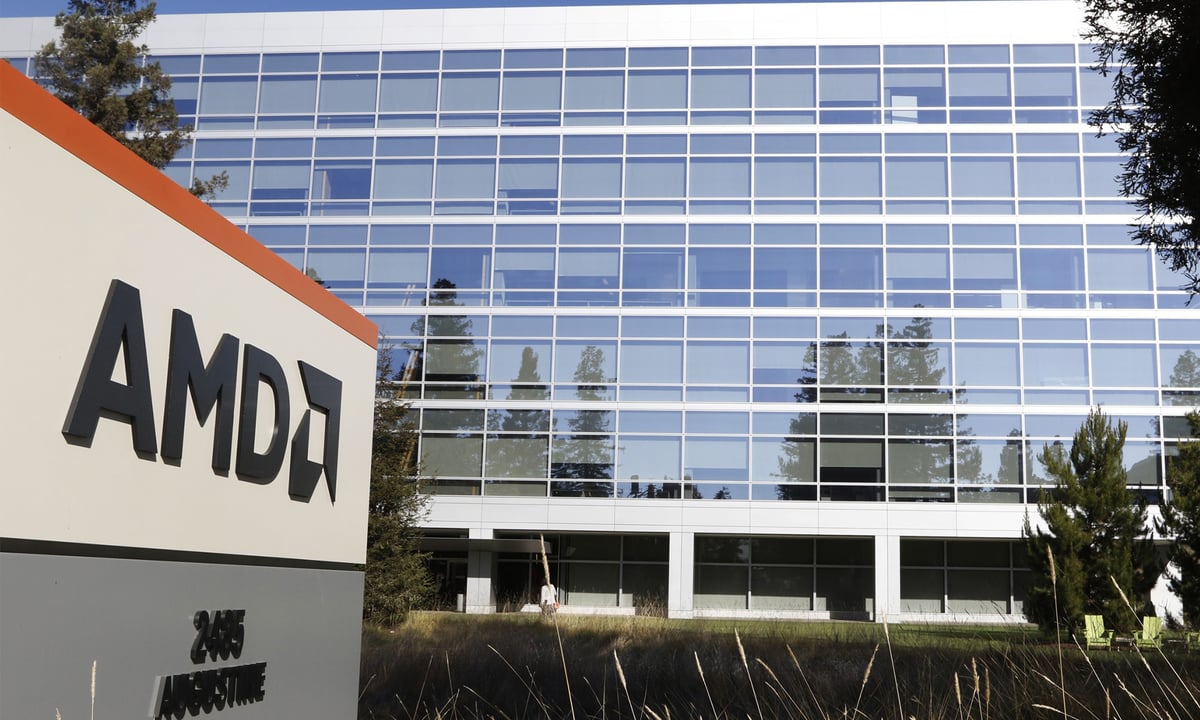
Both AMD and Broadcom have suffered steep stock declines amid a semiconductor sector rout, yet both reported robust recent earnings. Broadcom posted faster growth guidance (84% revenue expected this quarter), generates substantially more free cash flow, pays a dividend, and trades at half AMD's valuation multiple—making it the more attractive value play despite AMD's purer focus on AI accelerator share gains.
Summaries like this, in your inbox every morning.
Sign up free →What happened
The PHLX Semiconductor Index entered bear-market territory, down more than 20% from its June peak. AMD has fallen about 15% from its high and now trades around $500 per share; Broadcom has dropped about 25% and trades around $370 per share. Both companies reported strong recent results—AMD's Q1 revenue rose 38% year-over-year to $10.3 billion(約1.6兆円) with data-center revenue climbing 57%, while Broadcom's fiscal Q2 (ended May 3, 2026) showed revenue climbing 48% to $22.2 billion(約3.6兆円), with AI semiconductor revenue soaring 143% to $10.8 billion(約1.7兆円).
Why it matters
Broadcom trades at roughly 32 times this year's expected earnings and about 19 times next year's—roughly half of AMD's multiples (67× and 37×)—while generating about four times AMD's quarterly free cash flow and paying a $0.65 quarterly dividend per share that AMD does not offer. For investors seeking exposure to the AI chip boom, Broadcom offers faster guidance (84% total revenue growth expected this quarter versus AMD's roughly 46%), stronger cash generation, and a lower valuation, despite both companies executing well.
What to watch
Broadcom's fiscal Q3 guidance projects AI semiconductor revenue growth over 200% year-over-year to $16.0 billion(約2.6兆円), with total revenue guidance of about $29.4 billion(約4.7兆円). AMD's upcoming MI450 series accelerators and Helios rack systems are generating customer interest that exceeds initial forecasts, which could affect near-term earnings revisions if the ramp accelerates.
The semiconductor index's 20% decline from its June peak marked a severe correction for a sector that had powered much of the year's gains. Advanced Micro Devices and Broadcom, two flagship AI-chip names, fell in tandem but from different valuations and with divergent operational trajectories.
AMD reported Q1 results that demonstrated accelerating momentum across its business. Revenue rose 38% year-over-year to $10.3 billion(約1.6兆円), with the data-center segment—the engine of AI demand—climbing 57% to $5.8 billion(約9300億円) on strong demand for EPYC server processors and the ramp of Instinct AI accelerators. Non-GAAP earnings per share rose 43% to $1.37, and the company posted a quarterly free cash flow record of $2.6 billion(約4200億円). Adjusted gross margin expanded to 55% from 54% a year earlier. Management guided for Q2 revenue of about $11.2 billion(約1.8兆円), implying roughly 46% year-over-year growth—an acceleration from Q1. CEO Lisa Su noted that customer engagement around the upcoming MI450 series accelerators and Helios rack systems is strengthening, with forecasts from leading customers exceeding AMD's initial expectations.
Broadcom's fiscal Q2 (ended May 3, 2026) delivered even stronger headline growth. Revenue climbed 48% year-over-year to $22.2 billion(約3.6兆円). AI semiconductor revenue—custom AI accelerators and networking chips for cloud giants—soared 143% to $10.8 billion(約1.7兆円). Adjusted net income reached $12.1 billion(約1.9兆円), and free cash flow hit $10.3 billion(約1.6兆円), representing 46% of revenue. The company also pays a quarterly dividend of $0.65 per share, yielding about 0.7% at current prices. For fiscal Q3, CEO Hock Tan guided for AI semiconductor revenue growth over 200% year-over-year to $16.0 billion(約2.6兆円), with total revenue guidance of about $29.4 billion(約4.7兆円), up 84% year-over-year.
However, growth rates alone do not settle the investment case. AMD trades at about $500 per share, reflecting roughly 67 times this year's expected earnings and about 37 times next year's—a multiple that assumes sustained share gains in AI chips. Broadcom trades at about $370 per share, reflecting roughly 32 times this year's earnings and about 19 times next year's—roughly half of AMD's multiple on both counts. On cash, the contrast is stark: Broadcom generated about four times AMD's quarterly free cash flow. Broadcom's infrastructure software segment, about a third of revenue, grew just 9% year-over-year, representing a slower but profitable, steady business that dilutes overall growth. Broadcom's custom AI business also depends on a handful of hyperscale customers, creating lumpiness and concentration risk in order flow.
For investors seeking pure upside to AMD's AI accelerator share gains, AMD offers the more explosive stock—in both directions. But when the faster-growing business is also the cheaper stock and the stronger cash generator, the decision favors Broadcom: it delivers 84% revenue growth guidance versus AMD's 46%, generates substantially more free cash flow, pays an income stream, and trades at a valuation discount of roughly 50% on forward earnings multiples.
The semiconductor sector's brutal downturn has created a comparative valuation opportunity between two of the AI trade's strongest performers. Both AMD and Broadcom are executing well—AMD's data-center revenue climbed 57% with strong demand for EPYC processors and Instinct accelerators, while Broadcom's AI semiconductor business surged 143% to $10.8 billion(約1.7兆円), driven by custom chips for cloud giants. Yet the stock market has repriced both, with Broadcom experiencing a steeper decline despite delivering stronger absolute results.
The critical divergence lies in valuation and cash generation. Broadcom's current multiple (32× this year's earnings, 19× next year's) stands at roughly half of AMD's (67× and 37×), while its free cash flow of $10.3 billion(約1.6兆円) dwarfs AMD's $2.6 billion(約4200億円) quarterly record. Broadcom also generates 46% of revenue as free cash flow and supports a dividend, creating a tangible income stream AMD lacks. AMD's investment thesis hinges on its MI450 ramp exceeding forecasts, which could justify its premium multiple—but that upside appears largely priced in already, leaving limited margin of safety for investors.
AI-summarized, only the topics you pick — one digest a day via Email, Slack, or Discord.
Free · takes 30 seconds · unsubscribe anytime
No comments yet. Be the first to share your thoughts!
Log in to join the discussion



Get curated AI news from 200+ sources delivered daily to your inbox. Free to use.
Get Started FreeFree · takes 30 seconds · unsubscribe anytime
1 minute a day. The AI essentials.
200+ sources · Email / LINE / Slack
