What happened
AI infrastructure startup Groq announced $350 million in Series A funding led by returning backer Disruptive, with Nvidia planning to join the round at an unspecified amount. This comes less than three months after Groq closed a $650 million round.
Why it matters
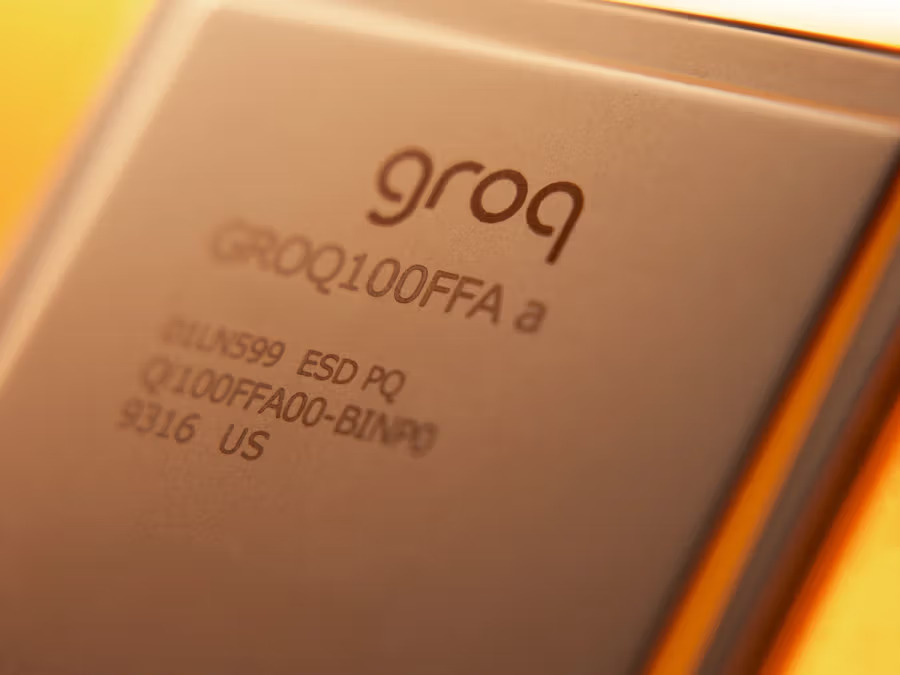
Groq operates GroqCloud, an AI-optimized public cloud platform powered by the Groq 3 LPU chip (co-developed with Nvidia). The chip is designed to handle inference workloads more efficiently by offloading feed-forward network calculations from Nvidia's GPUs, giving enterprises an alternative approach to running large language models in production.
What to watch
Groq plans to scale its cloud from 13 data centers worldwide and expand power capacity from 57 megawatts to more than 200 megawatts next year, using the funding to grow GroqCloud availability and capacity.
Summaries like this, in your inbox every morning.
Groq's $350 million Series A represents a significant bet on a disaggregated approach to AI inference. The company's pivot from hardware design to cloud infrastructure became possible after Nvidia licensed its core chip technology in a $20 billion deal last December, which also brought several Groq executives into Nvidia's ranks. Rather than compete head-to-head with Nvidia, Groq has positioned itself as a complementary service: it operates GroqCloud using racks of Groq 3 LPU chips paired with Nvidia Rubin GPUs, optimizing inference workloads by splitting computation between the two. The Groq 3 LPU excels at feed-forward network tasks—the components that store much of an LLM's learned knowledge and perform large portions of the generation work—while Nvidia's GPUs handle attention mechanisms. This split approach can also accelerate models with mixture-of-expert architecture or speculative decoding, broadening its appeal to enterprises seeking inference optimization.
The funding momentum—$650 million in one round followed by $350 million in the next within three months—signals market confidence in the infrastructure play. Nvidia's participation in the Series A, though at an unspecified amount, also underscores the strategic alignment: Groq's cloud platform drives demand for the very Rubin GPUs that Nvidia manufactures. Groq's expansion roadmap, scaling from 57 to over 200 megawatts of power capacity next year while growing from 13 to more data centers, shows the company is building toward meaningful scale in what remains a nascent market segment of specialized inference infrastructure.
Pick your industry and the AI tools you use, and get news related to your work every day.
Free · 30 seconds with Google · unsubscribe anytimeWhat is AIToday? →
Ask AI anything about this article. The AI reads this article, earlier AIToday articles, and Wikipedia, and cites its sources. Q&As are published on this page for other readers too.
Chunghwa Telecom president Rong-shy Lin said the shift from conversational AI to autonomous AI agents is resha…

CoreWeave fell 5% in premarket trading Friday and was on track to finish the week down 15%, after rebounding f…
Apple and Meta said they would jointly release a new open-weight AI model designed to run on high-end Macs, ai…

Investors put $38.5 billion into Asian startups in Q3, per Crunchbase data

A longtime Anthropic investor told Fortune he expects shares priced around $1.8 trillion, below the company's…

In Q2, billionaires or their funds sold six 'Magnificent Seven' AI stocks