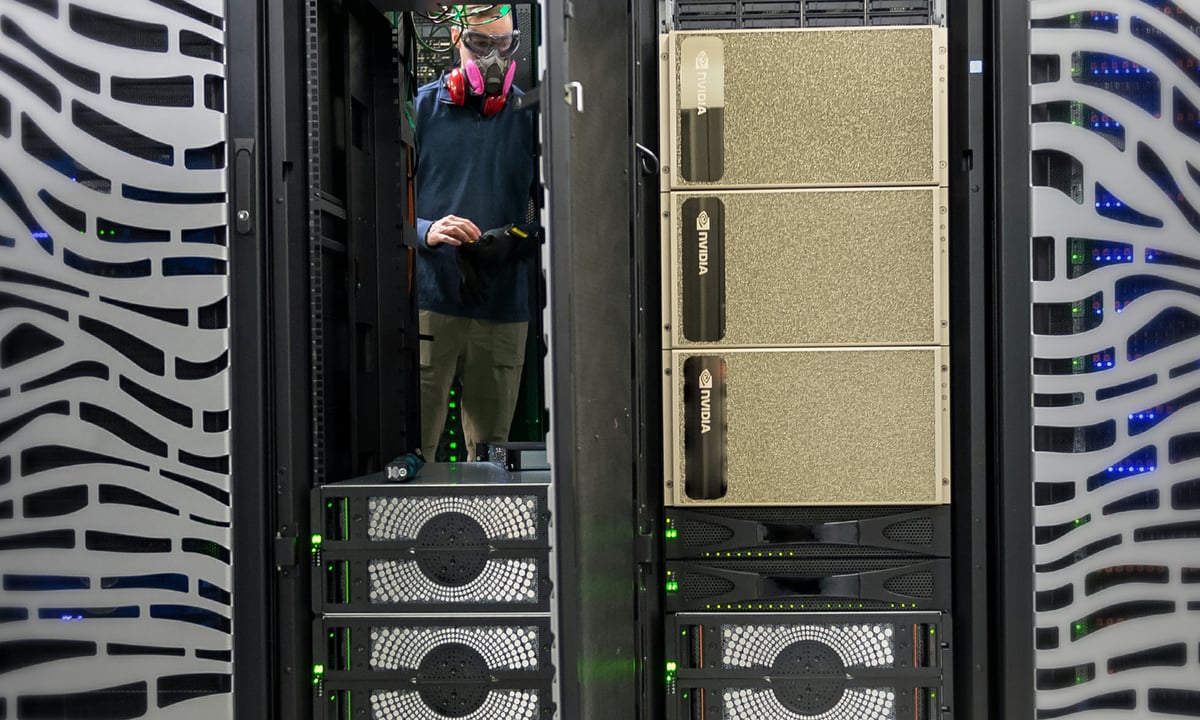
Nvidia and Micron both posted record AI-driven earnings despite higher Treasury yields. Nvidia's Q1 revenue hit $82 billion with $91 billion guidance for Q2.
Micron's fiscal Q3 revenue reached $41.5 billion with record 84.9% gross margin and $1 billion in HBM4 revenue.
Micron's 16 customer contracts lock in roughly $100 billion in minimum revenue, offering unusual pricing stability in memory markets.
What happened
Nvidia reported Q1 FY27 revenue of $82 billion (up 85% year-over-year), with Data Center revenue at $75 billion and guidance of $91 billion for Q2 at 75% non-GAAP gross margin. Micron reported fiscal Q3 revenue of $41.5 billion (up 346% year-over-year) with gross margin at a record 84.9%; HBM4 revenue crossed $1 billion and is ramping twice as fast as HBM3E.
Why it matters
Nvidia and Micron occupy complementary positions in the AI stack—Nvidia supplies accelerators and networking, Micron supplies the memory those systems require. Both reported results despite a 10-year Treasury yield of 4.65% (sitting in the 92.8th percentile of the past year), which typically pressures expensive growth stocks. Micron's 16 Strategic Customer Agreements lock in roughly $100 billion in minimum contracted revenue with price floors above prior peak quarterly margins, offering rare visibility in a historically cyclical business.
What to watch
Nvidia forecasts $1 trillion in Blackwell and Rubin revenue through calendar 2027, while Micron's customer deposits total $22 billion. Key risks include signs of HBM pricing weakness or trimmed hyperscaler capex plans. Nvidia trades at 25x forward P/E; Micron at 6x—a significant valuation gap despite both benefiting from AI infrastructure buildout.
Ask the AI about this article →
Nvidia and Micron's earnings arrive at a critical juncture for AI-focused investors. The 10-year Treasury yield sitting in the 92.8th percentile of the past year has historically pressured expensive growth stocks, yet both companies delivered results that reinforce their positions in the AI buildout. The body frames them as complementary: Nvidia controls the compute layer—Jensen Huang highlighted Microsoft's Fairwater site running hundreds of thousands of Blackwell GPUs and guided to $91 billion in Q2 revenue—while Micron holds the memory bottleneck that those systems cannot bypass.
Micron's structural innovation is the attempt to defang memory's historical cyclicality. The 16 Strategic Customer Agreements with roughly $100 billion in minimum contracted revenue and price floors above prior peak margins represent a departure from memory's boom-bust playbook. Customer cash deposits of $22 billion further lock in runway. For comparison, Nvidia's $145 billion in supply commitments and $1 trillion revenue forecast through calendar 2027 emphasize platform economics, though Huang noted China Data Center compute exclusions from guidance—a real overhead for the stock.
The market has already begun to parse this distinction. Nvidia fell 3.75% last week while Micron gained 2.58% and is up 241.59% year-to-date, reflecting the yield shock hitting high-multiple growth names harder. The body positions the two as responses to different investor profiles: Micron for value-focused investors seeking compressed multiples and rare memory-market visibility, Nvidia for those seeking the purest AI compounder willing to tolerate multiple compression during yield spikes.
AI-summarized, only the topics you pick — one digest a day via Email, Slack, or Discord.
Free · takes 30 seconds · unsubscribe anytime
Ask AI anything about this article. Q&As are published on this page for other readers too.
Nvidia announced a partnership with Cloverleaf Infrastructure on Friday, investing what the Wall Street Journa…
Broadcom stock closed 1.2% higher on Friday after BMO Capital Markets analyst Harsh Kumar initiated coverage w…

Google expanded its long-term partnership with Marvell Technology to co-develop additional accelerators and co…

David Tepper's Appaloosa Management acquired 1,078,248 CoreWeave shares in Q2 while increasing its Meta Platfo…
Nvidia is paying $6 billion for a non-exclusive license to Poolside AI's Model Factory—the system used to buil…

Nvidia's data center revenue reached $75.2 billion in the first quarter of fiscal 2027 (ended April 26, 2026)…