What happened
Google Cloud's Threat Intelligence group (GTIG) said an LLM framework called exploit_agent, paired with a Russian-language tool, repeatedly compared pre- and post-patch code to spot vulnerabilities and produced exploit programs with no human intervention.
Why it matters
This is the first confirmed case of an LLM autonomously creating working exploits, which could let attackers find and weaponize software flaws far faster than manual methods, according to GTIG.
What to watch
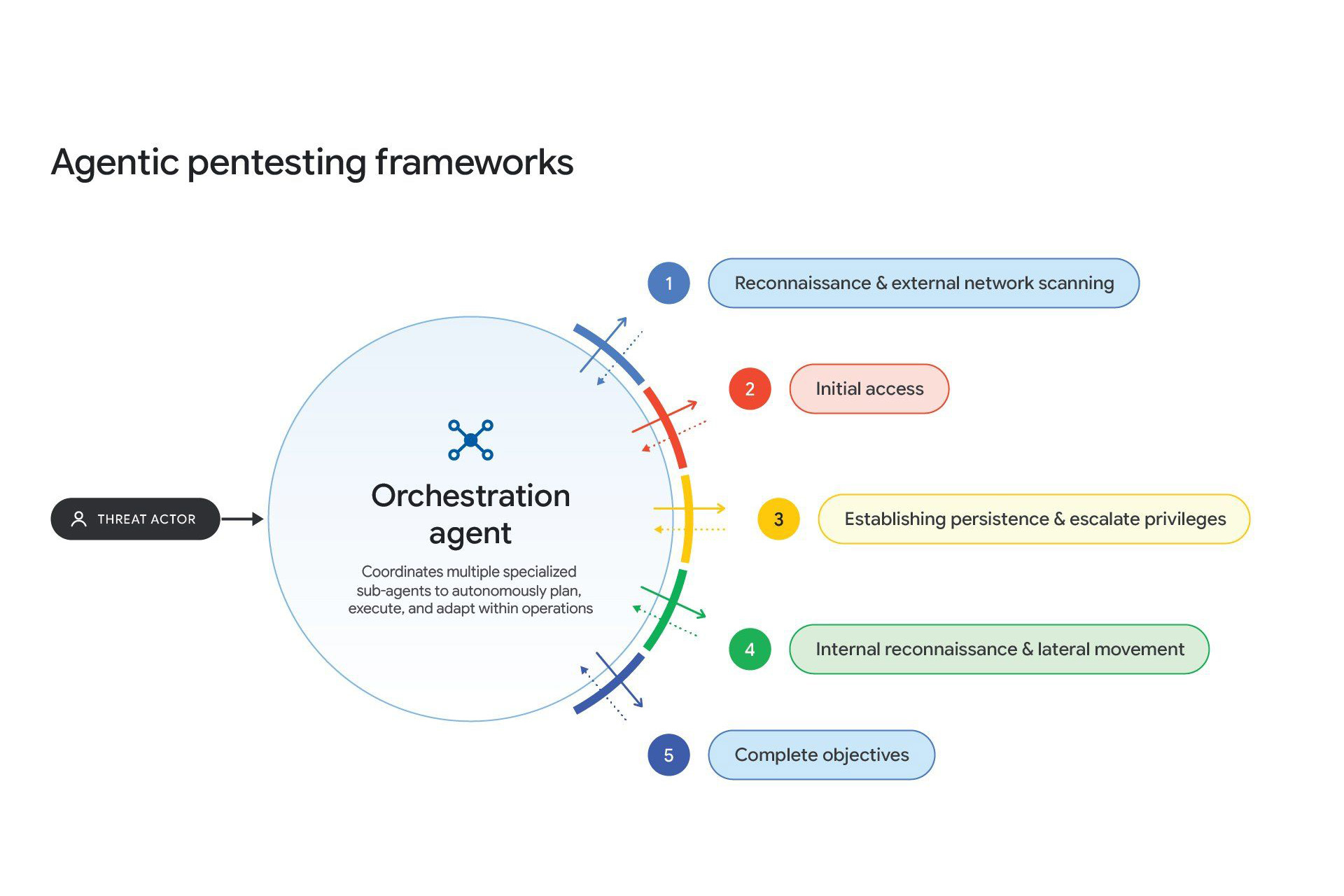
GTIG's Q4 AI threat tracker also found that both financially motivated and suspected cyber-espionage actors are using open-source agentic penetration-testing tools such as CAIRN, PentAGI, and CyberStrikeAI to automate entire attack procedures; a CAIRN deployment was observed in an intrusion targeting the U.S. aerospace sector.
WHO IT HITSSecurity teams at software vendors and enterprises now face a faster exploit-development cycle, while open-source agentic pentesting tools like CAIRN lower the barrier for attackers—making patch management and monitoring more urgent.
Summaries like this, every morning.
The GTIG report marks a shift in how AI is used in cyberattacks: it is now not just a helper but an autonomous actor in vulnerability discovery and exploit creation. The exploit_agent case shows an LLM framework can continuously compare patched and unpatched code, spot flaws, and generate working exploits without a human in the loop—compressing the time between patch release and attack.
Separately, the report notes that both financially motivated and suspected cyber-espionage actors have adopted open-source agentic penetration-testing tools like CAIRN, PentAGI, and CyberStrikeAI to automate full attack workflows. One CAIRN deployment was observed in an intrusion against the U.S. aerospace sector, indicating these tools are already operational against high-value targets.
GTIG also observed state-linked activity: China-related actors using LLMs to process acquired data, and North Korea-related operations using AI-generated personas—some with SynthID watermarks—to target cryptocurrency firms and attempts to manipulate autonomous coding assistants. These examples suggest AI is becoming embedded across the attack lifecycle, from reconnaissance to exploitation and social engineering.
Pick your industry and the AI tools you use, and get news related to your work every day.
Free · 30 seconds with Google · unsubscribe anytimeWhat is AIToday? →
Ask AI anything about this article. The AI reads this article, earlier AIToday articles, and Wikipedia, and cites its sources. Q&As are published on this page for other readers too.
Innovation BASE Hokkaido updated AI:Promo's image editing with OpenAI's GPT-Image-2.6 Sunburst, announced Nove…

Softcreate's Yamaguchi published a four-phase guide for Microsoft 365 Copilot: prepare a daily-report prompt…
Google announced a new generation of intelligent eyewear co-developed with Gentle Monster, Warby Parker, and S…

A Qiita article traces Softmax Attention → Linear → DeltaNet → Gated DeltaNet → KDA as a history of adding par…

A developer running Claude Code (Ultra, $220/month), Codex CLI (Pro, $100/month) and Devin's SWE-2 (Pro, $20/m…

The developer released mellow, which swaps chat for calls: you pick one of 20 AI friends, set in real cities…