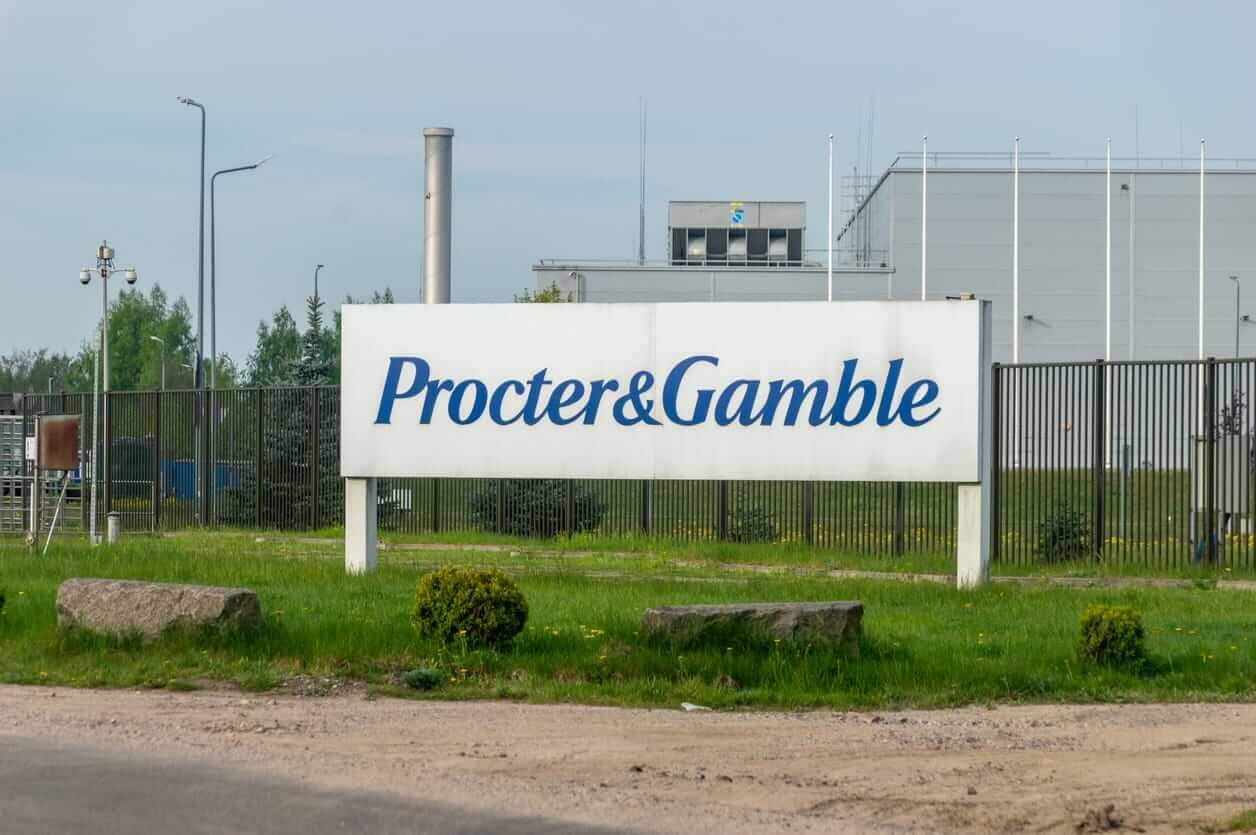
Procter & Gamble stock has outperformed the broader market as investors flee volatile AI stocks and semiconductors, rising 4.2% in 2026 while the S&P 500 and Nasdaq fell. With 136 years of consecutive dividend payments, a 70-year streak of annual dividend increases, and membership in the Dow Jones Industrial Average since 1932—the longest tenure of any current component—the consumer goods giant is attracting defensive investors seeking stability during a period of heightened uncertainty about AI valuations and profitability.
Summaries like this, in your inbox every morning.
Sign up free →What happened
As AI stocks and semiconductors tumbled last week amid valuation concerns, Procter & Gamble advanced 4.2% in 2026 and gained 0.65% over the past five trading sessions—sharply outpacing the S&P 500 (down 0.40%) and Nasdaq Composite (down 0.66%). The 188-year-old consumer goods company, with a market value of $349.2 billion(約56兆円), has emerged as a pocket of stability for investors seeking predictable earnings.
Why it matters
Investors are becoming more selective as doubts grow about whether AI demand can sustain the productivity gains many expected. P&G's 136-year track record of uninterrupted dividends, 70-year streak of annual dividend increases, and blue-chip presence in the Dow Jones Industrial Average since 1932 (longer than any current component) make it an appealing alternative for portfolios seeking defensive positioning and lower volatility during AI market uncertainty.
What to watch
P&G is scheduled to report fiscal 2026 fourth-quarter earnings before market open on Wednesday, July 29. The company's fiscal 2026 guidance projects 1% to 5% reported sales growth and flat to 4% organic sales growth, with core EPS expected to reach $6.83 to $7.09 per share. Analysts hold a consensus "Moderate Buy" rating with an average price target of $163.17, implying 9.2% upside potential.
Procter & Gamble, the 188-year-old consumer goods giant founded in 1837, has unexpectedly become a focal point for investors as artificial intelligence stocks and semiconductors faced a sharp selloff last week. The broader market tumble was driven by mounting concerns that AI valuations have climbed too high too quickly and that the explosive demand for AI chips and memory may not be sustainable if AI ultimately fails to deliver the profitability and productivity improvements many investors expect. In this environment of uncertainty, investors have begun shifting toward defensive sectors—and P&G has emerged as a rare pocket of stability.
With a market value of $349.2 billion(約56兆円), P&G advanced 4.2% in 2026 and gained a marginal 0.65% over the past five trading sessions, standing in stark contrast to the S&P 500 Index, which fell 0.40% over the same period, and the tech-heavy Nasdaq Composite, which declined 0.66%. The company's defensive credentials are substantial. Founded as a small soap and candle business, it has grown into one of the world's largest consumer goods companies, selling a portfolio of globally recognized brands including Tide, Pampers, Gillette, Ariel, Oral-B, Head & Shoulders, Olay, Pantene, Always, Dawn, Febreze, and Vicks across more than 180 countries. Critically, P&G has been a continuous member of the blue-chip Dow Jones Industrial Average since 1932—the longest-serving component of the index, even as once-prominent companies like General Electric have exited over the decades. The company is also a member of the exclusive Dividend Kings club, having paid an uninterrupted dividend for 136 consecutive years and increased its annual dividend for 70 straight years, a track record matched by only a handful of public companies.
P&G reinforced its reputation for consistency when it reported fiscal third-quarter results on April 24. For the quarter ended March 31, the company generated $21.2 billion(約3.4兆円) in net sales, up 7% year-over-year and comfortably ahead of the $20.5 billion(約3.3兆円) consensus estimate. Organic sales, excluding foreign exchange and acquisition/divestiture effects, rose 3% from a year earlier. Core earnings came in at $1.59 per share, a 3% increase from the prior year and slightly above the consensus estimate of $1.56. Notably, growth was supported primarily by higher sales volumes rather than price increases, suggesting healthy underlying consumer demand. Organic sales growth broke down as a 2% increase in volume complemented by a 1% contribution from pricing. Among segments, Beauty delivered the strongest performance, with organic sales climbing 7% and volumes rising 5%, supported by product innovation and strong demand for premium skincare. Fabric & Home Care, P&G's largest business by revenue at $7.4 billion(約1.2兆円) in sales, posted 3% organic growth, while Baby, Feminine & Family Care also recorded 3% organic sales growth. The Grooming and Health Care segments were comparatively softer, both reporting modest 2% declines in volumes. During the quarter, P&G returned $3.2 billion(約5100億円) to shareholders through $2.5 billion(約4000億円) in dividend payments and more than $600 million(約960億円) in share repurchases.
Looking ahead, management reaffirmed its fiscal 2026 outlook, maintaining its forecast for 1% to 5% reported sales growth and flat to 4% organic sales growth. The company reiterated guidance for diluted earnings per share growth of 1% to 6% from fiscal 2025, while projecting core EPS growth up to 4%, implying a fiscal 2026 core EPS range of $6.83 to $7.09 per share. Most recently, on July 14, P&G declared a quarterly dividend of $1.0885 per share, payable on August 17, translating to a forward annualized dividend of $4.35 per share and a dividend yield of approximately 2.87%. Analysts remain broadly constructive despite the challenging market backdrop. The stock holds a consensus "Moderate Buy" rating based on 26 analyst opinions, including 10 "Strong Buy" and four "Moderate Buy" recommendations, while 12 analysts remain on the sidelines with "Hold" ratings. The average price target of $163.17 indicates potential upside of 9.2%, with the highest target of $181 suggesting the stock could rally as much as 21.1%. P&G is scheduled to report its fiscal 2026 fourth-quarter earnings before the market opens on Wednesday, July 29.
The article frames P&G as a beneficiary of a significant market rotation away from artificial intelligence stocks. It documents that AI-related equities—particularly semiconductor stocks—experienced a sharp selloff last week amid mounting concerns that valuations have climbed too far while uncertainty persists about whether AI can deliver the productivity and profitability gains many investors anticipated. This rotation toward defensive sectors creates an opening for established companies with stable, predictable earnings streams.
P&G's appeal in this environment rests on three foundational attributes documented in the article: a nearly two-century history of navigating economic crises (wars, recessions, inflationary cycles), the longest-serving tenure on the Dow Jones Industrial Average among current components (since 1932), and an unmatched dividend track record—136 consecutive years of payments and 70 consecutive years of increases. The company's fiscal Q3 results, reported April 24, reinforce this consistency: $21.2 billion(約3.4兆円) in net sales (up 7% year-over-year, beating the $20.5 billion(約3.3兆円) consensus), and core earnings of $1.59 per share (up 3%, above the $1.56 estimate), with growth driven predominantly by higher sales volumes rather than price increases. This signals resilient underlying demand. During the quarter alone, P&G returned $3.2 billion(約5100億円) to shareholders ($2.5 billion(約4000億円) in dividends and over $600 million(約960億円) in share repurchases), underscoring its commitment to capital returns.
The contrast in recent performance is striking: P&G gained 0.65% over the past five trading sessions while the S&P 500 fell 0.40% and the Nasdaq Composite dropped 0.66%. Analysts remain constructive, with a consensus "Moderate Buy" and an average price target of $163.17, suggesting 9.2% upside from current levels. This positioning reflects the market's ongoing recalibration—as investors reassess AI's near-term payoff prospects and shift toward companies that can reliably deliver earnings and cash returns regardless of technology cycles.
AI-summarized, only the topics you pick — one digest a day via Email, Slack, or Discord.
Free · takes 30 seconds · unsubscribe anytime
No comments yet. Be the first to share your thoughts!
Log in to join the discussion




Get curated AI news from 200+ sources delivered daily to your inbox. Free to use.
Get Started FreeFree · takes 30 seconds · unsubscribe anytime
1 minute a day. The AI essentials.
200+ sources · Email / LINE / Slack
