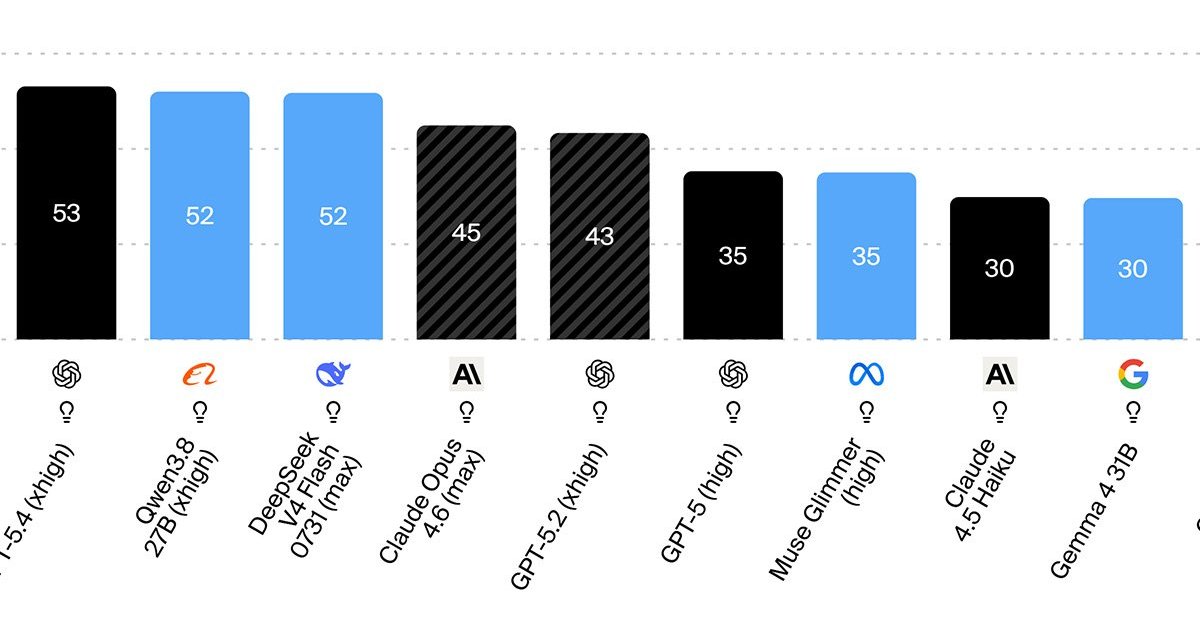
What happened
In 9 days from Aug 10, Meta (Muse Glimmer), NVIDIA (Nemotron 3.5 Lightning), and Alibaba Cloud (Qwen3.8-27B) released open-weight models with around 30B parameters. On Aug 18, Japan's NII added LLM-jp-4 33B (~33.2B params).
Why it matters
These models deliver near-frontier scores at much lower cost. Qwen3.8-27B scores 52 on the Intelligence Index, matching DeepSeek V4 Flash 0731 (284B params) and beating Claude Opus 4.6 and GPT-5.2 (estimated). They can run on consumer GPUs with 24GB VRAM. Always-on AI agents, like OpenClaw, drive demand for efficient local processing over expensive frontier APIs.
What to watch
Ramp's June survey shows US firms switching from pricey frontier models to cheaper Chinese ones. A July statement from NVIDIA, Microsoft, and OpenAI opposes open-model regulation. The shift to task-based model selection makes 30B-class the near-term battleground, raising the question: which one to pick, for individuals and businesses.
Summaries like this, in your inbox every morning.
The release of three 30B-class open-weight models within nine days marks a turning point. For years, this size was overshadowed by frontier models, but the dynamics have shifted. The article highlights two forces: the practical need for always-on AI agents and cost pressure on users. Agents performing routine tasks make lighter, local models an economical choice, especially as Ramp's survey indicates US firms are already migrating from expensive frontier to cheaper Chinese models. Data locality needs also favor local deployment.
A key tension exists in the reported performance. Qwen3.8-27B claims to surpass Claude Opus 4.6 on specific benchmarks, yet the article cautions that many comparative values are self-measured and show remaining gaps. This suggests careful scrutiny of vendor claims is needed. The political climate also matters: while US-led regulation is pushed, NVIDIA, Microsoft, and OpenAI's July statement opposing open-model regulation signals strong industry backing. The move toward task-based model selection appears established. For individuals, the growing choice of PC-runnable 30B models makes selection a new decision point in AI adoption.
Pick your industry and the AI tools you use, and get news related to your work every day.
Free · 30 seconds with Google · unsubscribe anytimeWhat is AIToday? →
Ask AI anything about this article. The AI reads this article, earlier AIToday articles, and Wikipedia, and cites its sources. Q&As are published on this page for other readers too.
Supermicro Computer appointed Mark Long as chief financial officer, bringing an experienced technology finance…

Holtek Semiconductor unveiled its 2026 product roadmap on October 15, focusing on four core areas: smart prote…
TSMC reported about NT$763.1b in Q3 net profit and confirmed that demand for advanced processors is running ah…

Nvidia-backed CoreWeave steadied Thursday after a sharp slump, as investors worried about the debt financing b…
Circlia started a proof-of-concept for TASTE SIGNAL: visitors to Holland Village Cafe FUKUOKA taste cookies an…

Weathernews said on October 15 it implemented its own AI weather-forecasting model, AI-Nowcast, in its Weather…