What happened
Lute raised $20 million in seed and pre-seed funding co-led by OTB Ventures and Forward.one, and introduced Lute-0, a video-action model it says was pre-trained on substantially less data and only a quarter of the training steps of π0.5.
Why it matters
Lute-0 achieved higher success rates than π0.5 across five internal retail manipulation tasks while delivering what the company describes as a twofold improvement in latency, suggesting tactile data can reduce training cost and boost performance, though the results come from Lute's own evaluations.
WHO IT HITSRetail, warehousing and logistics operators stand to gain robots that can handle fragile or slippery items with less training data, while systems integrators without in-house AI teams may get a guided path to deploying physical AI, according to OTB Ventures.
Summaries like this, every morning.
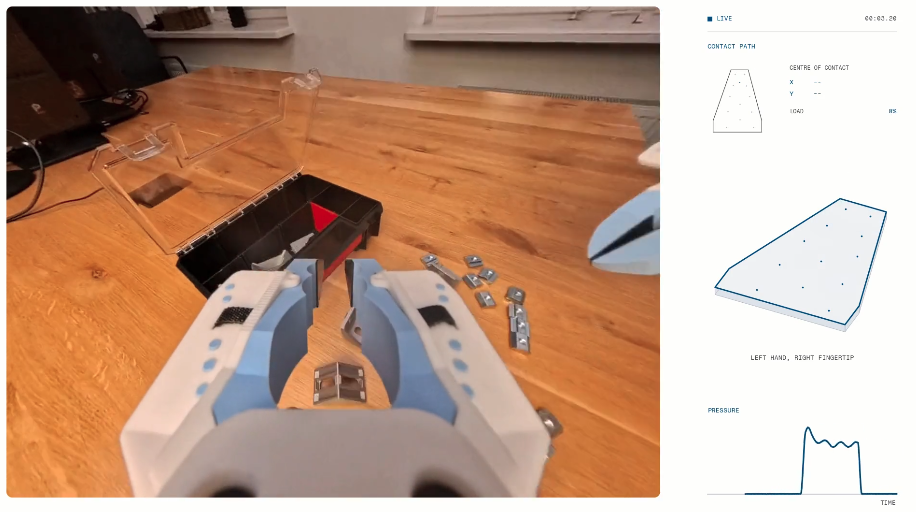
Lute's pitch rests on a gap it says current physical AI systems leave open: cameras can identify objects and their positions, but they offer limited information about grip force, slippage and how soft or fragile a material is. To close that gap, Lute worked with technology partners to co-design compact, elastomer-based tactile sensors and built them into a portable data collection system, which it uses to gather tactile information across different operating environments and train robotic foundation models. Lute-0 is the first in a planned family of models that combine touch and vision.
The company was founded in January 2026 by CEO Paweł Budzianowski and CTO Krzysztof Walas, with offices in Warsaw and San Mateo. Lute combines autonomous operation with remote human assistance when robots run into trouble, and feeds information from failures, unusual situations and human interventions back into model training. Forward.one's Boy de Jonge credited the founders' sense of urgency for putting Lute's models onto real retail and logistics sites within months, while OTB Ventures's Kris Pałucki said Lute removes the machine learning barrier for systems integrators that want to deploy AI-driven robots but lack in-house expertise, guiding them through hardware selection, task definition and on-site retraining.
Pick your industry and the AI tools you use, and get news related to your work every day.
Free · 30 seconds with Google · unsubscribe anytimeWhat is AIToday? →
Ask AI anything about this article. The AI reads this article, earlier AIToday articles, and Wikipedia, and cites its sources. Q&As are published on this page for other readers too.
THA president Asako Nishiyama will join the first session of 未来共創CROSS on December 1, 2026, at NCB Hall in Fuk…

The Digital Agency said a public call for Japanese-made large language models for ガバメントAI 源内 in 令和9年度(2027年度)…

Meta Platforms and Alphabet look like discounted buys, with Meta trading at 20x forward earnings and Alphabet…

CME FedWatch shows a 100% chance of a rate hike on Dec

NVIDIA said on November 27 that its RTX Spark compact desktop is on sale from ASUS, Dell and MSI, with a 20-co…
Foreign investors net-sold NT$1.09 trillion (about $33.1 billion) of Taiwanese shares in November, beating Oct…


