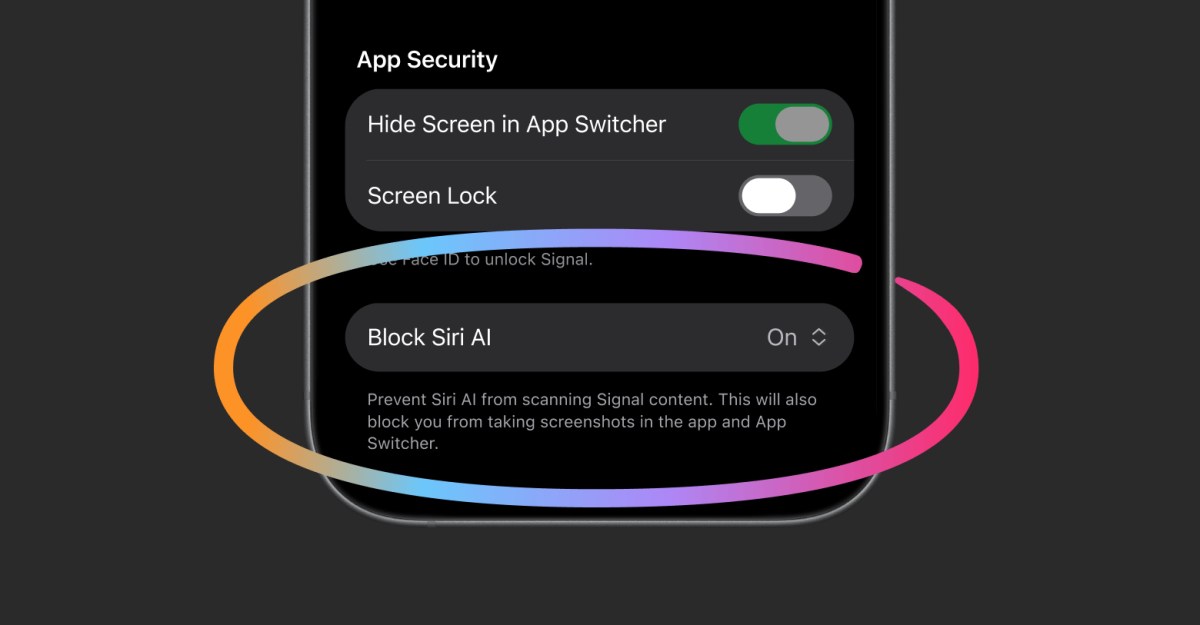
What happened
Signal is restricting screenshots on iOS 27 and Android to prevent Siri, Gemini, and other AI assistants from reading users' messages; users can restore screenshots but risk exposing content.
Why it matters
The block keeps AI agents from scanning on-screen messages, but Signal admits it is incomplete because agents can still reach app data via the device filesystem, so privacy protection remains partial.
WHO IT HITSPrivacy-conscious messaging app users, especially those on iOS 27 and Android, must choose between screenshot convenience and exposure to AI agents that scan on-screen content. App developers building encrypted services may also find they lack the tools to block similar access.
Summaries like this, every morning.
Signal's move follows a similar approach it took last year to prevent Microsoft's controversial Recall feature from capturing secured chats. The encrypted messaging service says it is struggling to develop a better solution due to the lack of available information regarding how AI agents are actually accessing application data.
Beyond operating system providers, Signal also says more tools are needed to prevent third-party agents, like Meta's Muse, from using deep accessibility settings in apps like a 'skeleton key' to access application data. Whittaker described the current integration of AI agents into operating systems, without common-sense remedies, as an existential threat to privacy at the application layer and to the ability of independent developers like Signal to protect sensitive data.
Pick your industry and the AI tools you use, and get news related to your work every day.
Free · 30 seconds with Google · unsubscribe anytimeWhat is AIToday? →
Ask AI anything about this article. The AI reads this article, earlier AIToday articles, and Wikipedia, and cites its sources. Q&As are published on this page for other readers too.
Researchers at the Technion, University of Haifa, and Google Research released AltRA-Test, which checks whethe…

The Nov 19 arXiv paper found ICLR critique overlap rose from 12.0% in 2026 to 21.3% in 2027, with LLM-flagged…
Feed Inc. began offering "Marugoto LLMO" on November 17, 2026, covering AI research, question design, page rew…
Co-Labo AI published the first of three explainer installments on ontology on November 20, 2026, aimed at manu…
The guide maps input types to fields — images and video to computer vision (CV), text to natural language proc…
Across 52 laboratory tasks in physical sciences, life sciences and engineering, Claude Fable 5.2 led 13 agents…

