What happened
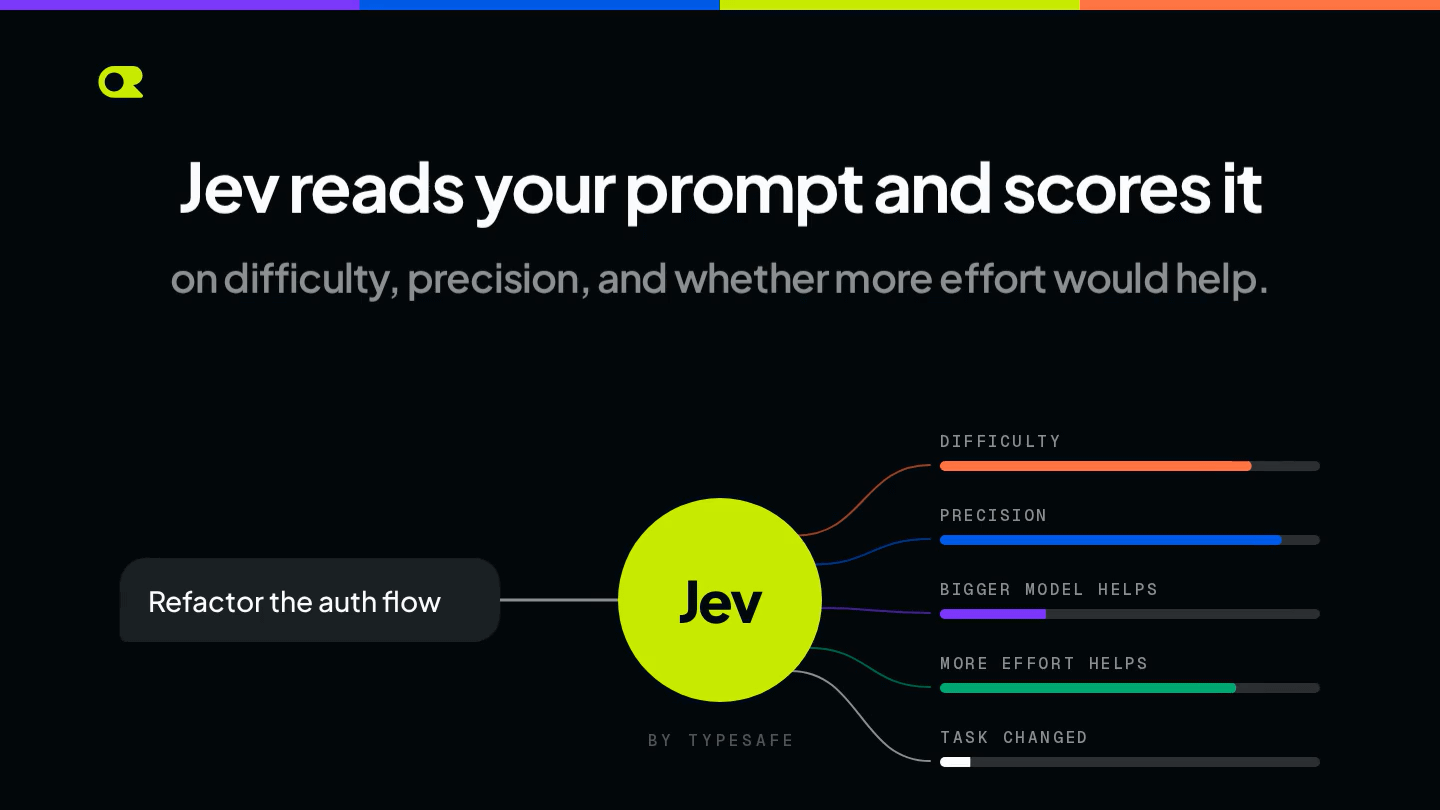
OpenRouter launched Jev Router, which feeds each prompt to Jev to judge difficulty, then assigns easy tasks to cheap smaller models and hard tasks to top-tier models. In routing four AI agent benchmark tasks, it completed 82% more tasks than OpenRouter's Auto Router.
Why it matters
Existing routers analyzed the kind of task but not its difficulty, so simple and hard work went to the same model and wasted tokens, according to OpenRouter. Jev Router's edge is judged by task completion, so developers may get more done per request.
What to watch
Jev Router only reads prompts to route them, and OpenRouter says nothing is stored or trained on, with attachments never sent to Jev and "zdr: true" requests supported. The test covers four AI agent benchmarks, so whether the 82% gap holds elsewhere is undecided.
WHO IT HITSDevelopers and teams building AI agent workflows on OpenRouter are the direct audience, since routing choices set their model spend and task success rate. Whether the gains hold beyond the four tested agent benchmarks is not yet established.
Summaries like this, in your inbox every morning.
Jev arrived on September 15, 2026, and drew immediate attention, with developers worldwide looking for ways to use it, according to the article. OpenRouter, which operates an AI gateway service and lets users manage many model APIs on a single platform, is the one bringing it into routing.
The gap Jev Router targets is a specific one: OpenRouter says routers could analyze the type of task but not its difficulty, so a simple request and a hard one landed on the same model and created waste. Jev Router instead feeds the prompt to Jev to judge difficulty and accuracy, then sorts work toward cheap small models or expensive frontier models. OpenRouter also frames the privacy terms as part of the pitch, saying Jev reads conversation text only to choose the model and effort, under zero data retention, with attachments never sent to Jev and "zdr: true" requests supported.
The reported result is a completion comparison: across four AI agent benchmarks, Jev Router completed 82% more tasks than OpenRouter's own Auto Router, and it was also found to be fast in time to first token. How far that margin travels is likely to hinge on whether benchmarking limited to four agent-style tasks reflects the everyday mixes developers actually route, so the thing to watch is how the gap behaves on other kinds of workloads.
For example, today's edition would include:
AI-summarized, only the topics you pick: one digest a day via Email, LINE, or Slack.
Free · 30 seconds with Google · unsubscribe anytimeWhat is AIToday? →
Ask AI anything about this article. The AI reads this article, earlier AIToday articles, and Wikipedia, and cites its sources. Q&As are published on this page for other readers too.
A security researcher identified a zero-day vulnerability in the macOS version of Meta's Muse AI agent

Adobe announced in September 2026 it is expanding its connector for Google Gemini and its plugin for Claude, s…

Elon Musk reposted Gizmodo senior editor Ray Wong's criticism that Meta's Muse AI agent allegedly gave a Faceb…

A buyer named Usman arrived around 9:15 for an MX Keys Mini pickup, waited and messaged, then left angry at 9:…

Hitachi began offering its "Vulnerability/Patch Discovery & Analysis Report Service" on September 28, and JPX…
AWS made Amazon CloudWatch Omni generally available last week, with 17 built-in evaluators that score coherenc…