AIToday

Nvidia drops 5%, chip stocks tumble as AI spending fears grip markets

Hacker News4h agoSend on LINE
Nvidia drops 5%, chip stocks tumble as AI spending fears grip markets

Key takeaway

Nvidia fell 5% after talks to invest around $250bn in OpenAI sparked concerns about whether massive AI data-centre spending will pay off. The decline rippled through Asia—South Korea's Kospi dropped 10.8% and Japan's Nikkei fell nearly 4%—with Samsung and SK Hynix hit hardest. Investors are questioning AI spending returns and rotating toward Apple, which has risen 25% this year and does not compete in the AI infrastructure race.

Summaries like this, in your inbox every morning.

Sign up free →

3 Key Points

  • What happened

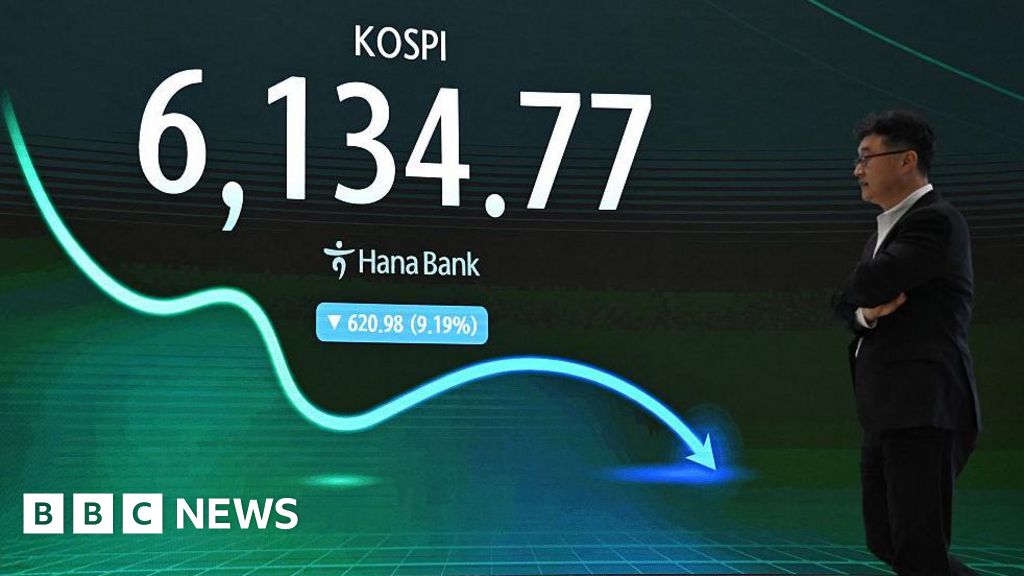
    Nvidia fell 5% on Monday, losing its position as the world's most valuable company to Apple, after the Wall Street Journal reported it is in talks to provide around $250bn for OpenAI as part of a data-centre project. The sell-off spread to Asian markets on Tuesday; South Korea's Kospi index fell 10.8% (paused temporarily after an 8% drop), with Samsung Electronics and SK Hynix each down more than 13%, and Japan's Nikkei 225 closed nearly 4% lower.

  • Why it matters

    Investors are questioning whether the billions tech firms are spending on AI data centres will generate returns, according to analysts cited in the article. South Korea's market amplified the decline because it is heavily concentrated in Samsung and SK Hynix, and many Korean investors use debt to buy stocks, which "exaggerates the movements when we get a correction like this," per Jane Sydenham of Rathbones. Apple's 25% rise this year and overtaking of Nvidia reflects investor appetite for companies "not taking part in the AI race," suggesting caution about unlimited AI infrastructure spending.

  • What to watch

    Jun Bei Liu of Ten Cap told the BBC investors are likely to reinvest in chip and AI stocks after the US holiday season, indicating the sell-off may be temporary profit-taking rather than lasting exit. Meanwhile, China's ChangXin Memory Technologies (CXMT) soared nearly 470% on its Shanghai debut Monday, signalling competition from Chinese chip makers is widening investor concerns about returns on Western AI spending.

In Depth

On Monday, Nvidia shares fell 5% in New York trading after the Wall Street Journal reported the AI chip giant is in talks to provide around $250bn for OpenAI as part of a massive data-centre project. The decline cost Nvidia its position as the world's most valuable listed company; Apple, which rose about 25% this year, took the top spot.

The sell-off swept through Asian markets on Tuesday. South Korea's Kospi index, heavily weighted toward technology, fell 8% in early trading, triggering a temporary 20-minute halt under the stock market's circuit-breaker mechanism designed to calm panic selling. After the halt was lifted, the index fell further, closing 10.8% lower for the day. Samsung Electronics and SK Hynix, both memory-chip makers central to AI infrastructure, each fell more than 13%. Japan's Nikkei 225, also dominated by tech companies, closed almost 4% lower.

Jane Sydenham, investment director at Rathbones, explained that the Asian slump followed "phenomenal rises" over the preceding months. She stressed that South Korea's market is "very concentrated" in Samsung and SK Hynix, both hit hard. A structural amplifier was at work: many Korean investors use debt to buy stocks, so "when we get a correction like this," the leverage "exaggerates the movements." Sydenham attributed the trigger to Nvidia's Monday drop, driven by concerns that the $250bn OpenAI spending plan signals widening uncertainty about AI infrastructure returns. "AI spending among tech firms is 'something that's been testing investors' nerves on and off in the last couple of months'," she said. "Is it going to earn a proper return in the future? That's what investors are worried about."

Cheng Chye Hsern, head of investments at wealth manager Providend, noted that Apple's appeal lies partly in its distance from the AI race. One of the few major tech firms "not taking part in the AI race," Apple becomes attractive to investors nervous about rivals' multi-billion-dollar data-centre commitments. Jun Bei Liu, founder of investment firm Ten Cap, flagged rising competitive pressure from China. She told the BBC that investors are "taking some profit off the table" but are likely to reinvest in chip and AI stocks after the US holiday season. That forecast suggests the sell-off may be temporary profit-realization rather than a lasting loss of faith in AI infrastructure spending.

The competitive threat appeared concrete on Monday when ChangXin Memory Technologies (CXMT), China's biggest memory chip maker, debuted on the Shanghai exchange with shares soaring nearly 470%. CXMT manufactures dynamic random-access memory (Dram) chips used in AI data centres, mobile phones, PCs, and tablets. The company said it plans to use most of the IPO proceeds to boost production and research and development. European markets, which have less AI-sector exposure, shrugged off the concerns; the UK's FTSE 100, France's Cac 40, and Germany's Dax 40 were each around 0.6% up a couple of hours after Tuesday's open.

Context & Analysis

The sell-off began with Nvidia's 5% Monday decline after reports of massive planned spending on OpenAI's data-centre infrastructure, but the real trigger appears deeper: investors are re-evaluating whether the billions tech firms are pouring into AI will actually generate returns. Jane Sydenham of Rathbones noted that "AI spending among tech firms is 'something that's been testing investors' nerves on and off in the last couple of months'." The question "Is it going to earn a proper return in the future?" is now front-and-centre for market participants.

Asia saw the sharpest pain because of market structure and sentiment. South Korea's Kospi is highly concentrated in memory-chip makers Samsung and SK Hynix, which fell sharply on Tuesday. Critically, many Korean investors use borrowed money to buy stocks, meaning corrections "exaggerate the movements," according to Sydenham. The index had more than doubled from the start of the year to mid-June but has since lost around a third of its value—a dramatic reversal that amplified Tuesday's panic selling.

Meanwhile, Apple's ascent to world's most valuable company reflects a tactical rotation toward lower-risk tech names. The iPhone maker has risen about 25% this year partly because it is "not taking part in the AI race" and avoids the massive data-centre capital intensity that rivals face. However, Jun Bei Liu of Ten Cap suggested the sell-off is profit-taking rather than permanent exit; she told the BBC investors are "likely to reinvest in these stocks after the US holiday season." That near-term outlook contrasts with longer-term concern about Chinese competition: ChangXin Memory Technologies (CXMT) soared nearly 470% on its Shanghai IPO debut Monday, signalling that Chinese chip makers are becoming a credible alternative supply source.

FAQ

Why did Nvidia's stock fall?
The Wall Street Journal reported that Nvidia is in talks to provide around $250bn for OpenAI as part of a massive data-centre project, triggering the 5% decline on Monday.
Which companies fell the most in Asia?
Samsung Electronics and SK Hynix both fell by more than 13% on South Korea's Kospi index on Tuesday, with the index closing 10.8% lower overall.
Why is Apple rising while Nvidia falls?
Apple rose about 25% this year and is now the world's most valuable company, appealing to investors concerned about the billions rivals are spending on AI data centres; Apple is described as "one of the few tech firms not taking part in the AI race."

Get AI news like this every morning

AI-summarized, only the topics you pick — one digest a day via Email, Slack, or Discord.

Free · takes 30 seconds · unsubscribe anytime

Discussion

No discussion yet for this article

Stay ahead with AI news

Get curated AI news from 200+ sources delivered daily to your inbox. Free to use.

Get Started Free

Free · takes 30 seconds · unsubscribe anytime

