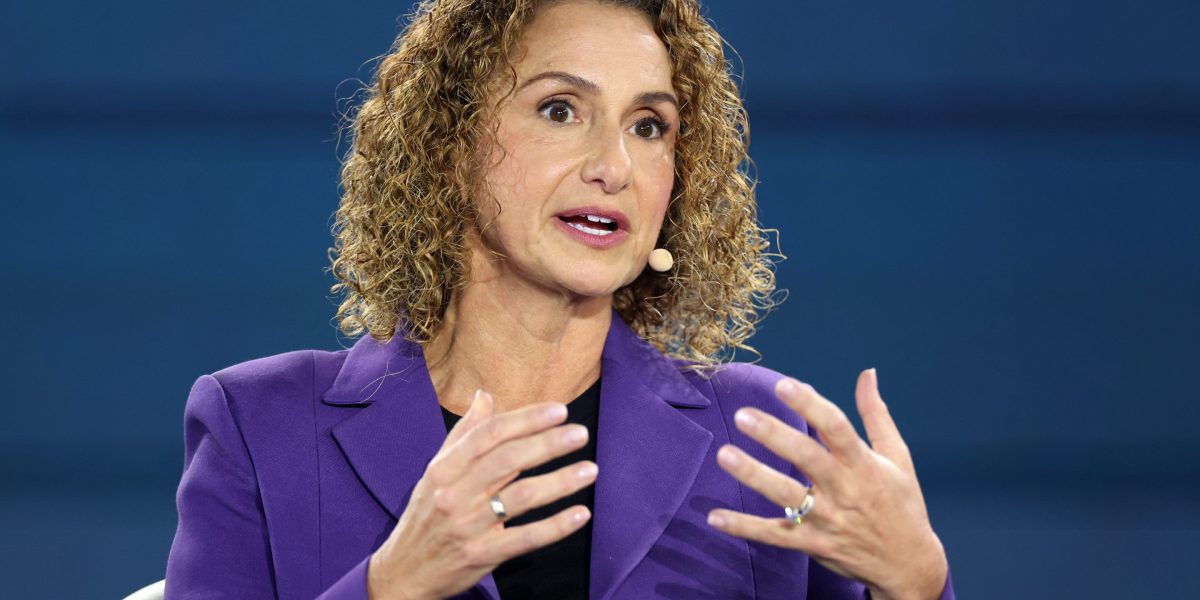
Lila Ibrahim, Google DeepMind's chief AI readiness officer, is one of the few senior executives remaining at the company following co-founder CEO Demis Hassabis's recent step-down to an advisory role.
Ibrahim, who took on the chief AI readiness officer position earlier this year after serving as the company's first chief operating officer since 2018, had no formal AI background when she joined—her career instead spanned two decades at Intel, where she rose to chief of staff overseeing 85,000 people, plus roles in venture capital and edtech.
Her outsider perspective, rooted in growing up as a first-generation Arab American with immigrant parents and working as a teenager in Indiana cornfields, has shaped her approach to spotting opportunities and navigating organizational change.
What happened
Lila Ibrahim, Google DeepMind's chief AI readiness officer, has become one of the company's most senior executives remaining after co-founder CEO Demis Hassabis stepped down to an advisory role amid delayed models and departures. Ibrahim was promoted to the chief AI readiness officer role earlier this year, a first position at the company, after serving as its first-ever chief operating officer since 2018.
Why it matters
Ibrahim brought no formal AI background when she joined Google DeepMind in 2018—her path instead ran through Intel (where she managed 85,000 people as chief of staff before leaving in 2010), venture capital, and edtech. Her outsider status, shaped by growing up as a first-generation Arab American in the Midwest with immigrant parents and working as a teenager detasseling corn in Indiana, equipped her to see opportunities others missed and to stay grounded during leadership instability.
What to watch
Ibrahim is now tasked with helping the world get ready for AI as Google DeepMind navigates what the company has described as one of its biggest shakeups in history, marked by reports of low morale and high-profile departures.
Lila Ibrahim's journey to Google DeepMind's executive ranks began in the cornfields of Indiana, where at age 14 she worked detasseling corn for "$1-something" an hour—a punishing summer job that left her with cuts and sores but also a resolve to pursue a different path. "I grew up in really humble beginnings," she told Fortune. Her parents were both immigrants; her Lebanese father, who had lost both parents as a young child before moving to the U.S., worked as an engineer developing early heart pacemakers and car-safety technology. Her Palestinian mother was, in Ibrahim's description, "too ambitious" to remain in her home country and was among the few working mothers in her community who took regular business trips. Growing up as a first-generation Arab American in the Midwest, often one of the only women in her electrical-engineering classes, Ibrahim learned early to be comfortable standing out. "Despite having dark hair, English as a second language, and growing up in the Midwest of the United States, I was taught that opportunity is everywhere, and you are not defined by anything other than your own curiosity," she recalled.
That curiosity led her from the cornfields to a Purdue lab, where while still in high school she worked as a research assistant on fruit fly DNA. She then spent two decades at Intel, working her way up through positions in Santa Clara, Tokyo, Hong Kong, and Shanghai. By the time she left Intel in 2010—just after having twins—she had become chief of staff in charge of 85,000 people. Rather than continue climbing within the semiconductor giant, Ibrahim moved into venture capital and edtech, roles that positioned her as an outsider in new industries. "I always felt like I saw opportunity where others didn't, and I saw solutions in places where others didn't," she explained. That willingness to take on unfamiliar territory made her an unlikely but successful candidate for Google DeepMind's first-ever chief operating officer role in 2018, despite her lack of formal AI background. "I spent more than 50 hours interviewing for" that position, she recalled.
Earlier this year, Ibrahim was promoted to another first role at the company: chief AI readiness officer, tasking her with helping the world get ready for AI. Her tenure there has unfolded against a backdrop of significant organizational turbulence. Co-founder CEO Demis Hassabis has just stepped down to a more advisory role amid delayed models, a wave of high-profile departures, and reports of low morale. Yet Ibrahim has remained in place, one of the most senior executives left standing at Google DeepMind. Her persistence through the shakeup underscores her capacity to navigate instability—a skill honed, she suggests, by a lifetime of being the outsider. "I had to get really comfortable very early on in my life that I was just an outsider," she said. "When there were openings and opportunities, I was the first to raise my hand."
Ibrahim's rise at Google DeepMind reflects a deliberate pattern of betting on unconventional paths. When she joined the company in 2018 as its first chief operating officer, she had no formal AI background—a liability that might have disqualified others but that she framed as an outsider's advantage. Her two-decade career at Intel, culminating in a chief-of-staff role overseeing 85,000 people, demonstrated operational and leadership scale, yet she was willing to leave that established track to venture into territory (venture capital, edtech, and finally AI) where she lacked formal credentials. That willingness to move sideways rather than upward aligns with how she describes her entire trajectory: as someone comfortable being different, shaped by her identity as a first-generation Arab American and by parents who had already immigrated and built careers in a foreign country.
Her tenure at Google DeepMind has coincided with significant leadership turbulence. Co-founder CEO Demis Hassabis's recent step-down to an advisory role, coupled with reports of delayed models, high-profile departures, and low morale, places Ibrahim in a stabilizing role—chief AI readiness officer—precisely when the organization appears most unstable. The fact that she has remained suggests either deep organizational trust or a deliberate decision to stay put during crisis, both of which square with her self-description as someone who raises her hand when others see only risk.
AI-summarized, only the topics you pick — one digest a day via Email, Slack, or Discord.
Free · takes 30 seconds · unsubscribe anytime
Ask AI anything about this article. Q&As are published on this page for other readers too.
GE Vernova reported second-quarter 2026 revenue of $11.1 billion (up 22% year-over-year) and orders that more…

Dell Technologies reported AI-optimized server revenue of $16.13 billion, up 757% year over year, with managem…

SanDisk reported Q4 2026 earnings on Aug

Marvell Technology is pivoting its business strategy to concentrate on AI networking semiconductors for data c…

Eli Lilly and Company has committed to roll out Veeva Vault CRM across its global operations, adopting Veeva's…

Visa, the global payments network, is positioning itself to profit from AI-driven commerce by securing its rol…

The AI news that matters, in one minute each morning.
Sign up free