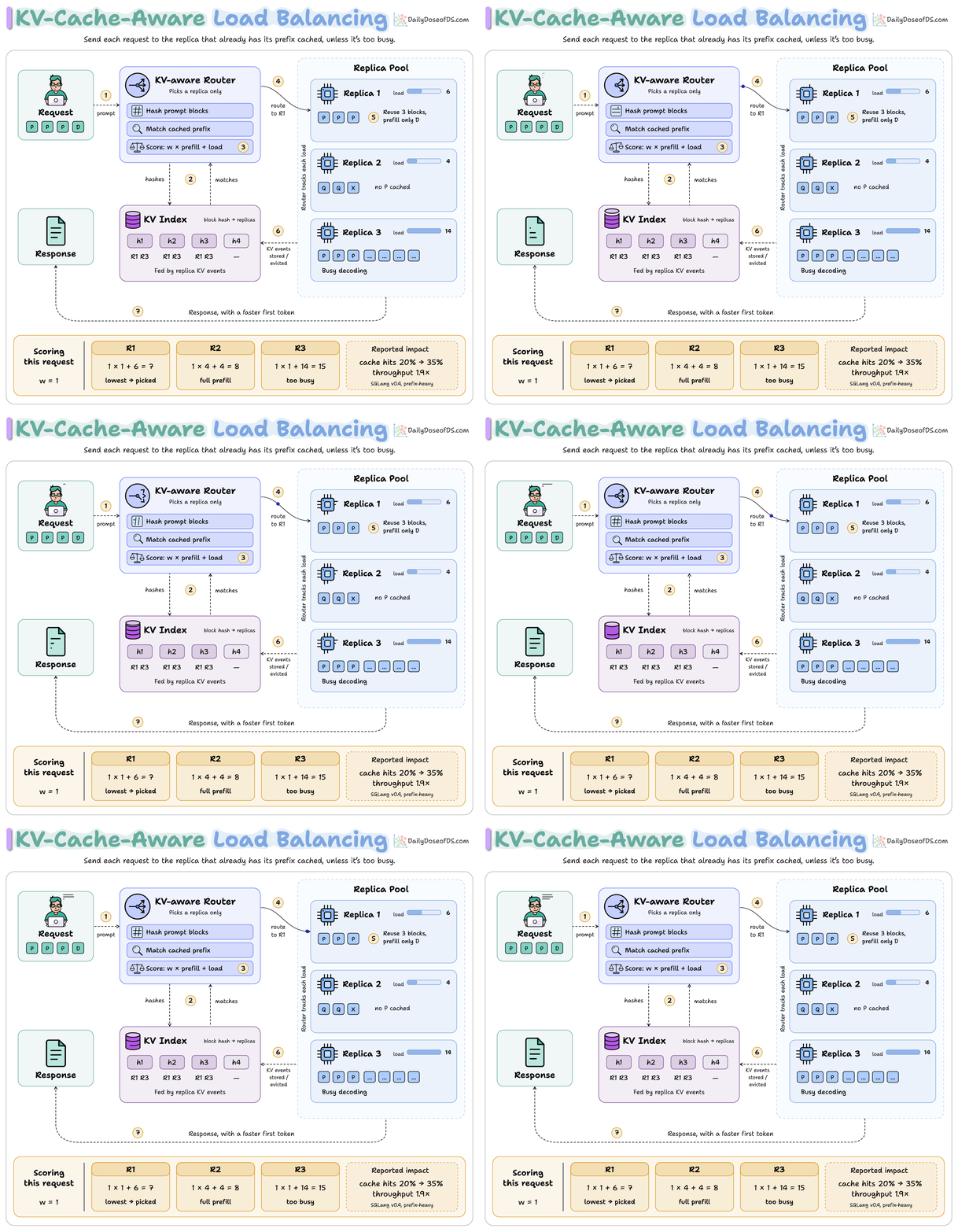
What happened
A KV cache-aware router estimates how much of each prompt a worker can reuse plus its existing load. SGLang v0.4's shared-prefix benchmark showed cache hits rising from 20% to 75% and throughput from 82,665 to 158,596 tokens per second.
Why it matters
That benchmark's balanced groups of long shared prefixes offered unusually high reuse, so similar gains shouldn't be expected for unrelated prompts. More cache hits also aren't an improvement if requests spend longer waiting.
Summaries like this, every morning.
A hardware constraint is the starting point: token generation is limited by memory bandwidth, not compute, because each new token requires reading model weights and the relevant KV cache from memory. At low batch sizes there is little arithmetic for all that data movement, so adding compute alone does not speed up decode. In an analysis of SWE-bench Pro and Terminal-Bench runs, model inference accounted for 71% to 98% of agent runtime, and even with extensive prefix caching, generating the answer one token at a time remained a large part of that cost.
Prefix caching is what makes routing matter. Later requests can reuse attention keys and values computed for an identical prefix, but only if the cached state is available to the worker serving the request. Block hashes identify matching prefixes and incorporate the preceding context, so changing an earlier token breaks the match even if later text is identical. This gives prompt layout a practical role: keeping stable instructions and tool definitions before changing request content creates more opportunities for reuse, provided the model and other cache settings are compatible.
A router that always chooses the largest cache match can overload a popular replica, so the decision has to weigh prefill work saved against extra waiting. Implementations maintain that cache view differently: the original SGLang v0.4 router kept an approximate cache view rather than requiring workers to synchronize their cache state. The benchmark workload contained balanced groups of long shared prefixes, so the same improvement shouldn't be assumed for other traffic; compare routing policies on the same traffic and hardware while measuring time to first token alongside throughput and prefill work avoided.
Pick your industry and the AI tools you use, and get news related to your work every day.
Free · 30 seconds with Google · unsubscribe anytimeWhat is AIToday? →
Ask AI anything about this article. The AI reads this article, earlier AIToday articles, and Wikipedia, and cites its sources. Q&As are published on this page for other readers too.
An MIT-led team with ETH Zurich and Imperial College London built an algorithm that trains AI climate emulator…

Across 10 runs each with and without the OpenCanary honeypot, the Llama 3.1 8B attacker role was recorded at t…

Uravation handled program design, materials and instructors for Itochu Interactive's corporate AI agent implem…

Amazon and Meta have held talks on multiple occasions about connecting Muse to Amazon's store and ending the b…

Alibaba launched Happy Wan, a studio merging the new HappyHorse model with Wan 3.0, spanning four video engine…

TOKIUM, which provides AI agents mainly for accounting work, listed on the TSE Growth Market on the 25th