What happened
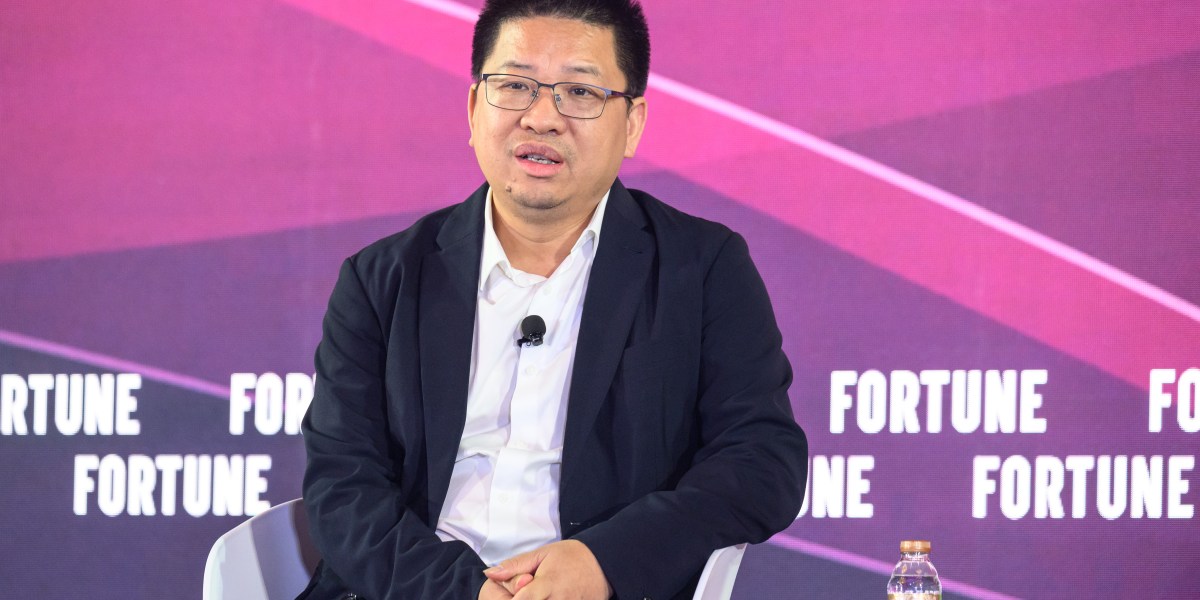
At the Fortune Leaders Forum in Macau on Sept. 8, BTR New Material Group's Youyuan Huang said China has installed too much green energy, and Jiangxing Intelligence CEO Haitian Pang said AI can forecast wind and solar conditions.
Why it matters
Huang and Pang framed AI as a way to manage the energy that China has already built, suggesting the country's excess capacity may be a manageable problem rather than a dead end, according to the panelists.
What to watch
BTR's Huang noted that AI itself needs a large and steady energy supply, calling energy a guarantee of computing safety, so the balance between consuming and managing power is the test for the AI fix.
WHO IT HITSChinese renewable energy operators and grid managers stand to gain from AI tools that forecast wind and solar output and automate panel maintenance, while energy-intensive data center builders may see their power demand reframed as part of the solution.
Summaries like this, in your inbox every morning.
The panel in Macau took place against a backdrop of energy anxiety elsewhere in Asia. Ever since the U.S.-Iran war choked the Strait of Hormuz, Asian importers have scrambled for new sources of oil and LNG. China, by contrast, has a different problem: it has built more clean energy infrastructure than the market needs.
The scale is notable. China will account for 60% of all installed renewable capacity through 2030, according to the International Energy Agency, and in July solar overtook coal as China's largest source of installed power capacity. Jinko Solar's Daniel Liu said renewables effectively covered all of China's electricity demand growth last year. The panelists' pitch is that AI can absorb and manage some of that excess — both by consuming large and steady power for computing, and by forecasting variable wind and solar output.
How far this solves overcapacity is likely to depend on whether AI-driven forecasting and automated maintenance can actually make surplus renewable power more usable at scale. For Chinese clean energy operators and the data center builders relocating to Southeast Asia, the question is whether the tools shown in Macau move from pilot projects to standard practice.
Pick your industry and the AI tools you use, and get news related to your work every day.
Free · 30 seconds with Google · unsubscribe anytimeWhat is AIToday? →
Ask AI anything about this article. The AI reads this article, earlier AIToday articles, and Wikipedia, and cites its sources. Q&As are published on this page for other readers too.
ElevenLabs completed a $300 million employee tender at a $22 billion valuation, and co-founder Mati Staniszews…

On October 15, OpenAI announced the Rosalind Academic Plan, giving approved US university labs free access to…

A Qiita article compared automated red-teaming methods for LLM apps — GCG, PAIR, and TAP — using mock implemen…

Liquid AI released d1-ultra on October 15, 2026, an upgraded open-weights decision model that averaged 76.7 ac…

Circlia started a proof-of-concept for TASTE SIGNAL: visitors to Holland Village Cafe FUKUOKA taste cookies an…

In a webinar hosted by French Mathematical Society president Isabelle Gallagher, Fields Medal winner Hugo Dumi…

