What happened
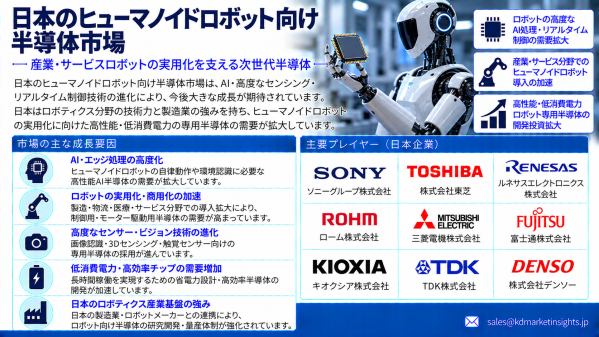
McKinsey says Japanese suppliers can provide almost all key humanoid robot components, and demand for AI processors, sensors, connectivity chips, and power-efficient semiconductors is expected to create strong opportunities through 2036.
Why it matters
That breadth suggests Japanese component makers could capture demand across every major semiconductor layer of a humanoid robot, not just one chip, positioning them early in a market expected to create strong opportunities through 2036.
What to watch
The test is whether suppliers turn this component breadth into integrated, application-specific platforms rather than selling individual parts. SEMICON Japan 2026's program places "AI x Humanoids & Allies" at the center of its semiconductor and robotics theme.
WHO IT HITSJapanese component makers, sensor suppliers, power-device vendors, and AI chip developers stand to gain as humanoid robots move from research demonstrations into industrial, logistics, healthcare, and service uses. Semiconductor suppliers may increasingly need to offer integrated platforms rather than standalone components.
Summaries like this, in your inbox every morning.
Japan's position in this market rests on an existing industrial base: manufacturers, component suppliers, and system integrators built around precision engineering, sensors, actuators, and control technology. Renesas describes humanoids as physical AI systems that integrate embedded processing, sensing, actuation, power management, software, and development tools, which is why the semiconductor opportunity spans five technology layers rather than a single robot chip. Industry moves are already aligning with that view. In July 2026, Fujitsu said it would explore physical AI business opportunities with FANUC, Yaskawa Electric, and Kawasaki Heavy Industries for manufacturing, logistics, and healthcare applications, while METI updated its AI robotics policy direction in May 2026. The next phase may center on sensor fusion, as robots combine inputs from multiple sensors to build a more reliable picture of their surroundings.
The stakes for semiconductor suppliers appear to hinge on whether they can shift from selling individual components to developing complete architectures that integrate intelligence, sensing, and control. Renesas's physical AI strategy emphasizes system-level demonstration and co-development for robotics, suggesting suppliers that join robot system development earlier could hold an advantage. For Japanese component makers, sensors such as six-axis force-torque, linear force, and tactile sensors are areas McKinsey specifically names as places where they could expand their role in humanoid robotics. Whether that translates into durable market share is likely to depend on how quickly humanoid platforms move from demonstrations into industrial, logistics, healthcare, and service deployments.
For example, today's edition would include:
AI-summarized, only the topics you pick: one digest a day via Email, LINE, or Slack.
Free · 30 seconds with Google · unsubscribe anytimeWhat is AIToday? →
Ask AI anything about this article. The AI reads this article, earlier AIToday articles, and Wikipedia, and cites its sources. Q&As are published on this page for other readers too.
PKSHA Technology provided the conversational AI agent feature of its AI SaaS "PKSHA ChatAgent" to NTT Docomo's…
The Blue Cross Blue Shield Association's analysis found that hospitals' use of AI tools in insurance claims le…

Tamara Grant, who finished Purdue University's Master of Science in Artificial Intelligence in spring 2026, wa…

In a Sept. 25 letter, Walmart CEO John Furner said the retailer will not use AI, customers' income, shopping h…

Texas Instruments is trading around $278.05, above its $275.21 breakout level, and is testing resistance at $2…

Qualcomm introduced the Snapdragon 8 Elite Gen 6 and Elite Extreme Gen 6 chips with on-device AI, aiming at pr…